

368
version, PROSPECT-D (Féret et al. 2017), used a large database of leaf spectra and
chemistry to predict the in-situ absorption coefficients for chlorophyll, carotenoid,
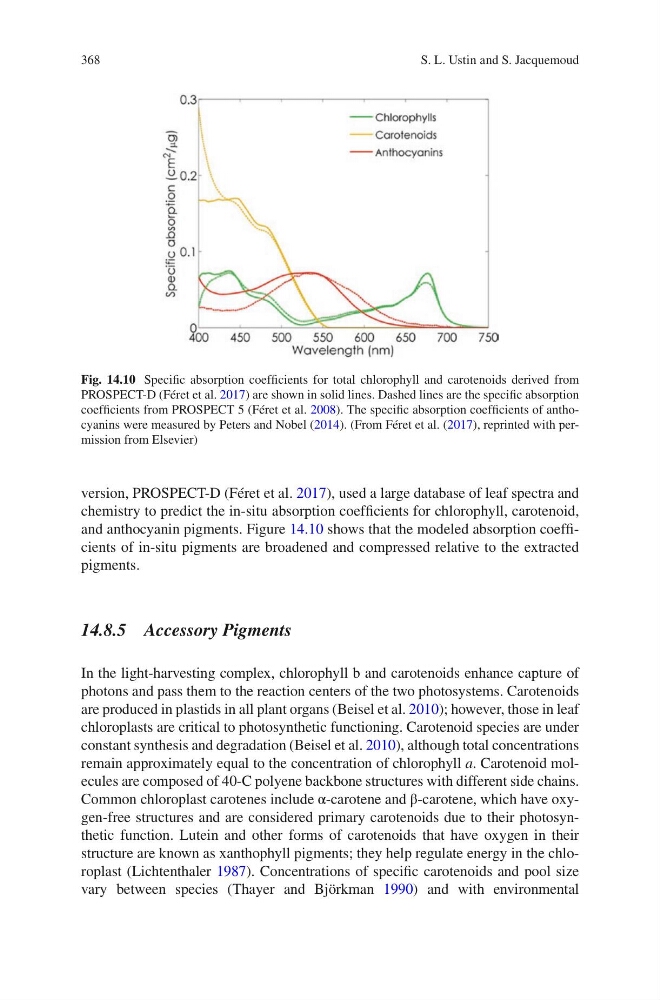
and anthocyanin pigments. Figure 14.10 shows that the modeled absorption coefficients of in-situ pigments are broadened and compressed relative to the extracted
pigments.
14.8.5 Accessory Pigments
In the light-harvesting complex, chlorophyll b and carotenoids enhance capture of
photons and pass them to the reaction centers of the two photosystems. Carotenoids
are produced in plastids in all plant organs (Beisel et al. 2010); however, those in leaf
chloroplasts are critical to photosynthetic functioning. Carotenoid species are under
constant synthesis and degradation (Beisel et al. 2010), although total concentrations
remain approximately equal to the concentration of chlorophyll a. Carotenoid molecules are composed of 40-C polyene backbone structures with different side chains.
Common chloroplast carotenes include α-carotene and β-carotene, which have oxygen-free structures and are considered primary carotenoids due to their photosynthetic function. Lutein and other forms of carotenoids that have oxygen in their
structure are known as xanthophyll pigments; they help regulate energy in the chloroplast (Lichtenthaler 1987). Concentrations of specific carotenoids and pool size
vary between species (Thayer and Björkman 1990) and with environmental
Fig. 14.10 Specific absorption coefficients for total chlorophyll and carotenoids derived from
PROSPECT-D (Féret et al. 2017) are shown in solid lines. Dashed lines are the specific absorption
coefficients from PROSPECT 5 (Féret et al. 2008). The specific absorption coefficients of anthocyanins were measured by Peters and Nobel (2014). (From Féret et al. (2017), reprinted with permission from Elsevier)
S. L. Ustin and S. Jacquemoud
version, PROSPECT-D (Féret et al. 2017), used a large database of leaf spectra and
chemistry to predict the in-situ absorption coefficients for chlorophyll, carotenoid,
and anthocyanin pigments. Figure 14.10 shows that the modeled absorption coefficients of in-situ pigments are broadened and compressed relative to the extracted
pigments.
14.8.5 Accessory Pigments
In the light-harvesting complex, chlorophyll b and carotenoids enhance capture of
photons and pass them to the reaction centers of the two photosystems. Carotenoids
are produced in plastids in all plant organs (Beisel et al. 2010); however, those in leaf
chloroplasts are critical to photosynthetic functioning. Carotenoid species are under
constant synthesis and degradation (Beisel et al. 2010), although total concentrations
remain approximately equal to the concentration of chlorophyll a. Carotenoid molecules are composed of 40-C polyene backbone structures with different side chains.
Common chloroplast carotenes include α-carotene and β-carotene, which have oxygen-free structures and are considered primary carotenoids due to their photosynthetic function. Lutein and other forms of carotenoids that have oxygen in their
structure are known as xanthophyll pigments; they help regulate energy in the chloroplast (Lichtenthaler 1987). Concentrations of specific carotenoids and pool size
vary between species (Thayer and Björkman 1990) and with environmental
Fig. 14.10 Specific absorption coefficients for total chlorophyll and carotenoids derived from
PROSPECT-D (Féret et al. 2017) are shown in solid lines. Dashed lines are the specific absorption
coefficients from PROSPECT 5 (Féret et al. 2008). The specific absorption coefficients of anthocyanins were measured by Peters and Nobel (2014). (From Féret et al. (2017), reprinted with permission from Elsevier)
S. L. Ustin and S. Jacquemoud