

166
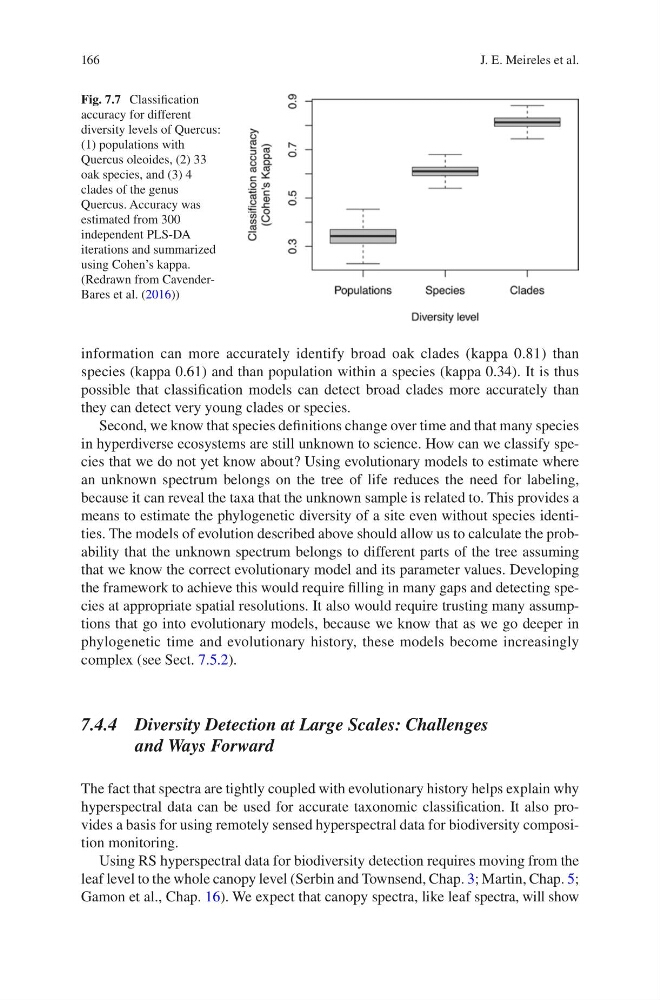
information can more accurately identify broad oak clades (kappa 0.81) than
species (kappa 0.61) and than population within a species (kappa 0.34). It is thus
possible that classification models can detect broad clades more accurately than
they can detect very young clades or species.
Second, we know that species definitions change over time and that many species
in hyperdiverse ecosystems are still unknown to science. How can we classify species that we do not yet know about? Using evolutionary models to estimate where
an unknown spectrum belongs on the tree of life reduces the need for labeling,
because it can reveal the taxa that the unknown sample is related to. This provides a
means to estimate the phylogenetic diversity of a site even without species identities. The models of evolution described above should allow us to calculate the probability that the unknown spectrum belongs to different parts of the tree assuming
that we know the correct evolutionary model and its parameter values. Developing
the framework to achieve this would require filling in many gaps and detecting species at appropriate spatial resolutions. It also would require trusting many assumptions that go into evolutionary models, because we know that as we go deeper in
phylogenetic time and evolutionary history, these models become increasingly
complex (see Sect. 7.5.2).
7.4.4 Diversity Detection at Large Scales: Challenges
and Ways Forward
The fact that spectra are tightly coupled with evolutionary history helps explain why
hyperspectral data can be used for accurate taxonomic classification. It also provides a basis for using remotely sensed hyperspectral data for biodiversity composition monitoring.
Using RS hyperspectral data for biodiversity detection requires moving from the
leaf level to the whole canopy level (Serbin and Townsend, Chap. 3; Martin, Chap. 5;
Gamon et al., Chap. 16). We expect that canopy spectra, like leaf spectra, will show
Fig. 7.7 Classification
accuracy for different
diversity levels of Quercus:
(1) populations with
Quercus oleoides, (2) 33
oak species, and (3) 4
clades of the genus
Quercus. Accuracy was
estimated from 300
independent PLS-DA
iterations and summarized
using Cohen’s kappa.
(Redrawn from CavenderBares et al. (2016))
J. E. Meireles et al.
information can more accurately identify broad oak clades (kappa 0.81) than
species (kappa 0.61) and than population within a species (kappa 0.34). It is thus
possible that classification models can detect broad clades more accurately than
they can detect very young clades or species.
Second, we know that species definitions change over time and that many species
in hyperdiverse ecosystems are still unknown to science. How can we classify species that we do not yet know about? Using evolutionary models to estimate where
an unknown spectrum belongs on the tree of life reduces the need for labeling,
because it can reveal the taxa that the unknown sample is related to. This provides a
means to estimate the phylogenetic diversity of a site even without species identities. The models of evolution described above should allow us to calculate the probability that the unknown spectrum belongs to different parts of the tree assuming
that we know the correct evolutionary model and its parameter values. Developing
the framework to achieve this would require filling in many gaps and detecting species at appropriate spatial resolutions. It also would require trusting many assumptions that go into evolutionary models, because we know that as we go deeper in
phylogenetic time and evolutionary history, these models become increasingly
complex (see Sect. 7.5.2).
7.4.4 Diversity Detection at Large Scales: Challenges
and Ways Forward
The fact that spectra are tightly coupled with evolutionary history helps explain why
hyperspectral data can be used for accurate taxonomic classification. It also provides a basis for using remotely sensed hyperspectral data for biodiversity composition monitoring.
Using RS hyperspectral data for biodiversity detection requires moving from the
leaf level to the whole canopy level (Serbin and Townsend, Chap. 3; Martin, Chap. 5;
Gamon et al., Chap. 16). We expect that canopy spectra, like leaf spectra, will show
Fig. 7.7 Classification
accuracy for different
diversity levels of Quercus:
(1) populations with
Quercus oleoides, (2) 33
oak species, and (3) 4
clades of the genus
Quercus. Accuracy was
estimated from 300
independent PLS-DA
iterations and summarized
using Cohen’s kappa.
(Redrawn from CavenderBares et al. (2016))
J. E. Meireles et al.