

167
tight coupling to phylogenetic information. Branching architecture, leaf angles, and
other structural traits of plants that contribute to spectral signals at the canopy level
are themselves evolved traits and are potentially phylogenetically conserved. To the
extent that remotely sensed hyperspectral data can capture the spectral profiles of
individual canopies (Gamon et al., Chap. 16), hyperspectral data should be capable
of detecting and identifying species (Morsdorf et al., Chap. 4) and lineages, following the logic presented above for leaves. Such an effort would require assembling
vast libraries of spectral information across the plant tree of life for a given region
of interest and comparing spectra obtained through remote sensing to those libraries.
Developing accurate classification models as the number of species and clades
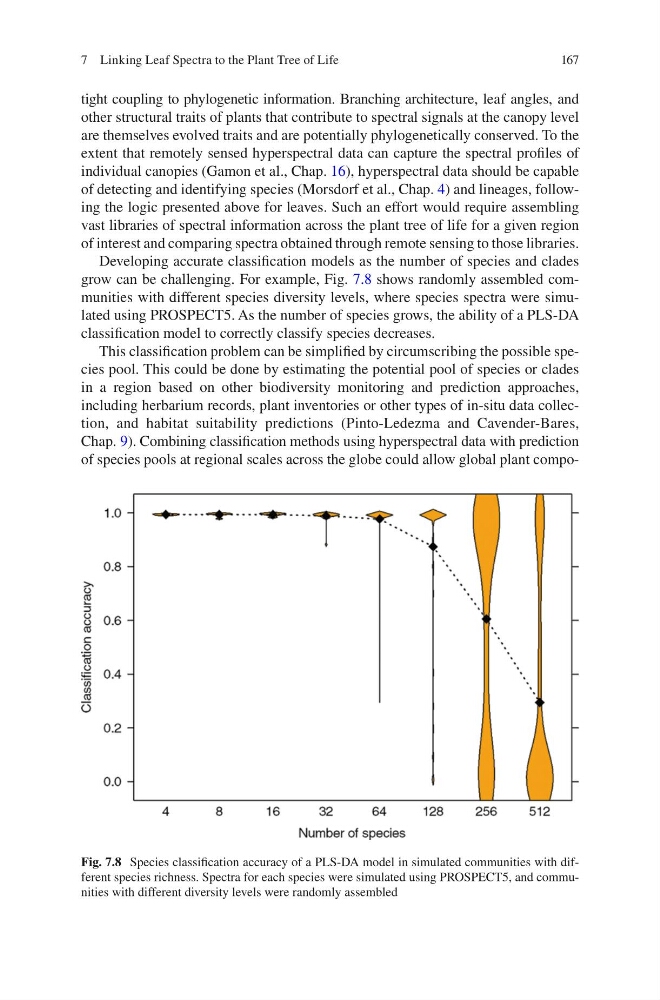
grow can be challenging. For example, Fig. 7.8 shows randomly assembled communities with different species diversity levels, where species spectra were simulated using PROSPECT5. As the number of species grows, the ability of a PLS-DA
classification model to correctly classify species decreases.
This classification problem can be simplified by circumscribing the possible species pool. This could be done by estimating the potential pool of species or clades
in a region based on other biodiversity monitoring and prediction approaches,
including herbarium records, plant inventories or other types of in-situ data collection, and habitat suitability predictions (Pinto-Ledezma and Cavender-Bares,
Chap. 9). Combining classification methods using hyperspectral data with prediction
of species pools at regional scales across the globe could allow global plant compoFig. 7.8 Species classification accuracy of a PLS-DA model in simulated communities with different species richness. Spectra for each species were simulated using PROSPECT5, and communities with different diversity levels were randomly assembled
7 Linking Leaf Spectra to the Plant Tree of Life
tight coupling to phylogenetic information. Branching architecture, leaf angles, and
other structural traits of plants that contribute to spectral signals at the canopy level
are themselves evolved traits and are potentially phylogenetically conserved. To the
extent that remotely sensed hyperspectral data can capture the spectral profiles of
individual canopies (Gamon et al., Chap. 16), hyperspectral data should be capable
of detecting and identifying species (Morsdorf et al., Chap. 4) and lineages, following the logic presented above for leaves. Such an effort would require assembling
vast libraries of spectral information across the plant tree of life for a given region
of interest and comparing spectra obtained through remote sensing to those libraries.
Developing accurate classification models as the number of species and clades
grow can be challenging. For example, Fig. 7.8 shows randomly assembled communities with different species diversity levels, where species spectra were simulated using PROSPECT5. As the number of species grows, the ability of a PLS-DA
classification model to correctly classify species decreases.
This classification problem can be simplified by circumscribing the possible species pool. This could be done by estimating the potential pool of species or clades
in a region based on other biodiversity monitoring and prediction approaches,
including herbarium records, plant inventories or other types of in-situ data collection, and habitat suitability predictions (Pinto-Ledezma and Cavender-Bares,
Chap. 9). Combining classification methods using hyperspectral data with prediction
of species pools at regional scales across the globe could allow global plant compoFig. 7.8 Species classification accuracy of a PLS-DA model in simulated communities with different species richness. Spectra for each species were simulated using PROSPECT5, and communities with different diversity levels were randomly assembled
7 Linking Leaf Spectra to the Plant Tree of Life