

162
Fitting evolutionary models directly to spectra can be useful for identifying
promising associations between phylogenetic history and plant spectral signatures.
However, this approach is largely devoid of mechanism and does not allow us to
verify that our inferences are biologically meaningful.
Another approach to integrate phylogenies and leaf spectra is to explicitly model
the evolution of structural and chemical traits that underlie the spectrum. This
approach matches more closely the reality of biology by acknowledging that any
signal of evolution found in the spectra is an emerging property of the evolutionary
dynamics of leaf traits (see Sect. 7.5.3). This idea can be implemented by coupling
the models of trait evolution described in the previous section with leaf radiative
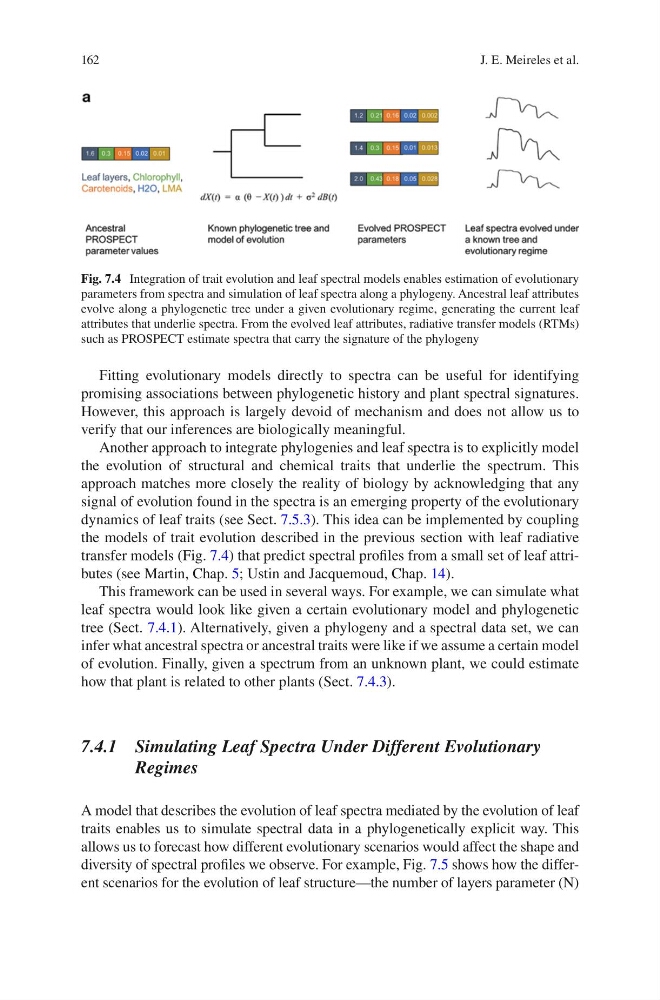
transfer models (Fig. 7.4) that predict spectral profiles from a small set of leaf attributes (see Martin, Chap. 5; Ustin and Jacquemoud, Chap. 14).
This framework can be used in several ways. For example, we can simulate what
leaf spectra would look like given a certain evolutionary model and phylogenetic
tree (Sect. 7.4.1). Alternatively, given a phylogeny and a spectral data set, we can
infer what ancestral spectra or ancestral traits were like if we assume a certain model
of evolution. Finally, given a spectrum from an unknown plant, we could estimate
how that plant is related to other plants (Sect. 7.4.3).
7.4.1 Simulating Leaf Spectra Under Different Evolutionary
Regimes
A model that describes the evolution of leaf spectra mediated by the evolution of leaf
traits enables us to simulate spectral data in a phylogenetically explicit way. This
allows us to forecast how different evolutionary scenarios would affect the shape and
diversity of spectral profiles we observe. For example, Fig. 7.5 shows how the different scenarios for the evolution of leaf structure—the number of layers parameter (N)
Fig. 7.4 Integration of trait evolution and leaf spectral models enables estimation of evolutionary
parameters from spectra and simulation of leaf spectra along a phylogeny. Ancestral leaf attributes
evolve along a phylogenetic tree under a given evolutionary regime, generating the current leaf
attributes that underlie spectra. From the evolved leaf attributes, radiative transfer models (RTMs)
such as PROSPECT estimate spectra that carry the signature of the phylogeny
J. E. Meireles et al.
Fitting evolutionary models directly to spectra can be useful for identifying
promising associations between phylogenetic history and plant spectral signatures.
However, this approach is largely devoid of mechanism and does not allow us to
verify that our inferences are biologically meaningful.
Another approach to integrate phylogenies and leaf spectra is to explicitly model
the evolution of structural and chemical traits that underlie the spectrum. This
approach matches more closely the reality of biology by acknowledging that any
signal of evolution found in the spectra is an emerging property of the evolutionary
dynamics of leaf traits (see Sect. 7.5.3). This idea can be implemented by coupling
the models of trait evolution described in the previous section with leaf radiative
transfer models (Fig. 7.4) that predict spectral profiles from a small set of leaf attributes (see Martin, Chap. 5; Ustin and Jacquemoud, Chap. 14).
This framework can be used in several ways. For example, we can simulate what
leaf spectra would look like given a certain evolutionary model and phylogenetic
tree (Sect. 7.4.1). Alternatively, given a phylogeny and a spectral data set, we can
infer what ancestral spectra or ancestral traits were like if we assume a certain model
of evolution. Finally, given a spectrum from an unknown plant, we could estimate
how that plant is related to other plants (Sect. 7.4.3).
7.4.1 Simulating Leaf Spectra Under Different Evolutionary
Regimes
A model that describes the evolution of leaf spectra mediated by the evolution of leaf
traits enables us to simulate spectral data in a phylogenetically explicit way. This
allows us to forecast how different evolutionary scenarios would affect the shape and
diversity of spectral profiles we observe. For example, Fig. 7.5 shows how the different scenarios for the evolution of leaf structure—the number of layers parameter (N)
Fig. 7.4 Integration of trait evolution and leaf spectral models enables estimation of evolutionary
parameters from spectra and simulation of leaf spectra along a phylogeny. Ancestral leaf attributes
evolve along a phylogenetic tree under a given evolutionary regime, generating the current leaf
attributes that underlie spectra. From the evolved leaf attributes, radiative transfer models (RTMs)
such as PROSPECT estimate spectra that carry the signature of the phylogeny
J. E. Meireles et al.