

125
leaf longevity or lead to significant defoliation. The most prominent factors causing
foliar reductions vary across ecoregions (e.g., drought is a dominant factor in the
western United States, whereas insect defoliation is prominent in the eastern states)
and over time (e.g., episodic drought, cyclic insect outbreaks). However, numerous
anthropogenic factors (e.g., ozone pollution, acid deposition, introduction of exotic
pests and pathogens) have expanded the list of stress agents that can lead to significant defoliation. Some stress agents directly result in defoliation, but many stress
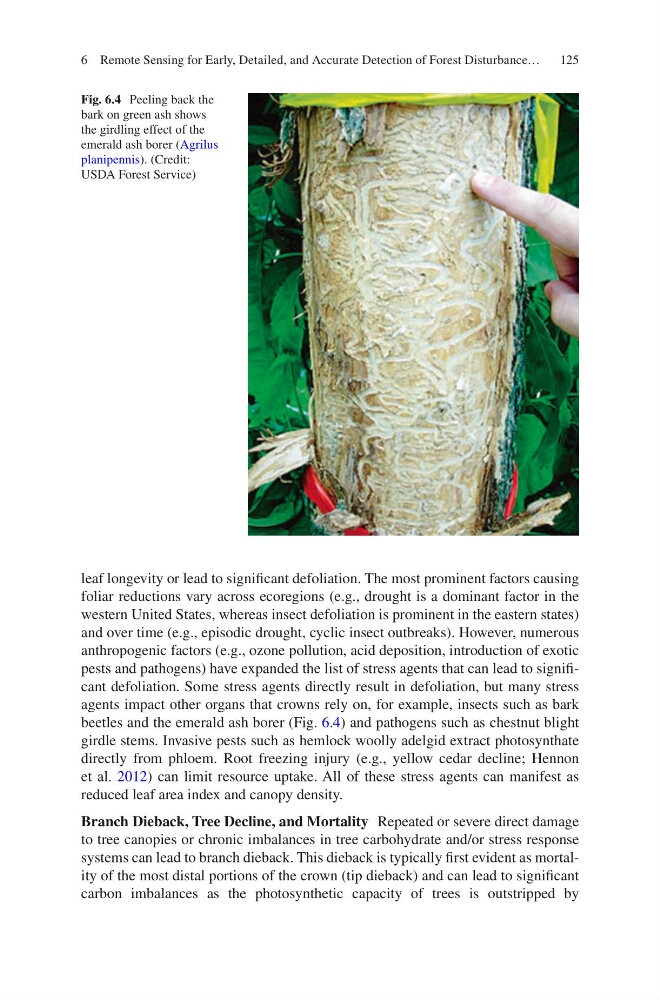
agents impact other organs that crowns rely on, for example, insects such as bark
beetles and the emerald ash borer (Fig. 6.4) and pathogens such as chestnut blight
girdle stems. Invasive pests such as hemlock woolly adelgid extract photosynthate
directly from phloem. Root freezing injury (e.g., yellow cedar decline; Hennon
et al. 2012) can limit resource uptake. All of these stress agents can manifest as
reduced leaf area index and canopy density.
Branch Dieback, Tree Decline, and Mortality Repeated or severe direct damage
to tree canopies or chronic imbalances in tree carbohydrate and/or stress response
systems can lead to branch dieback. This dieback is typically first evident as mortality of the most distal portions of the crown (tip dieback) and can lead to significant
carbon imbalances as the photosynthetic capacity of trees is outstripped by
Fig. 6.4 Peeling back the
bark on green ash shows
the girdling effect of the
emerald ash borer (Agrilus
planipennis). (Credit:
USDA Forest Service)
6 Remote Sensing for Early, Detailed, and Accurate Detection of Forest Disturbance…
leaf longevity or lead to significant defoliation. The most prominent factors causing
foliar reductions vary across ecoregions (e.g., drought is a dominant factor in the
western United States, whereas insect defoliation is prominent in the eastern states)
and over time (e.g., episodic drought, cyclic insect outbreaks). However, numerous
anthropogenic factors (e.g., ozone pollution, acid deposition, introduction of exotic
pests and pathogens) have expanded the list of stress agents that can lead to significant defoliation. Some stress agents directly result in defoliation, but many stress
agents impact other organs that crowns rely on, for example, insects such as bark
beetles and the emerald ash borer (Fig. 6.4) and pathogens such as chestnut blight
girdle stems. Invasive pests such as hemlock woolly adelgid extract photosynthate
directly from phloem. Root freezing injury (e.g., yellow cedar decline; Hennon
et al. 2012) can limit resource uptake. All of these stress agents can manifest as
reduced leaf area index and canopy density.
Branch Dieback, Tree Decline, and Mortality Repeated or severe direct damage
to tree canopies or chronic imbalances in tree carbohydrate and/or stress response
systems can lead to branch dieback. This dieback is typically first evident as mortality of the most distal portions of the crown (tip dieback) and can lead to significant
carbon imbalances as the photosynthetic capacity of trees is outstripped by
Fig. 6.4 Peeling back the
bark on green ash shows
the girdling effect of the
emerald ash borer (Agrilus
planipennis). (Credit:
USDA Forest Service)
6 Remote Sensing for Early, Detailed, and Accurate Detection of Forest Disturbance…