

limitation of flow cells. Generally, this is a major challenge in polymer analysis; but
fortunately, in the case of polyolefins, TCB is the most frequently used solvent/
mobile phase and it is sufficiently transparent in the wavenumber range of 2,700–
3,000 cm
À1 that is used for polyolefin detection. ODCB or tetrachloroethylene are
good alternatives for TCB in HT-SEC. Compositional heterogeneity or SCB can be
analysed successfully by on-flow SEC-FTIR [7, 8, 12, 13, 34–36]. This will be
discussed in more detail in the following application. The ratio-recorded transmittance spectra generate the chromatogram, where the spectrum of the pure mobile
phase is used as background. Sample concentrations are kept rather low in the range
of 1–3 mg/mL, whereas larger injection volumes (400–1,000 μL) are used for better
signal-to-noise ratio. The bands of FTIR spectra used for levels of methyl and
methylene end groups are 2,958 cm
À1 and 2,928 cm
À1 , respectively [7, 8,
34]. These bands can be effectively used for low-density materials. Multivariable
statistical techniques are preferred for high-density materials with low degree of
branching [36].
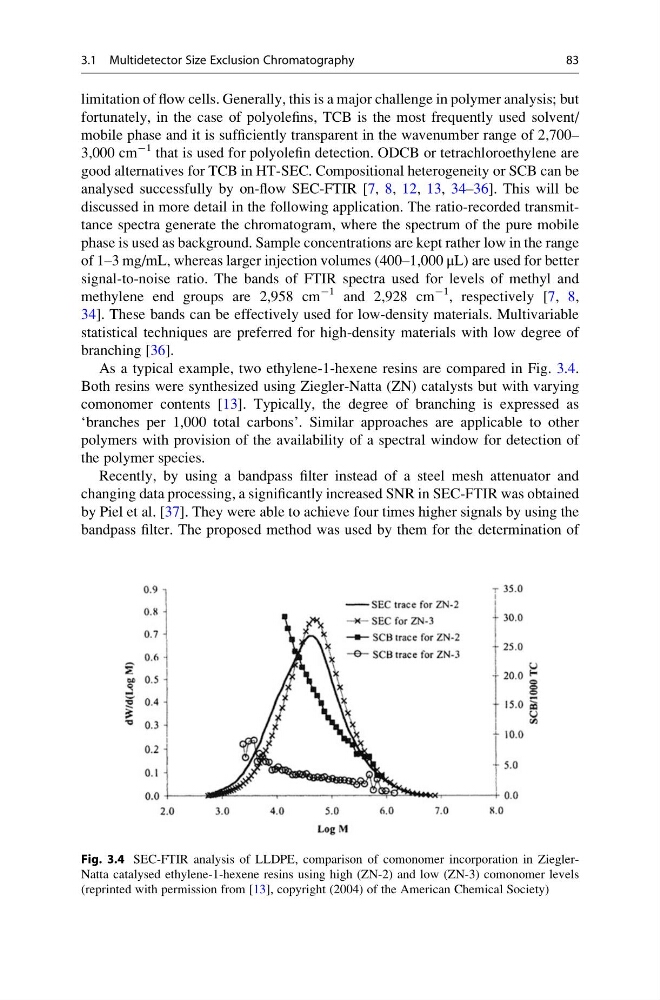
As a typical example, two ethylene-1-hexene resins are compared in Fig. 3.4.
Both resins were synthesized using Ziegler-Natta (ZN) catalysts but with varying
comonomer contents [13]. Typically, the degree of branching is expressed as
‘branches per 1,000 total carbons’. Similar approaches are applicable to other
polymers with provision of the availability of a spectral window for detection of
the polymer species.
Recently, by using a bandpass filter instead of a steel mesh attenuator and
changing data processing, a significantly increased SNR in SEC-FTIR was obtained
by Piel et al. [37]. They were able to achieve four times higher signals by using the
bandpass filter. The proposed method was used by them for the determination of
Fig. 3.4 SEC-FTIR analysis of LLDPE, comparison of comonomer incorporation in ZieglerNatta catalysed ethylene-1-hexene resins using high (ZN-2) and low (ZN-3) comonomer levels
(reprinted with permission from [13], copyright (2004) of the American Chemical Society)
3.1 Multidetector Size Exclusion Chromatography
83
fortunately, in the case of polyolefins, TCB is the most frequently used solvent/
mobile phase and it is sufficiently transparent in the wavenumber range of 2,700–
3,000 cm
À1 that is used for polyolefin detection. ODCB or tetrachloroethylene are
good alternatives for TCB in HT-SEC. Compositional heterogeneity or SCB can be
analysed successfully by on-flow SEC-FTIR [7, 8, 12, 13, 34–36]. This will be
discussed in more detail in the following application. The ratio-recorded transmittance spectra generate the chromatogram, where the spectrum of the pure mobile
phase is used as background. Sample concentrations are kept rather low in the range
of 1–3 mg/mL, whereas larger injection volumes (400–1,000 μL) are used for better
signal-to-noise ratio. The bands of FTIR spectra used for levels of methyl and
methylene end groups are 2,958 cm
À1 and 2,928 cm
À1 , respectively [7, 8,
34]. These bands can be effectively used for low-density materials. Multivariable
statistical techniques are preferred for high-density materials with low degree of
branching [36].
As a typical example, two ethylene-1-hexene resins are compared in Fig. 3.4.
Both resins were synthesized using Ziegler-Natta (ZN) catalysts but with varying
comonomer contents [13]. Typically, the degree of branching is expressed as
‘branches per 1,000 total carbons’. Similar approaches are applicable to other
polymers with provision of the availability of a spectral window for detection of
the polymer species.
Recently, by using a bandpass filter instead of a steel mesh attenuator and
changing data processing, a significantly increased SNR in SEC-FTIR was obtained
by Piel et al. [37]. They were able to achieve four times higher signals by using the
bandpass filter. The proposed method was used by them for the determination of
Fig. 3.4 SEC-FTIR analysis of LLDPE, comparison of comonomer incorporation in ZieglerNatta catalysed ethylene-1-hexene resins using high (ZN-2) and low (ZN-3) comonomer levels
(reprinted with permission from [13], copyright (2004) of the American Chemical Society)
3.1 Multidetector Size Exclusion Chromatography
83