

SCB. Analytical temperature rising elution fractionation (A-TREF) coupled to
FTIR can also be applied for SCB analysis.
The range of applicability of FTIR as a detector in LC can be broadened if the
mobile phase can be removed prior to detection. The fractions are then measured
without any interference from solvents. This concept was realized with the development of the LC-Transform interface. Details of LC Transform can be found in
[4–6].
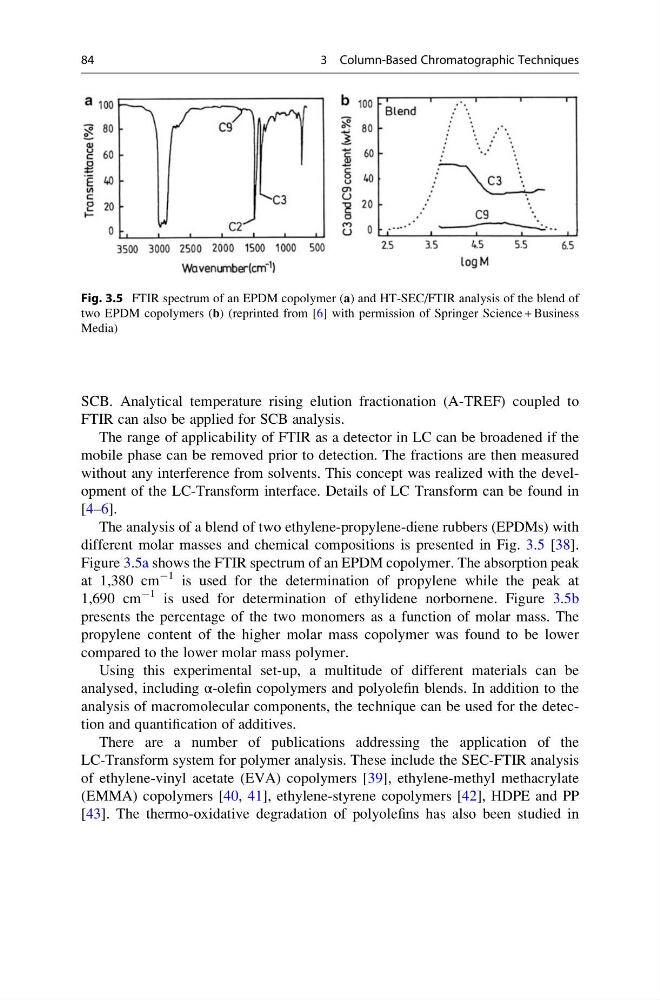
The analysis of a blend of two ethylene-propylene-diene rubbers (EPDMs) with
different molar masses and chemical compositions is presented in Fig. 3.5 [38].
Figure 3.5a shows the FTIR spectrum of an EPDM copolymer. The absorption peak
at 1,380 cm
À1 is used for the determination of propylene while the peak at
1,690 cm
À1 is used for determination of ethylidene norbornene. Figure 3.5b
presents the percentage of the two monomers as a function of molar mass. The
propylene content of the higher molar mass copolymer was found to be lower
compared to the lower molar mass polymer.
Using this experimental set-up, a multitude of different materials can be
analysed, including α-olefin copolymers and polyolefin blends. In addition to the
analysis of macromolecular components, the technique can be used for the detection and quantification of additives.
There are a number of publications addressing the application of the
LC-Transform system for polymer analysis. These include the SEC-FTIR analysis
of ethylene-vinyl acetate (EVA) copolymers [39], ethylene-methyl methacrylate
(EMMA) copolymers [40, 41], ethylene-styrene copolymers [42], HDPE and PP
[43]. The thermo-oxidative degradation of polyolefins has also been studied in
Fig. 3.5 FTIR spectrum of an EPDM copolymer (a) and HT-SEC/FTIR analysis of the blend of
two EPDM copolymers (b) (reprinted from [6] with permission of Springer Science + Business
Media)
84
3 Column-Based Chromatographic Techniques
FTIR can also be applied for SCB analysis.
The range of applicability of FTIR as a detector in LC can be broadened if the
mobile phase can be removed prior to detection. The fractions are then measured
without any interference from solvents. This concept was realized with the development of the LC-Transform interface. Details of LC Transform can be found in
[4–6].
The analysis of a blend of two ethylene-propylene-diene rubbers (EPDMs) with
different molar masses and chemical compositions is presented in Fig. 3.5 [38].
Figure 3.5a shows the FTIR spectrum of an EPDM copolymer. The absorption peak
at 1,380 cm
À1 is used for the determination of propylene while the peak at
1,690 cm
À1 is used for determination of ethylidene norbornene. Figure 3.5b
presents the percentage of the two monomers as a function of molar mass. The
propylene content of the higher molar mass copolymer was found to be lower
compared to the lower molar mass polymer.
Using this experimental set-up, a multitude of different materials can be
analysed, including α-olefin copolymers and polyolefin blends. In addition to the
analysis of macromolecular components, the technique can be used for the detection and quantification of additives.
There are a number of publications addressing the application of the
LC-Transform system for polymer analysis. These include the SEC-FTIR analysis
of ethylene-vinyl acetate (EVA) copolymers [39], ethylene-methyl methacrylate
(EMMA) copolymers [40, 41], ethylene-styrene copolymers [42], HDPE and PP
[43]. The thermo-oxidative degradation of polyolefins has also been studied in
Fig. 3.5 FTIR spectrum of an EPDM copolymer (a) and HT-SEC/FTIR analysis of the blend of
two EPDM copolymers (b) (reprinted from [6] with permission of Springer Science + Business
Media)
84
3 Column-Based Chromatographic Techniques