

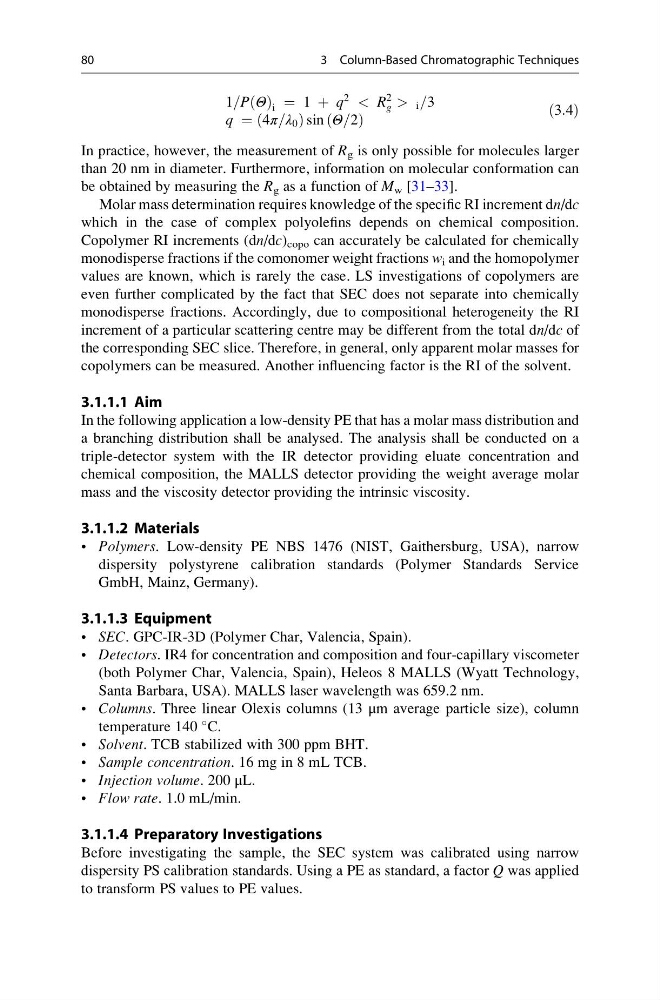
1=P Θ
ð Þ i ¼ 1 þ q
2
< R
2
g > i =3
q ¼ 4π=λ 0
ð
Þsin Θ=2
ð
Þ
ð3:4Þ
In practice, however, the measurement of R g is only possible for molecules larger
than 20 nm in diameter. Furthermore, information on molecular conformation can
be obtained by measuring the R g as a function of M w [31–33].
Molar mass determination requires knowledge of the specific RI increment dn/dc
which in the case of complex polyolefins depends on chemical composition.
Copolymer RI increments (dn/dc) copo can accurately be calculated for chemically
monodisperse fractions if the comonomer weight fractions w i and the homopolymer
values are known, which is rarely the case. LS investigations of copolymers are
even further complicated by the fact that SEC does not separate into chemically
monodisperse fractions. Accordingly, due to compositional heterogeneity the RI
increment of a particular scattering centre may be different from the total dn/dc of
the corresponding SEC slice. Therefore, in general, only apparent molar masses for
copolymers can be measured. Another influencing factor is the RI of the solvent.
3.1.1.1 Aim
In the following application a low-density PE that has a molar mass distribution and
a branching distribution shall be analysed. The analysis shall be conducted on a
triple-detector system with the IR detector providing eluate concentration and
chemical composition, the MALLS detector providing the weight average molar
mass and the viscosity detector providing the intrinsic viscosity.
3.1.1.2 Materials
• Polymers. Low-density PE NBS 1476 (NIST, Gaithersburg, USA), narrow
dispersity polystyrene calibration standards (Polymer Standards Service
GmbH, Mainz, Germany).
3.1.1.3 Equipment
• SEC. GPC-IR-3D (Polymer Char, Valencia, Spain).
• Detectors. IR4 for concentration and composition and four-capillary viscometer
(both Polymer Char, Valencia, Spain), Heleos 8 MALLS (Wyatt Technology,
Santa Barbara, USA). MALLS laser wavelength was 659.2 nm.
• Columns. Three linear Olexis columns (13 μm average particle size), column
temperature 140
C.
• Solvent. TCB stabilized with 300 ppm BHT.
• Sample concentration. 16 mg in 8 mL TCB.
• Injection volume. 200 μL.
• Flow rate. 1.0 mL/min.
3.1.1.4 Preparatory Investigations
Before investigating the sample, the SEC system was calibrated using narrow
dispersity PS calibration standards. Using a PE as standard, a factor Q was applied
to transform PS values to PE values.
80
3 Column-Based Chromatographic Techniques
ð Þ i ¼ 1 þ q
2
< R
2
g > i =3
q ¼ 4π=λ 0
ð
Þsin Θ=2
ð
Þ
ð3:4Þ
In practice, however, the measurement of R g is only possible for molecules larger
than 20 nm in diameter. Furthermore, information on molecular conformation can
be obtained by measuring the R g as a function of M w [31–33].
Molar mass determination requires knowledge of the specific RI increment dn/dc
which in the case of complex polyolefins depends on chemical composition.
Copolymer RI increments (dn/dc) copo can accurately be calculated for chemically
monodisperse fractions if the comonomer weight fractions w i and the homopolymer
values are known, which is rarely the case. LS investigations of copolymers are
even further complicated by the fact that SEC does not separate into chemically
monodisperse fractions. Accordingly, due to compositional heterogeneity the RI
increment of a particular scattering centre may be different from the total dn/dc of
the corresponding SEC slice. Therefore, in general, only apparent molar masses for
copolymers can be measured. Another influencing factor is the RI of the solvent.
3.1.1.1 Aim
In the following application a low-density PE that has a molar mass distribution and
a branching distribution shall be analysed. The analysis shall be conducted on a
triple-detector system with the IR detector providing eluate concentration and
chemical composition, the MALLS detector providing the weight average molar
mass and the viscosity detector providing the intrinsic viscosity.
3.1.1.2 Materials
• Polymers. Low-density PE NBS 1476 (NIST, Gaithersburg, USA), narrow
dispersity polystyrene calibration standards (Polymer Standards Service
GmbH, Mainz, Germany).
3.1.1.3 Equipment
• SEC. GPC-IR-3D (Polymer Char, Valencia, Spain).
• Detectors. IR4 for concentration and composition and four-capillary viscometer
(both Polymer Char, Valencia, Spain), Heleos 8 MALLS (Wyatt Technology,
Santa Barbara, USA). MALLS laser wavelength was 659.2 nm.
• Columns. Three linear Olexis columns (13 μm average particle size), column
temperature 140
C.
• Solvent. TCB stabilized with 300 ppm BHT.
• Sample concentration. 16 mg in 8 mL TCB.
• Injection volume. 200 μL.
• Flow rate. 1.0 mL/min.
3.1.1.4 Preparatory Investigations
Before investigating the sample, the SEC system was calibrated using narrow
dispersity PS calibration standards. Using a PE as standard, a factor Q was applied
to transform PS values to PE values.
80
3 Column-Based Chromatographic Techniques