

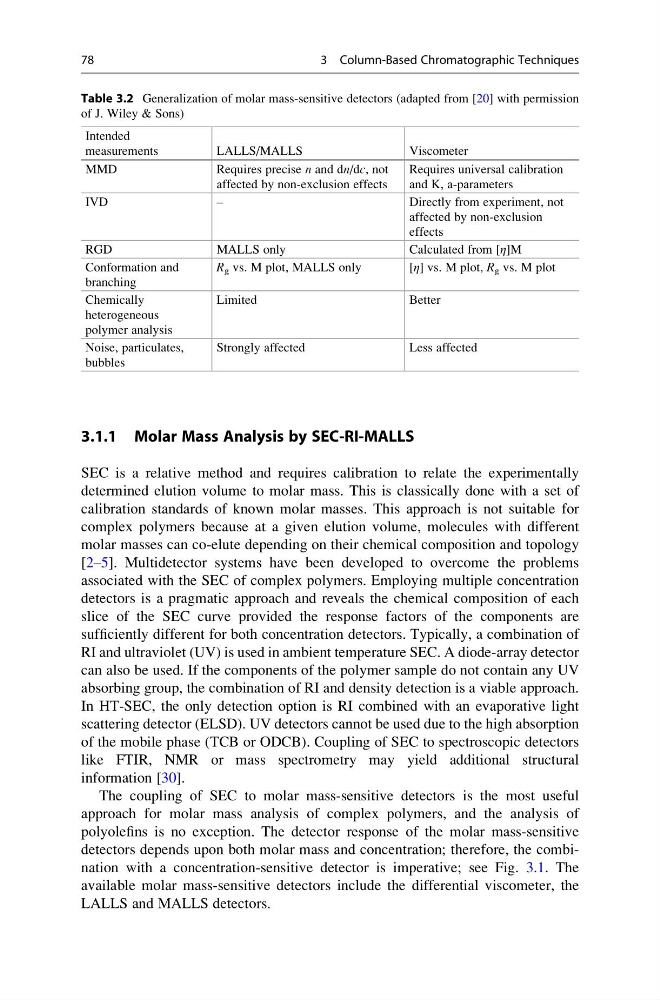
3.1.1 Molar Mass Analysis by SEC-RI-MALLS
SEC is a relative method and requires calibration to relate the experimentally
determined elution volume to molar mass. This is classically done with a set of
calibration standards of known molar masses. This approach is not suitable for
complex polymers because at a given elution volume, molecules with different
molar masses can co-elute depending on their chemical composition and topology
[2–5]. Multidetector systems have been developed to overcome the problems
associated with the SEC of complex polymers. Employing multiple concentration
detectors is a pragmatic approach and reveals the chemical composition of each
slice of the SEC curve provided the response factors of the components are
sufficiently different for both concentration detectors. Typically, a combination of
RI and ultraviolet (UV) is used in ambient temperature SEC. A diode-array detector
can also be used. If the components of the polymer sample do not contain any UV
absorbing group, the combination of RI and density detection is a viable approach.
In HT-SEC, the only detection option is RI combined with an evaporative light
scattering detector (ELSD). UV detectors cannot be used due to the high absorption
of the mobile phase (TCB or ODCB). Coupling of SEC to spectroscopic detectors
like FTIR, NMR or mass spectrometry may yield additional structural
information [30].
The coupling of SEC to molar mass-sensitive detectors is the most useful
approach for molar mass analysis of complex polymers, and the analysis of
polyolefins is no exception. The detector response of the molar mass-sensitive
detectors depends upon both molar mass and concentration; therefore, the combination with a concentration-sensitive detector is imperative; see Fig. 3.1. The
available molar mass-sensitive detectors include the differential viscometer, the
LALLS and MALLS detectors.
Table 3.2 Generalization of molar mass-sensitive detectors (adapted from [20] with permission
of J. Wiley & Sons)
Intended
measurements
LALLS/MALLS
Viscometer
MMD
Requires precise n and dn/dc, not
affected by non-exclusion effects
Requires universal calibration
and K, a-parameters
IVD
–
Directly from experiment, not
affected by non-exclusion
effects
RGD
MALLS only
Calculated from [η]M
Conformation and
branching
R g vs. M plot, MALLS only
[η] vs. M plot, R g vs. M plot
Chemically
heterogeneous
polymer analysis
Limited
Better
Noise, particulates,
bubbles
Strongly affected
Less affected
78
3 Column-Based Chromatographic Techniques
SEC is a relative method and requires calibration to relate the experimentally
determined elution volume to molar mass. This is classically done with a set of
calibration standards of known molar masses. This approach is not suitable for
complex polymers because at a given elution volume, molecules with different
molar masses can co-elute depending on their chemical composition and topology
[2–5]. Multidetector systems have been developed to overcome the problems
associated with the SEC of complex polymers. Employing multiple concentration
detectors is a pragmatic approach and reveals the chemical composition of each
slice of the SEC curve provided the response factors of the components are
sufficiently different for both concentration detectors. Typically, a combination of
RI and ultraviolet (UV) is used in ambient temperature SEC. A diode-array detector
can also be used. If the components of the polymer sample do not contain any UV
absorbing group, the combination of RI and density detection is a viable approach.
In HT-SEC, the only detection option is RI combined with an evaporative light
scattering detector (ELSD). UV detectors cannot be used due to the high absorption
of the mobile phase (TCB or ODCB). Coupling of SEC to spectroscopic detectors
like FTIR, NMR or mass spectrometry may yield additional structural
information [30].
The coupling of SEC to molar mass-sensitive detectors is the most useful
approach for molar mass analysis of complex polymers, and the analysis of
polyolefins is no exception. The detector response of the molar mass-sensitive
detectors depends upon both molar mass and concentration; therefore, the combination with a concentration-sensitive detector is imperative; see Fig. 3.1. The
available molar mass-sensitive detectors include the differential viscometer, the
LALLS and MALLS detectors.
Table 3.2 Generalization of molar mass-sensitive detectors (adapted from [20] with permission
of J. Wiley & Sons)
Intended
measurements
LALLS/MALLS
Viscometer
MMD
Requires precise n and dn/dc, not
affected by non-exclusion effects
Requires universal calibration
and K, a-parameters
IVD
–
Directly from experiment, not
affected by non-exclusion
effects
RGD
MALLS only
Calculated from [η]M
Conformation and
branching
R g vs. M plot, MALLS only
[η] vs. M plot, R g vs. M plot
Chemically
heterogeneous
polymer analysis
Limited
Better
Noise, particulates,
bubbles
Strongly affected
Less affected
78
3 Column-Based Chromatographic Techniques