

separation capabilities. Typical stationary phases for HT-SEC are polymeric
materials based on cross-linked polystyrene (PS-DVB gels). Various dissolution
procedures are used. Generally, a dissolution time between 1 h and 6 h at a
temperature of 140–180
C is recommended. During the dissolution process, the
sample may be shaken or stirred. For protection against thermo-oxidative degradation, phenolic antioxidants (e.g. butylated hydroxytoluene, BHT) are usually added
in concentrations of 0.2 mg/mL up to 1.5 mg/mL [25, 26] to the mobile phase. Care
must be taken to avoid the presence of oxygen, vigorous stirring and sample
filtering because these factors may lead to sample degradation. Polyolefin chains
may degrade during sample preparation or during the SEC separation itself [27–
29]. The thermo-oxidative degradation or the chain scission due to shear stress in
the SEC column is the main cause of the potential reduction of the polyolefin molar
masses [25, 27].
Depending on the complexity of the sample to be analysed, there are several
possible techniques; these mainly differ in terms of the added detectors and
calibration options [16]. As mentioned earlier, Tri-SEC makes use of three types
of detectors, namely concentration detectors, online viscometers and MALLS
detectors. The combination of SEC separation with molar mass-sensitive detectors
is an effective tool for the analysis of complex polyolefins. The value of coupling
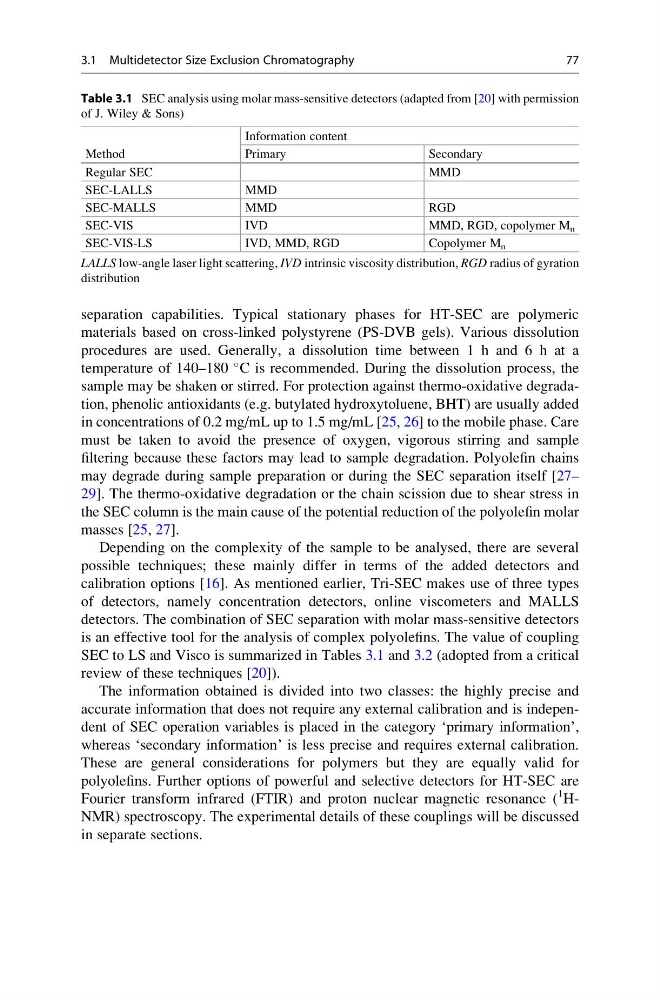
SEC to LS and Visco is summarized in Tables 3.1 and 3.2 (adopted from a critical
review of these techniques [20]).
The information obtained is divided into two classes: the highly precise and
accurate information that does not require any external calibration and is independent of SEC operation variables is placed in the category ‘primary information’,
whereas ‘secondary information’ is less precise and requires external calibration.
These are general considerations for polymers but they are equally valid for
polyolefins. Further options of powerful and selective detectors for HT-SEC are
Fourier transform infrared (FTIR) and proton nuclear magnetic resonance (
1 HNMR) spectroscopy. The experimental details of these couplings will be discussed
in separate sections.
Table 3.1 SEC analysis using molar mass-sensitive detectors (adapted from [20] with permission
of J. Wiley & Sons)
Method
Information content
Primary
Secondary
Regular SEC
MMD
SEC-LALLS
MMD
SEC-MALLS
MMD
RGD
SEC-VIS
IVD
MMD, RGD, copolymer M n
SEC-VIS-LS
IVD, MMD, RGD
Copolymer M n
LALLS low-angle laser light scattering, IVD intrinsic viscosity distribution, RGD radius of gyration
distribution
3.1 Multidetector Size Exclusion Chromatography
77
materials based on cross-linked polystyrene (PS-DVB gels). Various dissolution
procedures are used. Generally, a dissolution time between 1 h and 6 h at a
temperature of 140–180
C is recommended. During the dissolution process, the
sample may be shaken or stirred. For protection against thermo-oxidative degradation, phenolic antioxidants (e.g. butylated hydroxytoluene, BHT) are usually added
in concentrations of 0.2 mg/mL up to 1.5 mg/mL [25, 26] to the mobile phase. Care
must be taken to avoid the presence of oxygen, vigorous stirring and sample
filtering because these factors may lead to sample degradation. Polyolefin chains
may degrade during sample preparation or during the SEC separation itself [27–
29]. The thermo-oxidative degradation or the chain scission due to shear stress in
the SEC column is the main cause of the potential reduction of the polyolefin molar
masses [25, 27].
Depending on the complexity of the sample to be analysed, there are several
possible techniques; these mainly differ in terms of the added detectors and
calibration options [16]. As mentioned earlier, Tri-SEC makes use of three types
of detectors, namely concentration detectors, online viscometers and MALLS
detectors. The combination of SEC separation with molar mass-sensitive detectors
is an effective tool for the analysis of complex polyolefins. The value of coupling
SEC to LS and Visco is summarized in Tables 3.1 and 3.2 (adopted from a critical
review of these techniques [20]).
The information obtained is divided into two classes: the highly precise and
accurate information that does not require any external calibration and is independent of SEC operation variables is placed in the category ‘primary information’,
whereas ‘secondary information’ is less precise and requires external calibration.
These are general considerations for polymers but they are equally valid for
polyolefins. Further options of powerful and selective detectors for HT-SEC are
Fourier transform infrared (FTIR) and proton nuclear magnetic resonance (
1 HNMR) spectroscopy. The experimental details of these couplings will be discussed
in separate sections.
Table 3.1 SEC analysis using molar mass-sensitive detectors (adapted from [20] with permission
of J. Wiley & Sons)
Method
Information content
Primary
Secondary
Regular SEC
MMD
SEC-LALLS
MMD
SEC-MALLS
MMD
RGD
SEC-VIS
IVD
MMD, RGD, copolymer M n
SEC-VIS-LS
IVD, MMD, RGD
Copolymer M n
LALLS low-angle laser light scattering, IVD intrinsic viscosity distribution, RGD radius of gyration
distribution
3.1 Multidetector Size Exclusion Chromatography
77