

were obtained for the middle fraction collected at 100
C. The subsequent analysis
of the fractions by
13 C-NMR, DSC, SEC and CRYSTAF demonstrated that the
major constituents of the corresponding fractions of both products are the same;
only the amounts differed.
Sample 4V showed a delayed induction and a slower oxidation rate. The reason
for this behaviour is the higher ethylene content and lower isotacticity of the bulk
sample. Further explanations of this behaviour include the relative amounts of the
four major components within the two samples. Larger concentrations of amorphous EPR and transition EPC accompanied by a lower concentration of iPP were
found in copolymer 4V by TREF analysis of the nondegraded sample. iPP degrades
preferentially, for reasons explained earlier, despite of the presence of large
amounts of amorphous material. Data from hyphenation of TREF fractionation
with
13 C-NMR suggested that in the polymerization of sample 4V, the excess
ethylene that is added during the second stage is located in the EPR and the
transition EPC fractions.
The degradation behaviour of the two samples shows interesting trends. The
most important factors that determine the degradation behaviour are the amount and
distribution of ethylene in the four components of IPC. An increase in ethylene
content induces higher chemical stability and a barrier effect of the comonomer in
intrachain hydroperoxide formation. These effects account for the increase in
oxidation induction time and stability. The morphology of IPCs is also affected
by the amount of ethylene. The morphological variations include the shapes and
sizes of the dispersed EPR phase and the nature of the segmented EPCs that act as
compatibilizer at the interface between the EPR inclusions and the iPP matrix. The
role of this interface is vital in the migration and combination of free radicals during
the degradation of heterophase EPCs. It is therefore concluded that the stability
differences between the two grades are attributed to their morphological disparity.
20
40
60
80
100
120
140
0
1
2
3
4
5
i
3V-0h
3V-40h
3V-65h
3V-90h
W%/DT
W%/DT
i
TREF elution temperature (ºC)
20
40
60
80
100
120
140
0
1
2
3
4
5
4V-0h
4V-115h
4V-179h
4V-195h
TREF elution temperature (ºC)
a
b
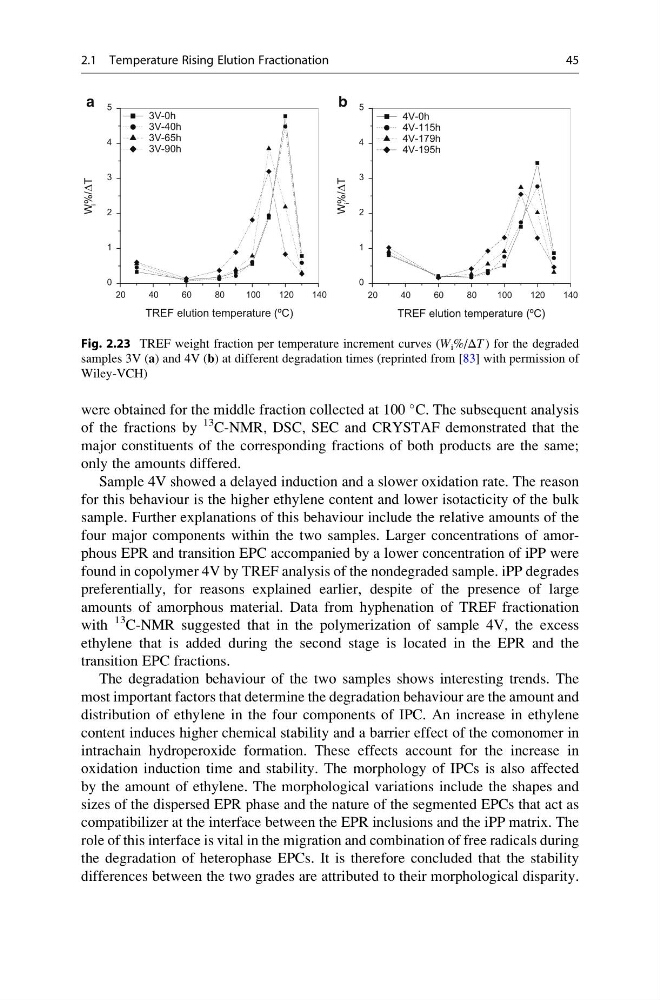
Fig. 2.23 TREF weight fraction per temperature increment curves (W i %/ΔT ) for the degraded
samples 3V (a) and 4V (b) at different degradation times (reprinted from [83] with permission of
Wiley-VCH)
2.1 Temperature Rising Elution Fractionation
45
C. The subsequent analysis
of the fractions by
13 C-NMR, DSC, SEC and CRYSTAF demonstrated that the
major constituents of the corresponding fractions of both products are the same;
only the amounts differed.
Sample 4V showed a delayed induction and a slower oxidation rate. The reason
for this behaviour is the higher ethylene content and lower isotacticity of the bulk
sample. Further explanations of this behaviour include the relative amounts of the
four major components within the two samples. Larger concentrations of amorphous EPR and transition EPC accompanied by a lower concentration of iPP were
found in copolymer 4V by TREF analysis of the nondegraded sample. iPP degrades
preferentially, for reasons explained earlier, despite of the presence of large
amounts of amorphous material. Data from hyphenation of TREF fractionation
with
13 C-NMR suggested that in the polymerization of sample 4V, the excess
ethylene that is added during the second stage is located in the EPR and the
transition EPC fractions.
The degradation behaviour of the two samples shows interesting trends. The
most important factors that determine the degradation behaviour are the amount and
distribution of ethylene in the four components of IPC. An increase in ethylene
content induces higher chemical stability and a barrier effect of the comonomer in
intrachain hydroperoxide formation. These effects account for the increase in
oxidation induction time and stability. The morphology of IPCs is also affected
by the amount of ethylene. The morphological variations include the shapes and
sizes of the dispersed EPR phase and the nature of the segmented EPCs that act as
compatibilizer at the interface between the EPR inclusions and the iPP matrix. The
role of this interface is vital in the migration and combination of free radicals during
the degradation of heterophase EPCs. It is therefore concluded that the stability
differences between the two grades are attributed to their morphological disparity.
20
40
60
80
100
120
140
0
1
2
3
4
5
i
3V-0h
3V-40h
3V-65h
3V-90h
W%/DT
W%/DT
i
TREF elution temperature (ºC)
20
40
60
80
100
120
140
0
1
2
3
4
5
4V-0h
4V-115h
4V-179h
4V-195h
TREF elution temperature (ºC)
a
b
Fig. 2.23 TREF weight fraction per temperature increment curves (W i %/ΔT ) for the degraded
samples 3V (a) and 4V (b) at different degradation times (reprinted from [83] with permission of
Wiley-VCH)
2.1 Temperature Rising Elution Fractionation
45