

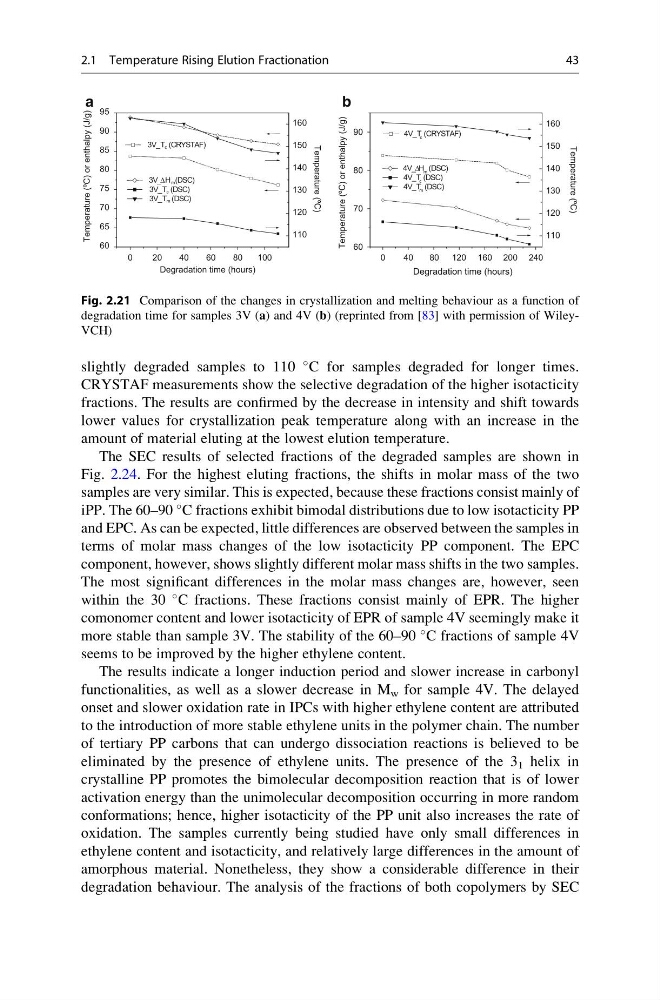
slightly degraded samples to 110
C for samples degraded for longer times.
CRYSTAF measurements show the selective degradation of the higher isotacticity
fractions. The results are confirmed by the decrease in intensity and shift towards
lower values for crystallization peak temperature along with an increase in the
amount of material eluting at the lowest elution temperature.
The SEC results of selected fractions of the degraded samples are shown in
Fig. 2.24. For the highest eluting fractions, the shifts in molar mass of the two
samples are very similar. This is expected, because these fractions consist mainly of
iPP. The 60–90
C fractions exhibit bimodal distributions due to low isotacticity PP
and EPC. As can be expected, little differences are observed between the samples in
terms of molar mass changes of the low isotacticity PP component. The EPC
component, however, shows slightly different molar mass shifts in the two samples.
The most significant differences in the molar mass changes are, however, seen
within the 30
C fractions. These fractions consist mainly of EPR. The higher
comonomer content and lower isotacticity of EPR of sample 4V seemingly make it
more stable than sample 3V. The stability of the 60–90
C fractions of sample 4V
seems to be improved by the higher ethylene content.
The results indicate a longer induction period and slower increase in carbonyl
functionalities, as well as a slower decrease in M w for sample 4V. The delayed
onset and slower oxidation rate in IPCs with higher ethylene content are attributed
to the introduction of more stable ethylene units in the polymer chain. The number
of tertiary PP carbons that can undergo dissociation reactions is believed to be
eliminated by the presence of ethylene units. The presence of the 3 1 helix in
crystalline PP promotes the bimolecular decomposition reaction that is of lower
activation energy than the unimolecular decomposition occurring in more random
conformations; hence, higher isotacticity of the PP unit also increases the rate of
oxidation. The samples currently being studied have only small differences in
ethylene content and isotacticity, and relatively large differences in the amount of
amorphous material. Nonetheless, they show a considerable difference in their
degradation behaviour. The analysis of the fractions of both copolymers by SEC
0
2 0
4 0
6 0
8 0
1 0 0
60
65
70
75
80
85
90
95
110
120
130
140
150
160
110
120
130
140
150
160
3V_DHm (DSC)
3V_Tc (DSC)
3V_Tm (DSC)
3V_Tc (CRYSTAF)
Temperature (ºC)
Temperature (ºC)
Temperature (ºC) or enthalpy (J/g)
Temperature (ºC) or enthalpy (J/g)
Degradation time (hours)
0
40
80 120 160 200 240
60
70
80
90
4V_DH m (DSC)
4V_T c (DSC)
4V_T m (DSC)
Degradation time (hours)
4V_T c (CRYSTAF)
a
b
Fig. 2.21 Comparison of the changes in crystallization and melting behaviour as a function of
degradation time for samples 3V (a) and 4V (b) (reprinted from [83] with permission of WileyVCH)
2.1 Temperature Rising Elution Fractionation
43
C for samples degraded for longer times.
CRYSTAF measurements show the selective degradation of the higher isotacticity
fractions. The results are confirmed by the decrease in intensity and shift towards
lower values for crystallization peak temperature along with an increase in the
amount of material eluting at the lowest elution temperature.
The SEC results of selected fractions of the degraded samples are shown in
Fig. 2.24. For the highest eluting fractions, the shifts in molar mass of the two
samples are very similar. This is expected, because these fractions consist mainly of
iPP. The 60–90
C fractions exhibit bimodal distributions due to low isotacticity PP
and EPC. As can be expected, little differences are observed between the samples in
terms of molar mass changes of the low isotacticity PP component. The EPC
component, however, shows slightly different molar mass shifts in the two samples.
The most significant differences in the molar mass changes are, however, seen
within the 30
C fractions. These fractions consist mainly of EPR. The higher
comonomer content and lower isotacticity of EPR of sample 4V seemingly make it
more stable than sample 3V. The stability of the 60–90
C fractions of sample 4V
seems to be improved by the higher ethylene content.
The results indicate a longer induction period and slower increase in carbonyl
functionalities, as well as a slower decrease in M w for sample 4V. The delayed
onset and slower oxidation rate in IPCs with higher ethylene content are attributed
to the introduction of more stable ethylene units in the polymer chain. The number
of tertiary PP carbons that can undergo dissociation reactions is believed to be
eliminated by the presence of ethylene units. The presence of the 3 1 helix in
crystalline PP promotes the bimolecular decomposition reaction that is of lower
activation energy than the unimolecular decomposition occurring in more random
conformations; hence, higher isotacticity of the PP unit also increases the rate of
oxidation. The samples currently being studied have only small differences in
ethylene content and isotacticity, and relatively large differences in the amount of
amorphous material. Nonetheless, they show a considerable difference in their
degradation behaviour. The analysis of the fractions of both copolymers by SEC
0
2 0
4 0
6 0
8 0
1 0 0
60
65
70
75
80
85
90
95
110
120
130
140
150
160
110
120
130
140
150
160
3V_DHm (DSC)
3V_Tc (DSC)
3V_Tm (DSC)
3V_Tc (CRYSTAF)
Temperature (ºC)
Temperature (ºC)
Temperature (ºC) or enthalpy (J/g)
Temperature (ºC) or enthalpy (J/g)
Degradation time (hours)
0
40
80 120 160 200 240
60
70
80
90
4V_DH m (DSC)
4V_T c (DSC)
4V_T m (DSC)
Degradation time (hours)
4V_T c (CRYSTAF)
a
b
Fig. 2.21 Comparison of the changes in crystallization and melting behaviour as a function of
degradation time for samples 3V (a) and 4V (b) (reprinted from [83] with permission of WileyVCH)
2.1 Temperature Rising Elution Fractionation
43