

The elution in TREF has been shown to be independent of molar mass above
10 kg/mol [1, 2]. As an alternative to the calibration of TREF with well
characterized polymer standards, a composition sensitive detector can be used, as
has been demonstrated by Monrabal [20, 21]. Using a state-of-the-art IR detector
with two simultaneous signals, one signal is used for total concentration while the
other signal measures the methyl absorption, which is indicative for comonomer
content. The ratio of the two signals gives the CH 3 /1,000C value for a typical
LLDPE; see Fig. 2.5a. Assuming that the sample has no long chain branches, the
value corresponds directly to the copolymer composition. It is remarkable that the
CH 3 /1,000C calibration curve shows a linear dependence on elution temperature.
The composition detector is particularly important in cases where the crystallization behaviour is influenced by copolymer composition and other parameters such
as tacticity and branching. A good example for such a situation is the fractionation
of high impact polypropylene copolymers (IPCs) where the IR detector reading
provides copolymer composition irrespective of polypropylene (PP) tacticity; see
Fig. 2.5b [9]. Other detector options are the online viscometer and the multiangle
laser light scattering (MALLS) detectors that provide direct molar mass
information.
As has been pointed out earlier, TREF is one of the workhorses of the polyolefin
industry for characterization of polyolefins with respect to crystallizability. A
typical procedure is to fractionate a complex polyolefin by TREF, isolate the
fractions and subject them to a range of analyses including size exclusion chromatography (SEC) for molar mass and FTIR/NMR for chemical composition. Other
approaches include the analysis of the crystalline structure by X-ray diffraction
(XRD) and the thermal properties by differential scanning calorimetry (DSC).
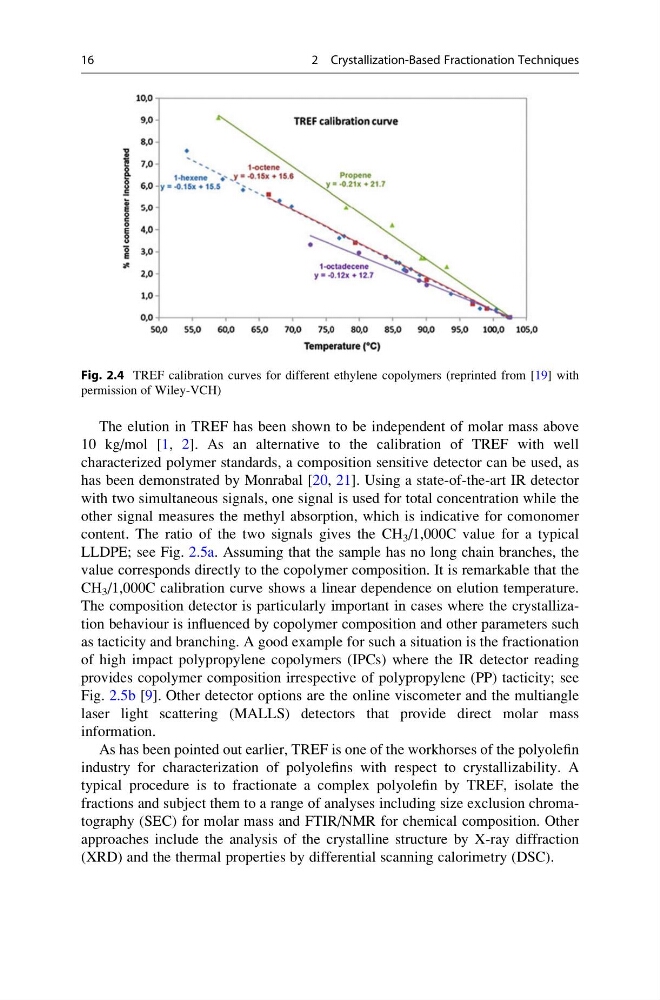
Fig. 2.4 TREF calibration curves for different ethylene copolymers (reprinted from [19] with
permission of Wiley-VCH)
16
2 Crystallization-Based Fractionation Techniques
10 kg/mol [1, 2]. As an alternative to the calibration of TREF with well
characterized polymer standards, a composition sensitive detector can be used, as
has been demonstrated by Monrabal [20, 21]. Using a state-of-the-art IR detector
with two simultaneous signals, one signal is used for total concentration while the
other signal measures the methyl absorption, which is indicative for comonomer
content. The ratio of the two signals gives the CH 3 /1,000C value for a typical
LLDPE; see Fig. 2.5a. Assuming that the sample has no long chain branches, the
value corresponds directly to the copolymer composition. It is remarkable that the
CH 3 /1,000C calibration curve shows a linear dependence on elution temperature.
The composition detector is particularly important in cases where the crystallization behaviour is influenced by copolymer composition and other parameters such
as tacticity and branching. A good example for such a situation is the fractionation
of high impact polypropylene copolymers (IPCs) where the IR detector reading
provides copolymer composition irrespective of polypropylene (PP) tacticity; see
Fig. 2.5b [9]. Other detector options are the online viscometer and the multiangle
laser light scattering (MALLS) detectors that provide direct molar mass
information.
As has been pointed out earlier, TREF is one of the workhorses of the polyolefin
industry for characterization of polyolefins with respect to crystallizability. A
typical procedure is to fractionate a complex polyolefin by TREF, isolate the
fractions and subject them to a range of analyses including size exclusion chromatography (SEC) for molar mass and FTIR/NMR for chemical composition. Other
approaches include the analysis of the crystalline structure by X-ray diffraction
(XRD) and the thermal properties by differential scanning calorimetry (DSC).
Fig. 2.4 TREF calibration curves for different ethylene copolymers (reprinted from [19] with
permission of Wiley-VCH)
16
2 Crystallization-Based Fractionation Techniques