

A few representative applications of TREF are reviewed as follows. The slow
crystallization of PE in extended mode occurs only below molar masses of
2,000 g/mol, as shown by the analysis of TREF fractions using Raman spectroscopy in longitudinal acoustic mode (LAM) and DSC by Tomba et al. [22]. Chain
folding takes place at higher molar masses. For a narrow molar mass range,
independent crystallization was observed, in contrast to broad molar mass ranges
where co-crystallization occurs in the case of polyolefin blends. These results
indicated that crystallizable sequences really existed, and could be attributed to
chain folding and co-crystallization phenomena. A perfect tool for the direct
examination of the distribution of crystallizable sequences length was the
Raman technique in LAM mode. DSC was limited only to samples where narrow
distributions of crystallizable sequences were expected.
Hassan et al. [23, 24] correlated the preparation procedure of the Ziegler–Natta
catalyst, the co-catalyst type, catalyst pretreatment and polymerization conditions
with the tacticity of resulting PP by using SEC, NMR and TREF. Zhang and
co-workers [25] studied the fractionation of random copolymers of propylene and
ethylene by P-TREF, and carried out subsequent analysis of P-TREF fractions by
SEC,
13 C NMR, DSC and wide-angle X-ray diffraction (WAXD) analysis. Copolymer molecules with varying compositions and molar masses were found in TREF
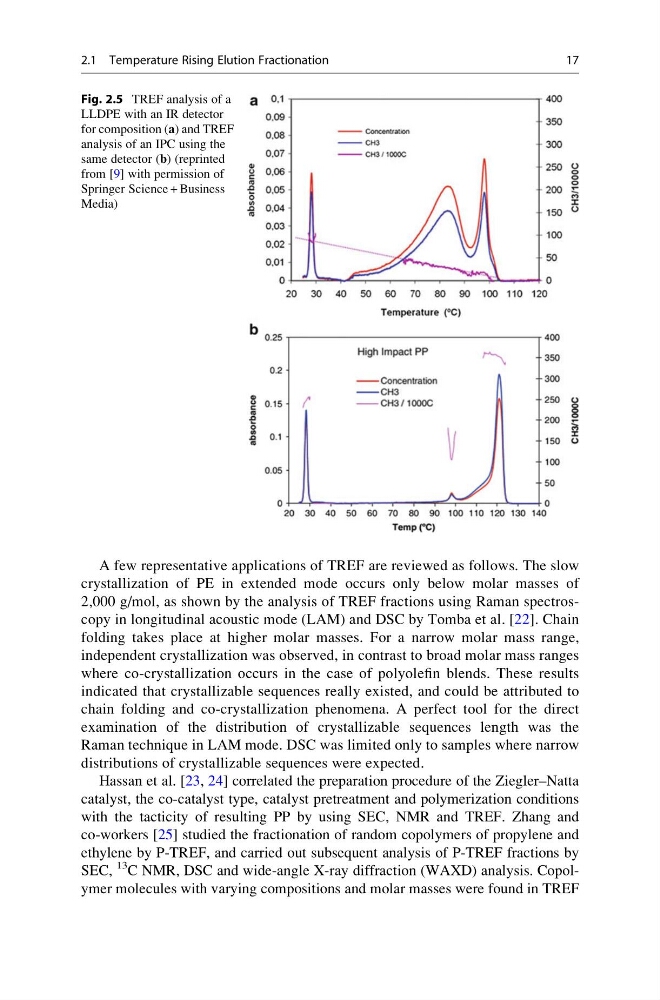
Fig. 2.5 TREF analysis of a
LLDPE with an IR detector
for composition (a) and TREF
analysis of an IPC using the
same detector (b) (reprinted
from [9] with permission of
Springer Science + Business
Media)
2.1 Temperature Rising Elution Fractionation
17
crystallization of PE in extended mode occurs only below molar masses of
2,000 g/mol, as shown by the analysis of TREF fractions using Raman spectroscopy in longitudinal acoustic mode (LAM) and DSC by Tomba et al. [22]. Chain
folding takes place at higher molar masses. For a narrow molar mass range,
independent crystallization was observed, in contrast to broad molar mass ranges
where co-crystallization occurs in the case of polyolefin blends. These results
indicated that crystallizable sequences really existed, and could be attributed to
chain folding and co-crystallization phenomena. A perfect tool for the direct
examination of the distribution of crystallizable sequences length was the
Raman technique in LAM mode. DSC was limited only to samples where narrow
distributions of crystallizable sequences were expected.
Hassan et al. [23, 24] correlated the preparation procedure of the Ziegler–Natta
catalyst, the co-catalyst type, catalyst pretreatment and polymerization conditions
with the tacticity of resulting PP by using SEC, NMR and TREF. Zhang and
co-workers [25] studied the fractionation of random copolymers of propylene and
ethylene by P-TREF, and carried out subsequent analysis of P-TREF fractions by
SEC,
13 C NMR, DSC and wide-angle X-ray diffraction (WAXD) analysis. Copolymer molecules with varying compositions and molar masses were found in TREF
Fig. 2.5 TREF analysis of a
LLDPE with an IR detector
for composition (a) and TREF
analysis of an IPC using the
same detector (b) (reprinted
from [9] with permission of
Springer Science + Business
Media)
2.1 Temperature Rising Elution Fractionation
17