

material. Furthermore, a decreased loss of small molecules through the pores of the
membrane is observed due to the low average cross-flow value of the exponential
gradient and, in turn, a large amount of solvent is saved.
The results demonstrate the enormous flexibility of AF4 as compared to SEC.
The adjustment of the cross-flow function enables one to create tailor-made calibration curves. An expensive and time consuming change of the SEC columns is
not necessary. Finally, an exponential-like gradient was chosen for further
measurements because of the good separation and the lower material loss for low
molar mass samples.
4.3.1.5 Measurement and Evaluation
The abnormal late elution of branched molecules that results in the co-elution of
linear and branched molecules with different molar masses in HT-SEC causes
severe problems in the accurate molar mass analysis of polyolefins with very high
molar masses and significant branching (UHM HDPE or LDPE). This leads to
errors in the calculated molar mass distributions. Macromolecules with molar
masses above 1,000 kg/mol are known to be very sensitive to shear degradation
in SEC. This is an additional source of error when molar masses are analysed
by SEC.
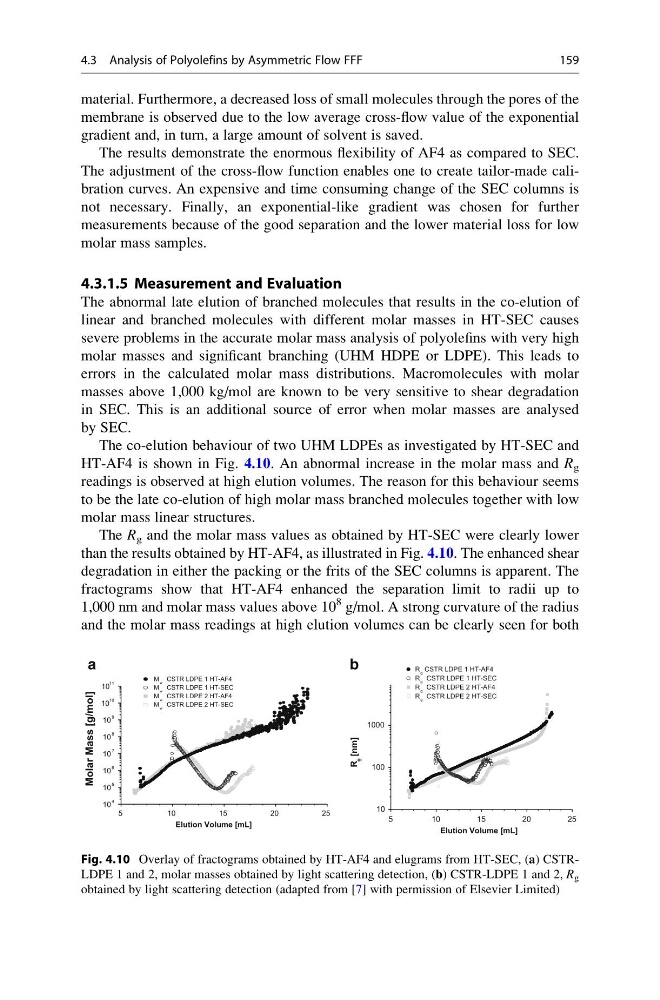
The co-elution behaviour of two UHM LDPEs as investigated by HT-SEC and
HT-AF4 is shown in Fig. 4.10. An abnormal increase in the molar mass and R g
readings is observed at high elution volumes. The reason for this behaviour seems
to be the late co-elution of high molar mass branched molecules together with low
molar mass linear structures.
The R g and the molar mass values as obtained by HT-SEC were clearly lower
than the results obtained by HT-AF4, as illustrated in Fig. 4.10. The enhanced shear
degradation in either the packing or the frits of the SEC columns is apparent. The
fractograms show that HT-AF4 enhanced the separation limit to radii up to
1,000 nm and molar mass values above 10
8 g/mol. A strong curvature of the radius
and the molar mass readings at high elution volumes can be clearly seen for both
5
1 0
1 5
2 0
2 5
10 4
10 5
10 6
10 7
10 8
10 9
10
10
10
11
Elution Volume [mL]
Molar Mass [g/mol]
M w CSTR LDPE 1 HT-AF4
M w CSTR LDPE 1 HT-SEC
M w CSTR LDPE 2 HT-AF4
M w CSTR LDPE 2 HT-SEC
5
1 0
1 5
2 0
2 5
10
100
1000
Elution Volume [mL]
R
g
[nm]
R g CSTR LDPE 1 HT-AF4
R g CSTR LDPE 1 HT-SEC
R g CSTR LDPE 2 HT-AF4
R g CSTR LDPE 2 HT-SEC
b
a
Fig. 4.10 Overlay of fractograms obtained by HT-AF4 and elugrams from HT-SEC, (a) CSTRLDPE 1 and 2, molar masses obtained by light scattering detection, (b) CSTR-LDPE 1 and 2, R g
obtained by light scattering detection (adapted from [7] with permission of Elsevier Limited)
4.3 Analysis of Polyolefins by Asymmetric Flow FFF
159
membrane is observed due to the low average cross-flow value of the exponential
gradient and, in turn, a large amount of solvent is saved.
The results demonstrate the enormous flexibility of AF4 as compared to SEC.
The adjustment of the cross-flow function enables one to create tailor-made calibration curves. An expensive and time consuming change of the SEC columns is
not necessary. Finally, an exponential-like gradient was chosen for further
measurements because of the good separation and the lower material loss for low
molar mass samples.
4.3.1.5 Measurement and Evaluation
The abnormal late elution of branched molecules that results in the co-elution of
linear and branched molecules with different molar masses in HT-SEC causes
severe problems in the accurate molar mass analysis of polyolefins with very high
molar masses and significant branching (UHM HDPE or LDPE). This leads to
errors in the calculated molar mass distributions. Macromolecules with molar
masses above 1,000 kg/mol are known to be very sensitive to shear degradation
in SEC. This is an additional source of error when molar masses are analysed
by SEC.
The co-elution behaviour of two UHM LDPEs as investigated by HT-SEC and
HT-AF4 is shown in Fig. 4.10. An abnormal increase in the molar mass and R g
readings is observed at high elution volumes. The reason for this behaviour seems
to be the late co-elution of high molar mass branched molecules together with low
molar mass linear structures.
The R g and the molar mass values as obtained by HT-SEC were clearly lower
than the results obtained by HT-AF4, as illustrated in Fig. 4.10. The enhanced shear
degradation in either the packing or the frits of the SEC columns is apparent. The
fractograms show that HT-AF4 enhanced the separation limit to radii up to
1,000 nm and molar mass values above 10
8 g/mol. A strong curvature of the radius
and the molar mass readings at high elution volumes can be clearly seen for both
5
1 0
1 5
2 0
2 5
10 4
10 5
10 6
10 7
10 8
10 9
10
10
10
11
Elution Volume [mL]
Molar Mass [g/mol]
M w CSTR LDPE 1 HT-AF4
M w CSTR LDPE 1 HT-SEC
M w CSTR LDPE 2 HT-AF4
M w CSTR LDPE 2 HT-SEC
5
1 0
1 5
2 0
2 5
10
100
1000
Elution Volume [mL]
R
g
[nm]
R g CSTR LDPE 1 HT-AF4
R g CSTR LDPE 1 HT-SEC
R g CSTR LDPE 2 HT-AF4
R g CSTR LDPE 2 HT-SEC
b
a
Fig. 4.10 Overlay of fractograms obtained by HT-AF4 and elugrams from HT-SEC, (a) CSTRLDPE 1 and 2, molar masses obtained by light scattering detection, (b) CSTR-LDPE 1 and 2, R g
obtained by light scattering detection (adapted from [7] with permission of Elsevier Limited)
4.3 Analysis of Polyolefins by Asymmetric Flow FFF
159