

dissolution process. Argon was flushed through the solvent to remove any
remaining oxygen. The flow rate was set at 0.5 mL/min.
• Columns. Two PLgel mixed B columns with particle sizes of 10 μm and column
sizes of 300 Â 8 mm i.d. (Polymer Laboratories, Church Stretton, England).
• Mobile phase. TCB for both AF4 and SEC, distilled prior to use.
• Detectors. IR detector (IR4, Polymer Char, Valencia, Spain) and a HT-MALLS
detector (Heleos 2, Wyatt Technology, Santa Barbara, USA). The specific RI
increments used in TCB at 145
C were—0.091 for PE and 0.097 for PP.
• Separation temperature. 145
C for both AF4 and SEC.
• Sample concentration. 2 mg/mL in TCB.
• Injection volume. 200 μL.
4.3.1.4 Preparatory Investigations
In the first part of the experiments, the correct operation of the HT-AF4-SEC
system was investigated. In order to ensure that both AF4 and SEC yield the
same results, an ‘easy-to-analyse’ sample of linear HDPE was selected and
measured by both methods coupled to the MALLS detector. The sample was of
rather low molar mass to minimize shear degradation in HT-SEC. The MALLS
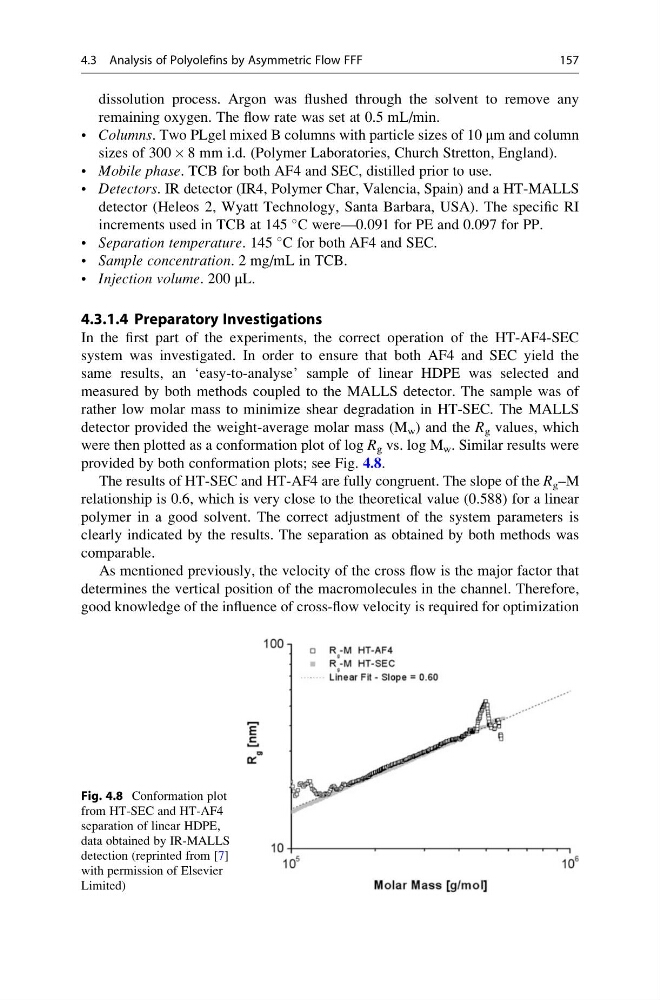
detector provided the weight-average molar mass (M w ) and the R g values, which
were then plotted as a conformation plot of log R g vs. log M w . Similar results were
provided by both conformation plots; see Fig. 4.8.
The results of HT-SEC and HT-AF4 are fully congruent. The slope of the R g –M
relationship is 0.6, which is very close to the theoretical value (0.588) for a linear
polymer in a good solvent. The correct adjustment of the system parameters is
clearly indicated by the results. The separation as obtained by both methods was
comparable.
As mentioned previously, the velocity of the cross flow is the major factor that
determines the vertical position of the macromolecules in the channel. Therefore,
good knowledge of the influence of cross-flow velocity is required for optimization
Fig. 4.8 Conformation plot
from HT-SEC and HT-AF4
separation of linear HDPE,
data obtained by IR-MALLS
detection (reprinted from [7]
with permission of Elsevier
Limited)
4.3 Analysis of Polyolefins by Asymmetric Flow FFF
157
remaining oxygen. The flow rate was set at 0.5 mL/min.
• Columns. Two PLgel mixed B columns with particle sizes of 10 μm and column
sizes of 300 Â 8 mm i.d. (Polymer Laboratories, Church Stretton, England).
• Mobile phase. TCB for both AF4 and SEC, distilled prior to use.
• Detectors. IR detector (IR4, Polymer Char, Valencia, Spain) and a HT-MALLS
detector (Heleos 2, Wyatt Technology, Santa Barbara, USA). The specific RI
increments used in TCB at 145
C were—0.091 for PE and 0.097 for PP.
• Separation temperature. 145
C for both AF4 and SEC.
• Sample concentration. 2 mg/mL in TCB.
• Injection volume. 200 μL.
4.3.1.4 Preparatory Investigations
In the first part of the experiments, the correct operation of the HT-AF4-SEC
system was investigated. In order to ensure that both AF4 and SEC yield the
same results, an ‘easy-to-analyse’ sample of linear HDPE was selected and
measured by both methods coupled to the MALLS detector. The sample was of
rather low molar mass to minimize shear degradation in HT-SEC. The MALLS
detector provided the weight-average molar mass (M w ) and the R g values, which
were then plotted as a conformation plot of log R g vs. log M w . Similar results were
provided by both conformation plots; see Fig. 4.8.
The results of HT-SEC and HT-AF4 are fully congruent. The slope of the R g –M
relationship is 0.6, which is very close to the theoretical value (0.588) for a linear
polymer in a good solvent. The correct adjustment of the system parameters is
clearly indicated by the results. The separation as obtained by both methods was
comparable.
As mentioned previously, the velocity of the cross flow is the major factor that
determines the vertical position of the macromolecules in the channel. Therefore,
good knowledge of the influence of cross-flow velocity is required for optimization
Fig. 4.8 Conformation plot
from HT-SEC and HT-AF4
separation of linear HDPE,
data obtained by IR-MALLS
detection (reprinted from [7]
with permission of Elsevier
Limited)
4.3 Analysis of Polyolefins by Asymmetric Flow FFF
157