

1 and PE 2 were broadly distributed HDPE and LDPE, respectively; technical PP
samples PP 1 and 2 differed in molar mass and degree of branching. All
polyolefins were produced by LyondellBasell (Frankfurt, Germany).
4.3.1.3 Equipment
• AF4 instrument. AF2000 (Postnova Analytics, Landsberg/Lech, Germany),
specifically configured to be used at high temperature above 130
C. For this
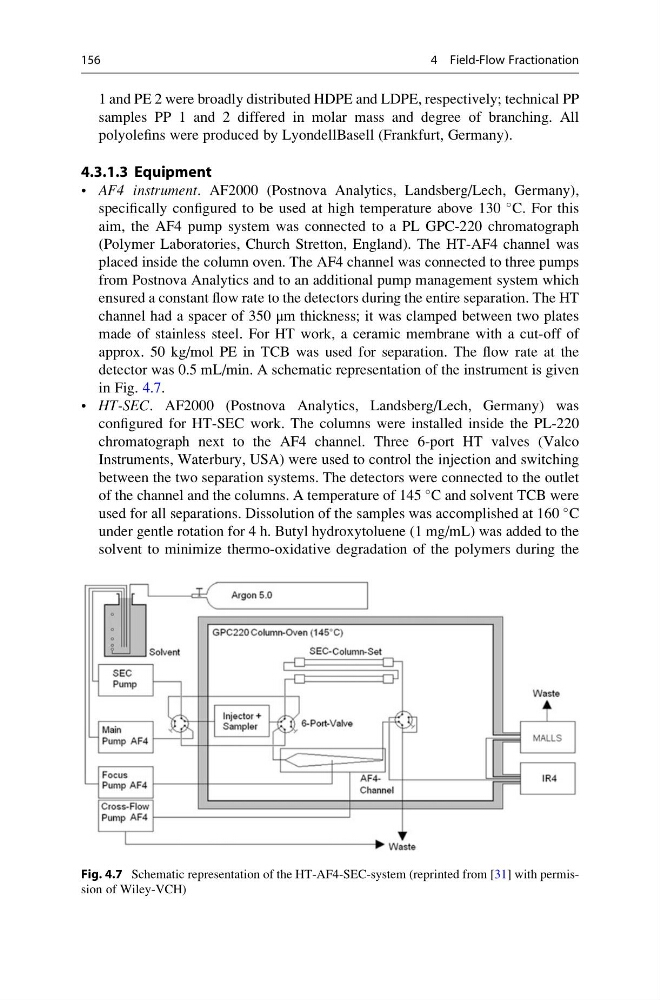
aim, the AF4 pump system was connected to a PL GPC-220 chromatograph
(Polymer Laboratories, Church Stretton, England). The HT-AF4 channel was
placed inside the column oven. The AF4 channel was connected to three pumps
from Postnova Analytics and to an additional pump management system which
ensured a constant flow rate to the detectors during the entire separation. The HT
channel had a spacer of 350 μm thickness; it was clamped between two plates
made of stainless steel. For HT work, a ceramic membrane with a cut-off of
approx. 50 kg/mol PE in TCB was used for separation. The flow rate at the
detector was 0.5 mL/min. A schematic representation of the instrument is given
in Fig. 4.7.
• HT-SEC. AF2000 (Postnova Analytics, Landsberg/Lech, Germany) was
configured for HT-SEC work. The columns were installed inside the PL-220
chromatograph next to the AF4 channel. Three 6-port HT valves (Valco
Instruments, Waterbury, USA) were used to control the injection and switching
between the two separation systems. The detectors were connected to the outlet
of the channel and the columns. A temperature of 145
C and solvent TCB were
used for all separations. Dissolution of the samples was accomplished at 160
C
under gentle rotation for 4 h. Butyl hydroxytoluene (1 mg/mL) was added to the
solvent to minimize thermo-oxidative degradation of the polymers during the
Fig. 4.7 Schematic representation of the HT-AF4-SEC-system (reprinted from [31] with permission of Wiley-VCH)
156
4 Field-Flow Fractionation
samples PP 1 and 2 differed in molar mass and degree of branching. All
polyolefins were produced by LyondellBasell (Frankfurt, Germany).
4.3.1.3 Equipment
• AF4 instrument. AF2000 (Postnova Analytics, Landsberg/Lech, Germany),
specifically configured to be used at high temperature above 130
C. For this
aim, the AF4 pump system was connected to a PL GPC-220 chromatograph
(Polymer Laboratories, Church Stretton, England). The HT-AF4 channel was
placed inside the column oven. The AF4 channel was connected to three pumps
from Postnova Analytics and to an additional pump management system which
ensured a constant flow rate to the detectors during the entire separation. The HT
channel had a spacer of 350 μm thickness; it was clamped between two plates
made of stainless steel. For HT work, a ceramic membrane with a cut-off of
approx. 50 kg/mol PE in TCB was used for separation. The flow rate at the
detector was 0.5 mL/min. A schematic representation of the instrument is given
in Fig. 4.7.
• HT-SEC. AF2000 (Postnova Analytics, Landsberg/Lech, Germany) was
configured for HT-SEC work. The columns were installed inside the PL-220
chromatograph next to the AF4 channel. Three 6-port HT valves (Valco
Instruments, Waterbury, USA) were used to control the injection and switching
between the two separation systems. The detectors were connected to the outlet
of the channel and the columns. A temperature of 145
C and solvent TCB were
used for all separations. Dissolution of the samples was accomplished at 160
C
under gentle rotation for 4 h. Butyl hydroxytoluene (1 mg/mL) was added to the
solvent to minimize thermo-oxidative degradation of the polymers during the
Fig. 4.7 Schematic representation of the HT-AF4-SEC-system (reprinted from [31] with permission of Wiley-VCH)
156
4 Field-Flow Fractionation