

3.3.1.5 Measurement and Evaluation
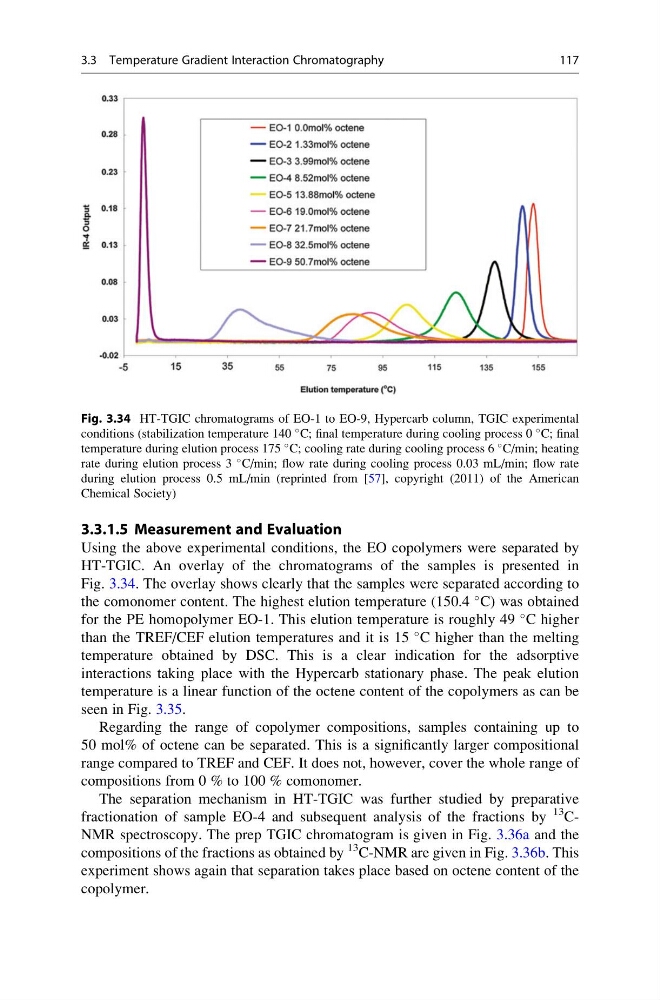
Using the above experimental conditions, the EO copolymers were separated by
HT-TGIC. An overlay of the chromatograms of the samples is presented in
Fig. 3.34. The overlay shows clearly that the samples were separated according to
the comonomer content. The highest elution temperature (150.4
C) was obtained
for the PE homopolymer EO-1. This elution temperature is roughly 49
C higher
than the TREF/CEF elution temperatures and it is 15
C higher than the melting
temperature obtained by DSC. This is a clear indication for the adsorptive
interactions taking place with the Hypercarb stationary phase. The peak elution
temperature is a linear function of the octene content of the copolymers as can be
seen in Fig. 3.35.
Regarding the range of copolymer compositions, samples containing up to
50 mol% of octene can be separated. This is a significantly larger compositional
range compared to TREF and CEF. It does not, however, cover the whole range of
compositions from 0 % to 100 % comonomer.
The separation mechanism in HT-TGIC was further studied by preparative
fractionation of sample EO-4 and subsequent analysis of the fractions by
13 CNMR spectroscopy. The prep TGIC chromatogram is given in Fig. 3.36a and the
compositions of the fractions as obtained by
13 C-NMR are given in Fig. 3.36b. This
experiment shows again that separation takes place based on octene content of the
copolymer.
Fig. 3.34 HT-TGIC chromatograms of EO-1 to EO-9, Hypercarb column, TGIC experimental
conditions (stabilization temperature 140
C; final temperature during cooling process 0
C; final
temperature during elution process 175
C; cooling rate during cooling process 6
C/min; heating
rate during elution process 3
C/min; flow rate during cooling process 0.03 mL/min; flow rate
during elution process 0.5 mL/min (reprinted from [57], copyright (2011) of the American
Chemical Society)
3.3 Temperature Gradient Interaction Chromatography
117
Using the above experimental conditions, the EO copolymers were separated by
HT-TGIC. An overlay of the chromatograms of the samples is presented in
Fig. 3.34. The overlay shows clearly that the samples were separated according to
the comonomer content. The highest elution temperature (150.4
C) was obtained
for the PE homopolymer EO-1. This elution temperature is roughly 49
C higher
than the TREF/CEF elution temperatures and it is 15
C higher than the melting
temperature obtained by DSC. This is a clear indication for the adsorptive
interactions taking place with the Hypercarb stationary phase. The peak elution
temperature is a linear function of the octene content of the copolymers as can be
seen in Fig. 3.35.
Regarding the range of copolymer compositions, samples containing up to
50 mol% of octene can be separated. This is a significantly larger compositional
range compared to TREF and CEF. It does not, however, cover the whole range of
compositions from 0 % to 100 % comonomer.
The separation mechanism in HT-TGIC was further studied by preparative
fractionation of sample EO-4 and subsequent analysis of the fractions by
13 CNMR spectroscopy. The prep TGIC chromatogram is given in Fig. 3.36a and the
compositions of the fractions as obtained by
13 C-NMR are given in Fig. 3.36b. This
experiment shows again that separation takes place based on octene content of the
copolymer.
Fig. 3.34 HT-TGIC chromatograms of EO-1 to EO-9, Hypercarb column, TGIC experimental
conditions (stabilization temperature 140
C; final temperature during cooling process 0
C; final
temperature during elution process 175
C; cooling rate during cooling process 6
C/min; heating
rate during elution process 3
C/min; flow rate during cooling process 0.03 mL/min; flow rate
during elution process 0.5 mL/min (reprinted from [57], copyright (2011) of the American
Chemical Society)
3.3 Temperature Gradient Interaction Chromatography
117