

The molar mass dependence of the elution temperature was investigated by
analysing a set of HDPE calibration standards. It was found that samples with
lower molar masses eluted at lower temperatures. When increasing the molar mass,
the elution temperature stabilized at about 153
C and from molar masses of about
20 kg/mol upwards this elution temperature was obtained irrespective of molar
mass. The co-crystallization was analysed by separating EO copolymer blends and
it was found that co-crystallization does not occur in HT-TGIC.
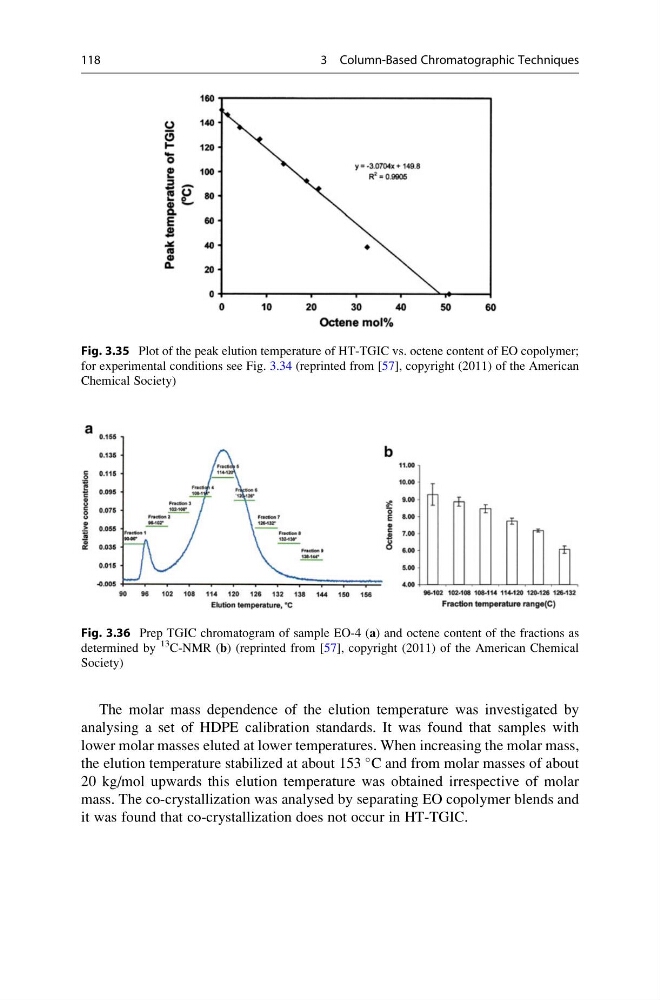
Fig. 3.35 Plot of the peak elution temperature of HT-TGIC vs. octene content of EO copolymer;
for experimental conditions see Fig. 3.34 (reprinted from [57], copyright (2011) of the American
Chemical Society)
Fig. 3.36 Prep TGIC chromatogram of sample EO-4 (a) and octene content of the fractions as
determined by
13
C-NMR (b) (reprinted from [57], copyright (2011) of the American Chemical
Society)
118
3 Column-Based Chromatographic Techniques
analysing a set of HDPE calibration standards. It was found that samples with
lower molar masses eluted at lower temperatures. When increasing the molar mass,
the elution temperature stabilized at about 153
C and from molar masses of about
20 kg/mol upwards this elution temperature was obtained irrespective of molar
mass. The co-crystallization was analysed by separating EO copolymer blends and
it was found that co-crystallization does not occur in HT-TGIC.
Fig. 3.35 Plot of the peak elution temperature of HT-TGIC vs. octene content of EO copolymer;
for experimental conditions see Fig. 3.34 (reprinted from [57], copyright (2011) of the American
Chemical Society)
Fig. 3.36 Prep TGIC chromatogram of sample EO-4 (a) and octene content of the fractions as
determined by
13
C-NMR (b) (reprinted from [57], copyright (2011) of the American Chemical
Society)
118
3 Column-Based Chromatographic Techniques