

surface chemistries show similar selectivities for ethylene copolymers [73,
102]. This is shown in Fig. 3.33 for a comparison of Hypercarb and a molybdenum
sulphide stationary phase.
3.3.1 Separation of Ethylene-Octene Copolymers [57]
3.3.1.1 Aim
The separation of olefin copolymers according to chemical composition has been
accomplished by SGIC; see Sect. 3.2.3 for more details. TREF and CRYSTAF have
been used to fractionate EO copolymers by composition; these fractionations,
however, are limited to the crystallizable part of the samples. The separation of
these important copolymers over a broad range of compositions including
non-crystalline components shall be conducted using HT-TGIC. The aim is to
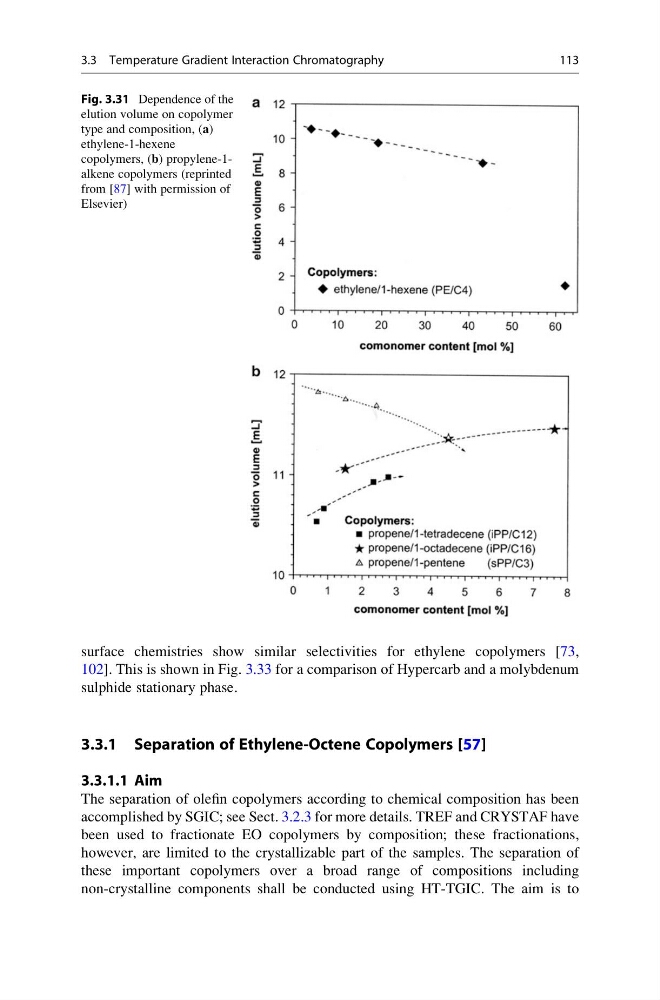
Fig. 3.31 Dependence of the
elution volume on copolymer
type and composition, (a)
ethylene-1-hexene
copolymers, (b) propylene-1alkene copolymers (reprinted
from [87] with permission of
Elsevier)
3.3 Temperature Gradient Interaction Chromatography
113
102]. This is shown in Fig. 3.33 for a comparison of Hypercarb and a molybdenum
sulphide stationary phase.
3.3.1 Separation of Ethylene-Octene Copolymers [57]
3.3.1.1 Aim
The separation of olefin copolymers according to chemical composition has been
accomplished by SGIC; see Sect. 3.2.3 for more details. TREF and CRYSTAF have
been used to fractionate EO copolymers by composition; these fractionations,
however, are limited to the crystallizable part of the samples. The separation of
these important copolymers over a broad range of compositions including
non-crystalline components shall be conducted using HT-TGIC. The aim is to
Fig. 3.31 Dependence of the
elution volume on copolymer
type and composition, (a)
ethylene-1-hexene
copolymers, (b) propylene-1alkene copolymers (reprinted
from [87] with permission of
Elsevier)
3.3 Temperature Gradient Interaction Chromatography
113