

by a combination of IR, MALLS and Visco. A linear relationship between the
elution time (elution temperature) and the copolymer composition was obtained. It
was found that elution is independent of molar mass above 20 kg/mol.
The samples were dissolved in ODCB and injected into the column flushed with
the solvent. After injection, a temperature gradient was applied; see Fig. 3.32. As a
consequence, the samples eluted from the column in an elution order of decreasing
comonomer content. The authors claimed that co-crystallization does not play a
role in TGIC.
The work of Cong et al. [57] was followed by a number of detailed studies on the
mechanism of TGIC. Monrabal explained the interaction with the graphite surface
by weak van der Waals forces. In addition, he postulated that the flat surface of the
graphene sheets interacts favourably with linear PE chains while copolymers or iPP
show some steric hindrance causing a decrease in adsorption. The fact that flat
surfaces enhance interaction was proven by Monrabal who showed that different
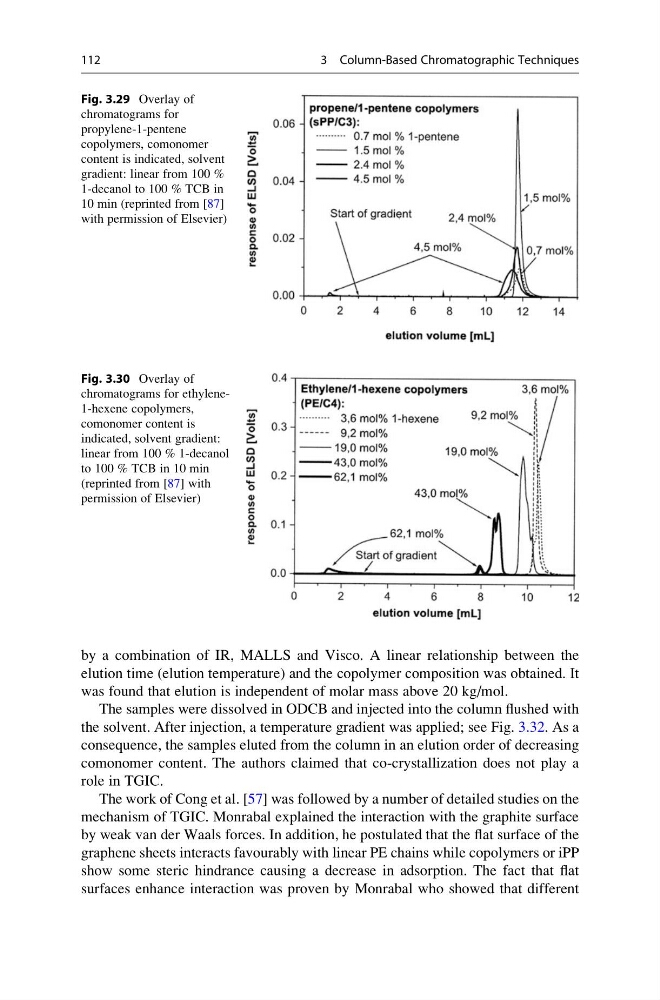
Fig. 3.29 Overlay of
chromatograms for
propylene-1-pentene
copolymers, comonomer
content is indicated, solvent
gradient: linear from 100 %
1-decanol to 100 % TCB in
10 min (reprinted from [87]
with permission of Elsevier)
Fig. 3.30 Overlay of
chromatograms for ethylene1-hexene copolymers,
comonomer content is
indicated, solvent gradient:
linear from 100 % 1-decanol
to 100 % TCB in 10 min
(reprinted from [87] with
permission of Elsevier)
112
3 Column-Based Chromatographic Techniques
elution time (elution temperature) and the copolymer composition was obtained. It
was found that elution is independent of molar mass above 20 kg/mol.
The samples were dissolved in ODCB and injected into the column flushed with
the solvent. After injection, a temperature gradient was applied; see Fig. 3.32. As a
consequence, the samples eluted from the column in an elution order of decreasing
comonomer content. The authors claimed that co-crystallization does not play a
role in TGIC.
The work of Cong et al. [57] was followed by a number of detailed studies on the
mechanism of TGIC. Monrabal explained the interaction with the graphite surface
by weak van der Waals forces. In addition, he postulated that the flat surface of the
graphene sheets interacts favourably with linear PE chains while copolymers or iPP
show some steric hindrance causing a decrease in adsorption. The fact that flat
surfaces enhance interaction was proven by Monrabal who showed that different
Fig. 3.29 Overlay of
chromatograms for
propylene-1-pentene
copolymers, comonomer
content is indicated, solvent
gradient: linear from 100 %
1-decanol to 100 % TCB in
10 min (reprinted from [87]
with permission of Elsevier)
Fig. 3.30 Overlay of
chromatograms for ethylene1-hexene copolymers,
comonomer content is
indicated, solvent gradient:
linear from 100 % 1-decanol
to 100 % TCB in 10 min
(reprinted from [87] with
permission of Elsevier)
112
3 Column-Based Chromatographic Techniques