

The solvent gradient also poses major limitations on the use of molar mass-sensitive
detectors such as viscometers and LS detectors.
It is known that the adsorption of a polymer on a stationary phase is a function of
temperature [98]. This phenomenon has been applied to the separation of synthetic
polymers by a number of authors including Lochmu ¨ller et al. [99] for poly(ethylene
glycol) and (most prominently) Chang and co-workers [59, 100, 101] for a variety
of polymers. Very recently, Cong et al. described experimental conditions for the
application of temperature changes to the separation of polyolefins [57]. In ‘temperature gradient interaction chromatography’ (TGIC), the solvent gradient is
replaced by a thermal gradient using an isocratic mobile phase composition. The
separation of EO copolymers was achieved by the interaction of the polyolefin with
a graphite surface (Hypercarb) in a thermodynamically good solvent for PE. The
solvent used was ODCB.
The results obtained were quite similar to those obtained with the solvent
gradient approach, but, instead of using an ELS detector, detection was conducted
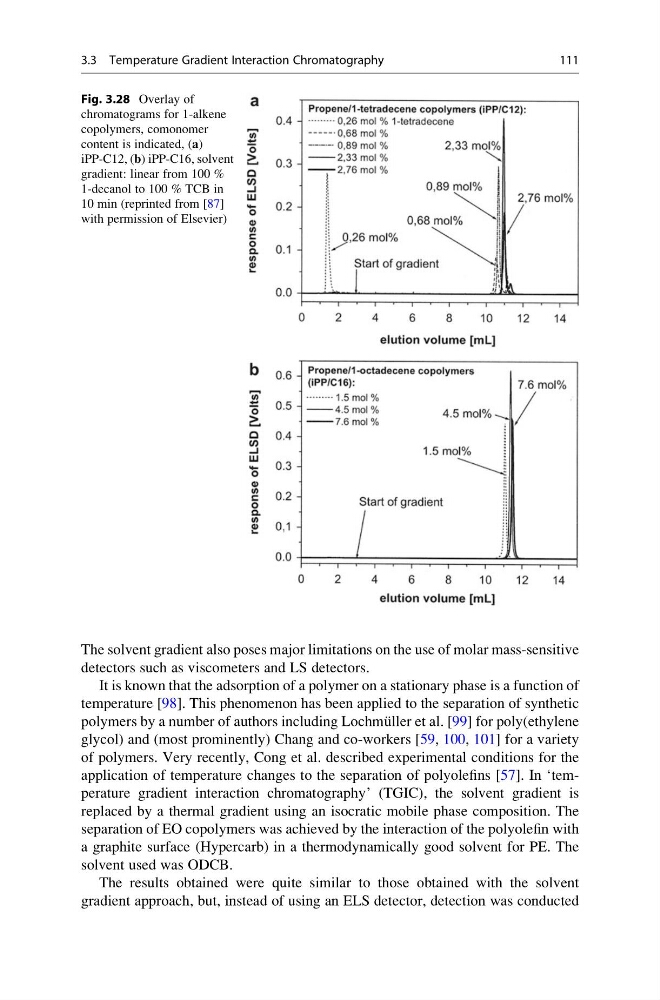
Fig. 3.28 Overlay of
chromatograms for 1-alkene
copolymers, comonomer
content is indicated, (a)
iPP-C12, (b) iPP-C16, solvent
gradient: linear from 100 %
1-decanol to 100 % TCB in
10 min (reprinted from [87]
with permission of Elsevier)
3.3 Temperature Gradient Interaction Chromatography
111
detectors such as viscometers and LS detectors.
It is known that the adsorption of a polymer on a stationary phase is a function of
temperature [98]. This phenomenon has been applied to the separation of synthetic
polymers by a number of authors including Lochmu ¨ller et al. [99] for poly(ethylene
glycol) and (most prominently) Chang and co-workers [59, 100, 101] for a variety
of polymers. Very recently, Cong et al. described experimental conditions for the
application of temperature changes to the separation of polyolefins [57]. In ‘temperature gradient interaction chromatography’ (TGIC), the solvent gradient is
replaced by a thermal gradient using an isocratic mobile phase composition. The
separation of EO copolymers was achieved by the interaction of the polyolefin with
a graphite surface (Hypercarb) in a thermodynamically good solvent for PE. The
solvent used was ODCB.
The results obtained were quite similar to those obtained with the solvent
gradient approach, but, instead of using an ELS detector, detection was conducted
Fig. 3.28 Overlay of
chromatograms for 1-alkene
copolymers, comonomer
content is indicated, (a)
iPP-C12, (b) iPP-C16, solvent
gradient: linear from 100 %
1-decanol to 100 % TCB in
10 min (reprinted from [87]
with permission of Elsevier)
3.3 Temperature Gradient Interaction Chromatography
111