

blockiness). Hence, quantitative
13 C-NMR spectroscopy was used to study these
samples. The calculated triads of EMA 1 and EMA 10 are summarized in Table 3.4.
The total branching content per 1,000 carbons of both samples is similar.
Therefore, the differences in elution behaviour are assumed to be due to CCD.
However, the investigation of the effect of the microstructure on elution behaviour
of copolymers is an important future challenge. The copolymerization parameter
(r 1 ¼ 0.045 and r 2 ¼ 5.3 for EMA) explains the presence of microblocks in both
samples. These parameters favour the cross-propagation reaction for the ethylene
radical compared to the homopropagation reaction for the end acrylate radical
[93–95].
3.2.2 Separation of Ethylene-Propylene Copolymers [89]
3.2.2.1 Aim
Ethylene-propylene copolymers are the most important semi-crystalline copolymer
materials. Their crystallinity changes as a function of chemical composition and
ranges from highly crystalline to mostly amorphous. As has been discussed earlier,
it is not only the average chemical composition but also the chemical heterogeneity
that determines the crystallization behaviour and eventually the application
16
18
20
22
24
26
28
0
5
10
15
20
25
30
MA wt. %
Elution Volume (mL)
EMA 1
EMA 2
EMA 3
EMA 4
EMA 5
EMA 6
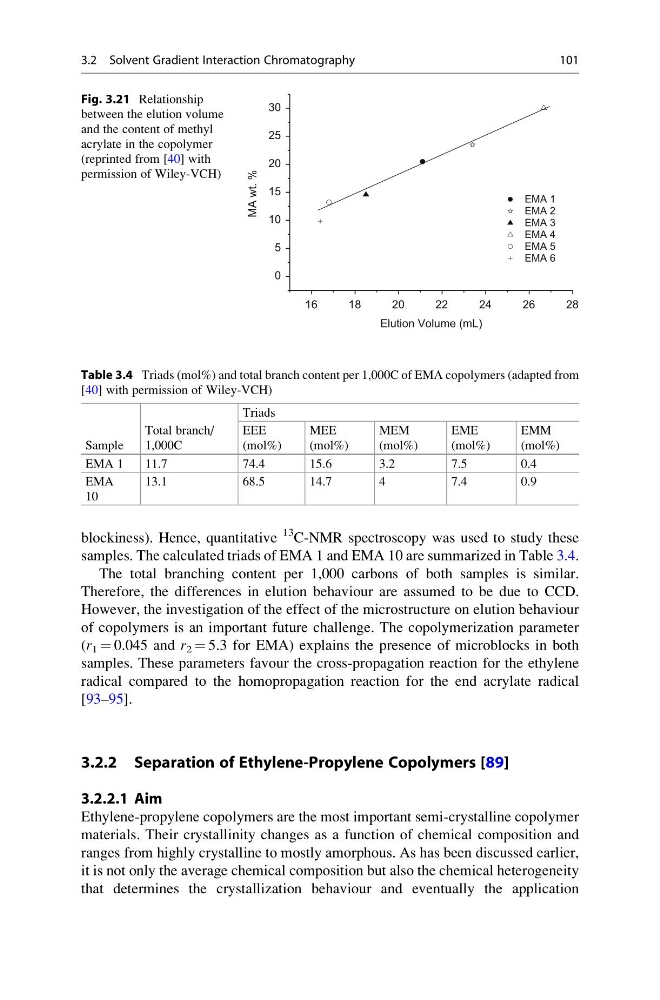
Fig. 3.21 Relationship
between the elution volume
and the content of methyl
acrylate in the copolymer
(reprinted from [40] with
permission of Wiley-VCH)
Table 3.4 Triads (mol%) and total branch content per 1,000C of EMA copolymers (adapted from
[40] with permission of Wiley-VCH)
Sample
Total branch/
1,000C
Triads
EEE
(mol%)
MEE
(mol%)
MEM
(mol%)
EME
(mol%)
EMM
(mol%)
EMA 1
11.7
74.4
15.6
3.2
7.5
0.4
EMA
10
13.1
68.5
14.7
4
7.4
0.9
3.2 Solvent Gradient Interaction Chromatography
101
13 C-NMR spectroscopy was used to study these
samples. The calculated triads of EMA 1 and EMA 10 are summarized in Table 3.4.
The total branching content per 1,000 carbons of both samples is similar.
Therefore, the differences in elution behaviour are assumed to be due to CCD.
However, the investigation of the effect of the microstructure on elution behaviour
of copolymers is an important future challenge. The copolymerization parameter
(r 1 ¼ 0.045 and r 2 ¼ 5.3 for EMA) explains the presence of microblocks in both
samples. These parameters favour the cross-propagation reaction for the ethylene
radical compared to the homopropagation reaction for the end acrylate radical
[93–95].
3.2.2 Separation of Ethylene-Propylene Copolymers [89]
3.2.2.1 Aim
Ethylene-propylene copolymers are the most important semi-crystalline copolymer
materials. Their crystallinity changes as a function of chemical composition and
ranges from highly crystalline to mostly amorphous. As has been discussed earlier,
it is not only the average chemical composition but also the chemical heterogeneity
that determines the crystallization behaviour and eventually the application
16
18
20
22
24
26
28
0
5
10
15
20
25
30
MA wt. %
Elution Volume (mL)
EMA 1
EMA 2
EMA 3
EMA 4
EMA 5
EMA 6
Fig. 3.21 Relationship
between the elution volume
and the content of methyl
acrylate in the copolymer
(reprinted from [40] with
permission of Wiley-VCH)
Table 3.4 Triads (mol%) and total branch content per 1,000C of EMA copolymers (adapted from
[40] with permission of Wiley-VCH)
Sample
Total branch/
1,000C
Triads
EEE
(mol%)
MEE
(mol%)
MEM
(mol%)
EME
(mol%)
EMM
(mol%)
EMA 1
11.7
74.4
15.6
3.2
7.5
0.4
EMA
10
13.1
68.5
14.7
4
7.4
0.9
3.2 Solvent Gradient Interaction Chromatography
101