

properties of the material. HT-HPLC is the only method that can provide a
complete chemical composition separation irrespective of crystallinity. Making
use of the different interactions of the polymer segments with the stationary
phase, separations in the direction of increasing or decreasing comonomer contents
can be obtained. In the present application a novel stationary phase—Hypercarb—
shall be used. Hypercarb has been shown to be extremely selective regarding
ethylene segments in a variety of homo- and copolymers [6, 73, 85].
3.2.2.2 Materials
• Calibration standards. Linear PE standards (PSS GmbH, Mainz, Germany).
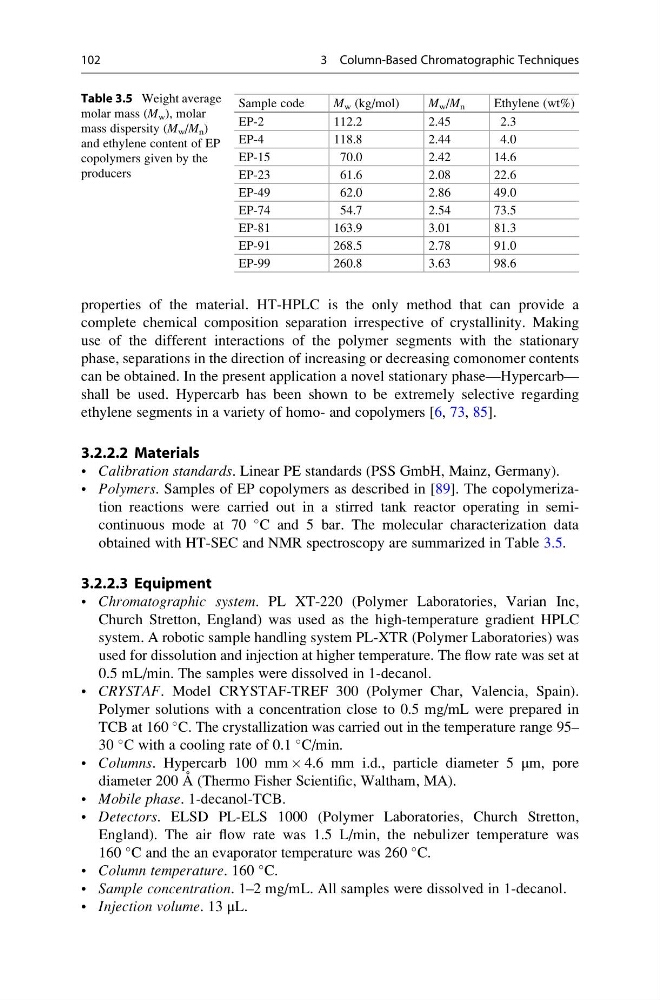
• Polymers. Samples of EP copolymers as described in [89]. The copolymerization reactions were carried out in a stirred tank reactor operating in semicontinuous mode at 70
C and 5 bar. The molecular characterization data
obtained with HT-SEC and NMR spectroscopy are summarized in Table 3.5.
3.2.2.3 Equipment
• Chromatographic system. PL XT-220 (Polymer Laboratories, Varian Inc,
Church Stretton, England) was used as the high-temperature gradient HPLC
system. A robotic sample handling system PL-XTR (Polymer Laboratories) was
used for dissolution and injection at higher temperature. The flow rate was set at
0.5 mL/min. The samples were dissolved in 1-decanol.
• CRYSTAF. Model CRYSTAF-TREF 300 (Polymer Char, Valencia, Spain).
Polymer solutions with a concentration close to 0.5 mg/mL were prepared in
TCB at 160
C. The crystallization was carried out in the temperature range 95–
30
C with a cooling rate of 0.1
C/min.
• Columns. Hypercarb 100 mm  4.6 mm i.d., particle diameter 5 μm, pore
diameter 200 A ˚ (Thermo Fisher Scientific, Waltham, MA).
• Mobile phase. 1-decanol-TCB.
• Detectors. ELSD PL-ELS 1000 (Polymer Laboratories, Church Stretton,
England). The air flow rate was 1.5 L/min, the nebulizer temperature was
160
C and the an evaporator temperature was 260
C.
• Column temperature. 160
C.
• Sample concentration. 1–2 mg/mL. All samples were dissolved in 1-decanol.
• Injection volume. 13 μL.
Table 3.5 Weight average
molar mass (M w ), molar
mass dispersity (M w /M n )
and ethylene content of EP
copolymers given by the
producers
Sample code
M w (kg/mol)
M w /M n
Ethylene (wt%)
EP-2
112.2
2.45
2.3
EP-4
118.8
2.44
4.0
EP-15
70.0
2.42
14.6
EP-23
61.6
2.08
22.6
EP-49
62.0
2.86
49.0
EP-74
54.7
2.54
73.5
EP-81
163.9
3.01
81.3
EP-91
268.5
2.78
91.0
EP-99
260.8
3.63
98.6
102
3 Column-Based Chromatographic Techniques
complete chemical composition separation irrespective of crystallinity. Making
use of the different interactions of the polymer segments with the stationary
phase, separations in the direction of increasing or decreasing comonomer contents
can be obtained. In the present application a novel stationary phase—Hypercarb—
shall be used. Hypercarb has been shown to be extremely selective regarding
ethylene segments in a variety of homo- and copolymers [6, 73, 85].
3.2.2.2 Materials
• Calibration standards. Linear PE standards (PSS GmbH, Mainz, Germany).
• Polymers. Samples of EP copolymers as described in [89]. The copolymerization reactions were carried out in a stirred tank reactor operating in semicontinuous mode at 70
C and 5 bar. The molecular characterization data
obtained with HT-SEC and NMR spectroscopy are summarized in Table 3.5.
3.2.2.3 Equipment
• Chromatographic system. PL XT-220 (Polymer Laboratories, Varian Inc,
Church Stretton, England) was used as the high-temperature gradient HPLC
system. A robotic sample handling system PL-XTR (Polymer Laboratories) was
used for dissolution and injection at higher temperature. The flow rate was set at
0.5 mL/min. The samples were dissolved in 1-decanol.
• CRYSTAF. Model CRYSTAF-TREF 300 (Polymer Char, Valencia, Spain).
Polymer solutions with a concentration close to 0.5 mg/mL were prepared in
TCB at 160
C. The crystallization was carried out in the temperature range 95–
30
C with a cooling rate of 0.1
C/min.
• Columns. Hypercarb 100 mm  4.6 mm i.d., particle diameter 5 μm, pore
diameter 200 A ˚ (Thermo Fisher Scientific, Waltham, MA).
• Mobile phase. 1-decanol-TCB.
• Detectors. ELSD PL-ELS 1000 (Polymer Laboratories, Church Stretton,
England). The air flow rate was 1.5 L/min, the nebulizer temperature was
160
C and the an evaporator temperature was 260
C.
• Column temperature. 160
C.
• Sample concentration. 1–2 mg/mL. All samples were dissolved in 1-decanol.
• Injection volume. 13 μL.
Table 3.5 Weight average
molar mass (M w ), molar
mass dispersity (M w /M n )
and ethylene content of EP
copolymers given by the
producers
Sample code
M w (kg/mol)
M w /M n
Ethylene (wt%)
EP-2
112.2
2.45
2.3
EP-4
118.8
2.44
4.0
EP-15
70.0
2.42
14.6
EP-23
61.6
2.08
22.6
EP-49
62.0
2.86
49.0
EP-74
54.7
2.54
73.5
EP-81
163.9
3.01
81.3
EP-91
268.5
2.78
91.0
EP-99
260.8
3.63
98.6
102
3 Column-Based Chromatographic Techniques