

0
1
2
3
4
1000
10000
100000
LAC
LCCC
SEC
Decalin/Cyclohexanone
(vol% Decalin)
95.0%
95.5%
95.8%
95.9%
96,0%
Molar Mass (g/mol)
Elution Volume (mL)
0
1
2
3
4
0
1
2
3
4
5
6
7
polystyrene 127 kg/mol
polyethylene 126 kg/mol
Detector Signal (V)
Elution Volume (mL)
0
1
2
3
4
0
2
4
6
8
10
12
polystyrene 1.45 kg/mol
polyethylene 1.1 kg/mol
Detector Signal (V)
Elution Volume (mL)
a
b
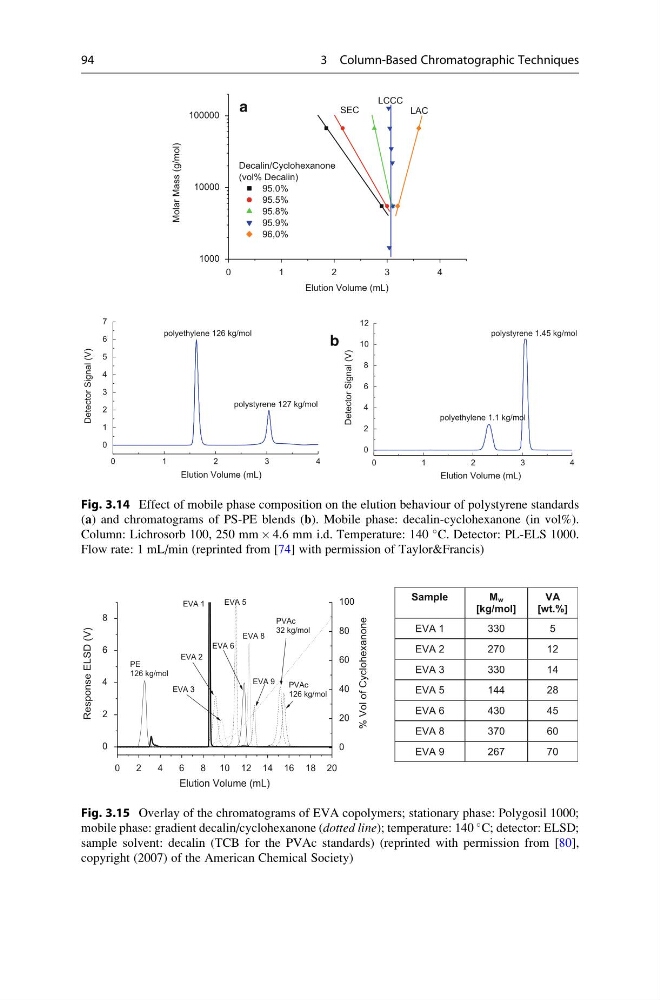
Fig. 3.14 Effect of mobile phase composition on the elution behaviour of polystyrene standards
(a) and chromatograms of PS-PE blends (b). Mobile phase: decalin-cyclohexanone (in vol%).
Column: Lichrosorb 100, 250 mm  4.6 mm i.d. Temperature: 140
C. Detector: PL-ELS 1000.
Flow rate: 1 mL/min (reprinted from [74] with permission of Taylor&Francis)
0
2
4
6
8 10 12 14 16 18 20
0
2
4
6
8
0
20
40
60
80
100
PVAc
126 kg/mol
PVAc
32 kg/mol
Response ELSD (V)
Elution Volume (mL)
PE
126 kg/mol
EVA 1
EVA 2
EVA 3
EVA 5
EVA 6
EVA 8
EVA 9
% Vol of Cyclohexanone
Sample
M w
[kg/mol]
VA
[wt.%]
EVA 1
330
5
EVA 2
270
12
EVA 3
330
14
EVA 5
144
28
EVA 6
430
45
EVA 8
370
60
EVA 9
267
70
Fig. 3.15 Overlay of the chromatograms of EVA copolymers; stationary phase: Polygosil 1000;
mobile phase: gradient decalin/cyclohexanone (dotted line); temperature: 140
C; detector: ELSD;
sample solvent: decalin (TCB for the PVAc standards) (reprinted with permission from [80],
copyright (2007) of the American Chemical Society)
94
3 Column-Based Chromatographic Techniques
1
2
3
4
1000
10000
100000
LAC
LCCC
SEC
Decalin/Cyclohexanone
(vol% Decalin)
95.0%
95.5%
95.8%
95.9%
96,0%
Molar Mass (g/mol)
Elution Volume (mL)
0
1
2
3
4
0
1
2
3
4
5
6
7
polystyrene 127 kg/mol
polyethylene 126 kg/mol
Detector Signal (V)
Elution Volume (mL)
0
1
2
3
4
0
2
4
6
8
10
12
polystyrene 1.45 kg/mol
polyethylene 1.1 kg/mol
Detector Signal (V)
Elution Volume (mL)
a
b
Fig. 3.14 Effect of mobile phase composition on the elution behaviour of polystyrene standards
(a) and chromatograms of PS-PE blends (b). Mobile phase: decalin-cyclohexanone (in vol%).
Column: Lichrosorb 100, 250 mm  4.6 mm i.d. Temperature: 140
C. Detector: PL-ELS 1000.
Flow rate: 1 mL/min (reprinted from [74] with permission of Taylor&Francis)
0
2
4
6
8 10 12 14 16 18 20
0
2
4
6
8
0
20
40
60
80
100
PVAc
126 kg/mol
PVAc
32 kg/mol
Response ELSD (V)
Elution Volume (mL)
PE
126 kg/mol
EVA 1
EVA 2
EVA 3
EVA 5
EVA 6
EVA 8
EVA 9
% Vol of Cyclohexanone
Sample
M w
[kg/mol]
VA
[wt.%]
EVA 1
330
5
EVA 2
270
12
EVA 3
330
14
EVA 5
144
28
EVA 6
430
45
EVA 8
370
60
EVA 9
267
70
Fig. 3.15 Overlay of the chromatograms of EVA copolymers; stationary phase: Polygosil 1000;
mobile phase: gradient decalin/cyclohexanone (dotted line); temperature: 140
C; detector: ELSD;
sample solvent: decalin (TCB for the PVAc standards) (reprinted with permission from [80],
copyright (2007) of the American Chemical Society)
94
3 Column-Based Chromatographic Techniques