

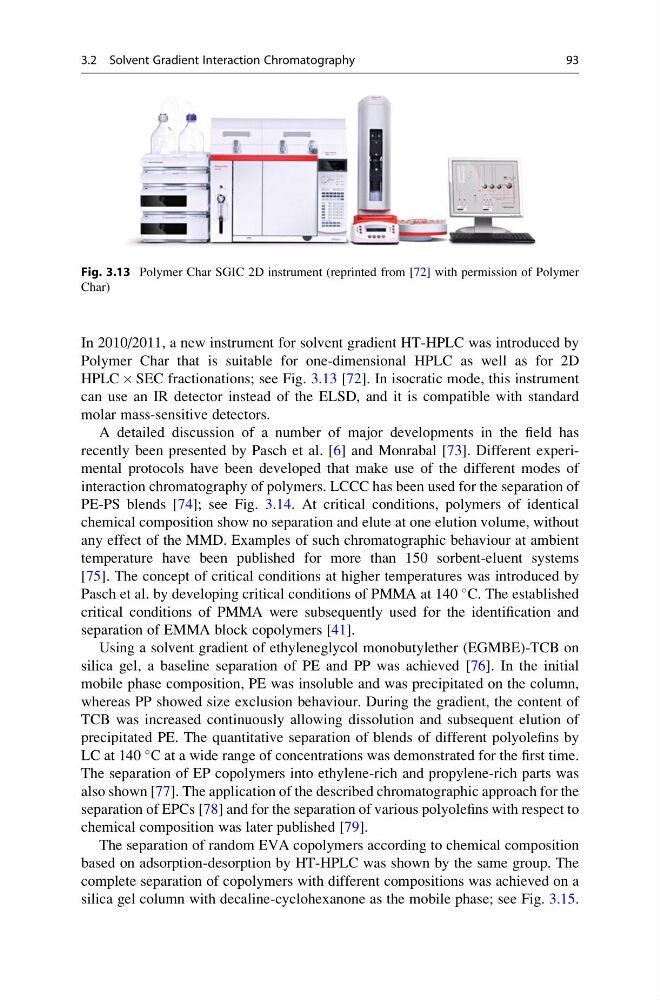
In 2010/2011, a new instrument for solvent gradient HT-HPLC was introduced by
Polymer Char that is suitable for one-dimensional HPLC as well as for 2D
HPLC Â SEC fractionations; see Fig. 3.13 [72]. In isocratic mode, this instrument
can use an IR detector instead of the ELSD, and it is compatible with standard
molar mass-sensitive detectors.
A detailed discussion of a number of major developments in the field has
recently been presented by Pasch et al. [6] and Monrabal [73]. Different experimental protocols have been developed that make use of the different modes of
interaction chromatography of polymers. LCCC has been used for the separation of
PE-PS blends [74]; see Fig. 3.14. At critical conditions, polymers of identical
chemical composition show no separation and elute at one elution volume, without
any effect of the MMD. Examples of such chromatographic behaviour at ambient
temperature have been published for more than 150 sorbent-eluent systems
[75]. The concept of critical conditions at higher temperatures was introduced by
Pasch et al. by developing critical conditions of PMMA at 140
C. The established
critical conditions of PMMA were subsequently used for the identification and
separation of EMMA block copolymers [41].
Using a solvent gradient of ethyleneglycol monobutylether (EGMBE)-TCB on
silica gel, a baseline separation of PE and PP was achieved [76]. In the initial
mobile phase composition, PE was insoluble and was precipitated on the column,
whereas PP showed size exclusion behaviour. During the gradient, the content of
TCB was increased continuously allowing dissolution and subsequent elution of
precipitated PE. The quantitative separation of blends of different polyolefins by
LC at 140
C at a wide range of concentrations was demonstrated for the first time.
The separation of EP copolymers into ethylene-rich and propylene-rich parts was
also shown [77]. The application of the described chromatographic approach for the
separation of EPCs [78] and for the separation of various polyolefins with respect to
chemical composition was later published [79].
The separation of random EVA copolymers according to chemical composition
based on adsorption-desorption by HT-HPLC was shown by the same group. The
complete separation of copolymers with different compositions was achieved on a
silica gel column with decaline-cyclohexanone as the mobile phase; see Fig. 3.15.
Fig. 3.13 Polymer Char SGIC 2D instrument (reprinted from [72] with permission of Polymer
Char)
3.2 Solvent Gradient Interaction Chromatography
93
Polymer Char that is suitable for one-dimensional HPLC as well as for 2D
HPLC Â SEC fractionations; see Fig. 3.13 [72]. In isocratic mode, this instrument
can use an IR detector instead of the ELSD, and it is compatible with standard
molar mass-sensitive detectors.
A detailed discussion of a number of major developments in the field has
recently been presented by Pasch et al. [6] and Monrabal [73]. Different experimental protocols have been developed that make use of the different modes of
interaction chromatography of polymers. LCCC has been used for the separation of
PE-PS blends [74]; see Fig. 3.14. At critical conditions, polymers of identical
chemical composition show no separation and elute at one elution volume, without
any effect of the MMD. Examples of such chromatographic behaviour at ambient
temperature have been published for more than 150 sorbent-eluent systems
[75]. The concept of critical conditions at higher temperatures was introduced by
Pasch et al. by developing critical conditions of PMMA at 140
C. The established
critical conditions of PMMA were subsequently used for the identification and
separation of EMMA block copolymers [41].
Using a solvent gradient of ethyleneglycol monobutylether (EGMBE)-TCB on
silica gel, a baseline separation of PE and PP was achieved [76]. In the initial
mobile phase composition, PE was insoluble and was precipitated on the column,
whereas PP showed size exclusion behaviour. During the gradient, the content of
TCB was increased continuously allowing dissolution and subsequent elution of
precipitated PE. The quantitative separation of blends of different polyolefins by
LC at 140
C at a wide range of concentrations was demonstrated for the first time.
The separation of EP copolymers into ethylene-rich and propylene-rich parts was
also shown [77]. The application of the described chromatographic approach for the
separation of EPCs [78] and for the separation of various polyolefins with respect to
chemical composition was later published [79].
The separation of random EVA copolymers according to chemical composition
based on adsorption-desorption by HT-HPLC was shown by the same group. The
complete separation of copolymers with different compositions was achieved on a
silica gel column with decaline-cyclohexanone as the mobile phase; see Fig. 3.15.
Fig. 3.13 Polymer Char SGIC 2D instrument (reprinted from [72] with permission of Polymer
Char)
3.2 Solvent Gradient Interaction Chromatography
93