

significant retention of PP and PE was also observed [69]. A summary of the elution
behaviours of PP and PE on different column packings is given in [70].
Early investigations were conducted on instruments for HT-SEC where a mixed
mobile phase was delivered isocratically or a solvent gradient was formed by
adding a second HPLC pump to the system. The reproducibility of this experimental set-up was rather low and a technically more advanced instrument was required
that possesses the flexibility to conduct both isocratic and solvent gradient
separations under reproducible conditions.
The recovery of high molar mass polymers is often a problem; it requires
gradient elution to ensure complete elution and full recovery. The first instrument
that allowed solvent gradients while working at higher temperatures was introduced
in 2004 after joint efforts of Polymer Laboratories, Ltd. (Church Stretton, England)
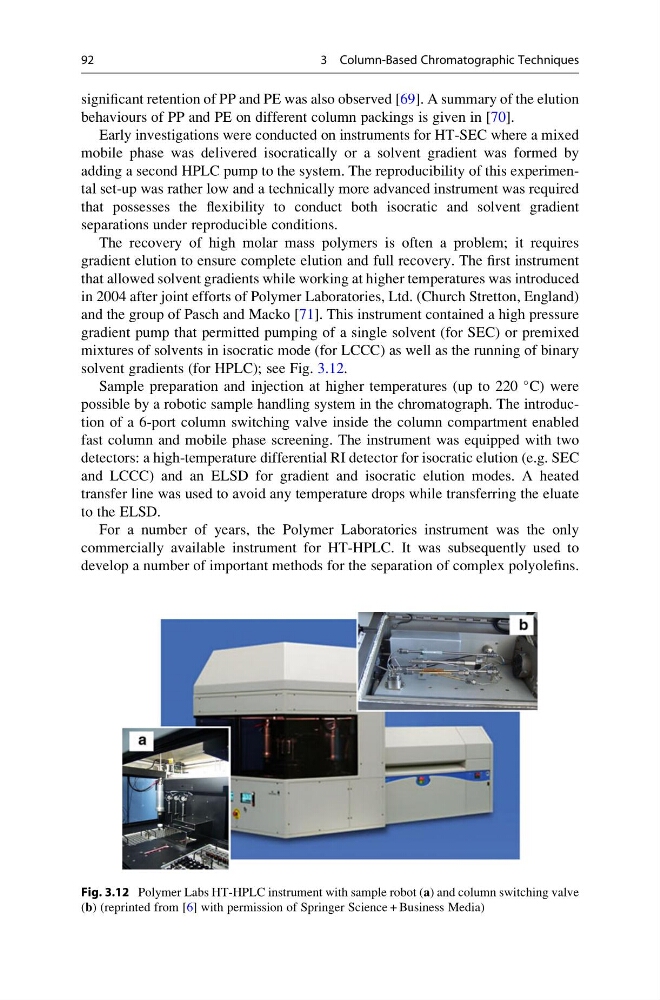
and the group of Pasch and Macko [71]. This instrument contained a high pressure
gradient pump that permitted pumping of a single solvent (for SEC) or premixed
mixtures of solvents in isocratic mode (for LCCC) as well as the running of binary
solvent gradients (for HPLC); see Fig. 3.12.
Sample preparation and injection at higher temperatures (up to 220
C) were
possible by a robotic sample handling system in the chromatograph. The introduction of a 6-port column switching valve inside the column compartment enabled
fast column and mobile phase screening. The instrument was equipped with two
detectors: a high-temperature differential RI detector for isocratic elution (e.g. SEC
and LCCC) and an ELSD for gradient and isocratic elution modes. A heated
transfer line was used to avoid any temperature drops while transferring the eluate
to the ELSD.
For a number of years, the Polymer Laboratories instrument was the only
commercially available instrument for HT-HPLC. It was subsequently used to
develop a number of important methods for the separation of complex polyolefins.
Fig. 3.12 Polymer Labs HT-HPLC instrument with sample robot (a) and column switching valve
(b) (reprinted from [6] with permission of Springer Science + Business Media)
92
3 Column-Based Chromatographic Techniques
behaviours of PP and PE on different column packings is given in [70].
Early investigations were conducted on instruments for HT-SEC where a mixed
mobile phase was delivered isocratically or a solvent gradient was formed by
adding a second HPLC pump to the system. The reproducibility of this experimental set-up was rather low and a technically more advanced instrument was required
that possesses the flexibility to conduct both isocratic and solvent gradient
separations under reproducible conditions.
The recovery of high molar mass polymers is often a problem; it requires
gradient elution to ensure complete elution and full recovery. The first instrument
that allowed solvent gradients while working at higher temperatures was introduced
in 2004 after joint efforts of Polymer Laboratories, Ltd. (Church Stretton, England)
and the group of Pasch and Macko [71]. This instrument contained a high pressure
gradient pump that permitted pumping of a single solvent (for SEC) or premixed
mixtures of solvents in isocratic mode (for LCCC) as well as the running of binary
solvent gradients (for HPLC); see Fig. 3.12.
Sample preparation and injection at higher temperatures (up to 220
C) were
possible by a robotic sample handling system in the chromatograph. The introduction of a 6-port column switching valve inside the column compartment enabled
fast column and mobile phase screening. The instrument was equipped with two
detectors: a high-temperature differential RI detector for isocratic elution (e.g. SEC
and LCCC) and an ELSD for gradient and isocratic elution modes. A heated
transfer line was used to avoid any temperature drops while transferring the eluate
to the ELSD.
For a number of years, the Polymer Laboratories instrument was the only
commercially available instrument for HT-HPLC. It was subsequently used to
develop a number of important methods for the separation of complex polyolefins.
Fig. 3.12 Polymer Labs HT-HPLC instrument with sample robot (a) and column switching valve
(b) (reprinted from [6] with permission of Springer Science + Business Media)
92
3 Column-Based Chromatographic Techniques