

The method allowed the separation of copolymers from the respective PE and PVA
homopolymers. This was a breakthrough in the analysis of polyolefins as it allowed
separation of olefin copolymers with regard to chemical composition irrespective of
their crystalline or amorphous nature. The entire range of chemical compositions
was covered, contrary to traditional crystallization-based techniques that work only
for the crystalline part. Both PE and PVAc were soluble in the components of the
binary mobile phase. The nonpolar component of the mobile phase, decalin,
promoted adsorption of PVAc on silica gel. Cyclohexanone, on the other hand, is
a polar solvent that promoted desorption and elution of the adsorbed polymer
species [80]. The coupling of this highly selective copolymer separation with
FTIR spectroscopy revealed the CCD of the samples. The LC-Transform interface
was employed for the hyphenation of LC to FTIR [81].
The most important achievement, however, was the discovery by Macko and
Pasch that a specific carbon-based stationary phase—Hypercarb [82]—enables
highly selective separations of polyolefins. Hypercarb was originally developed
by Knox and co-workers [83] and had been used in HPLC analysis of small
molecules; it was, however, never applied to the separation of synthetic polymers.
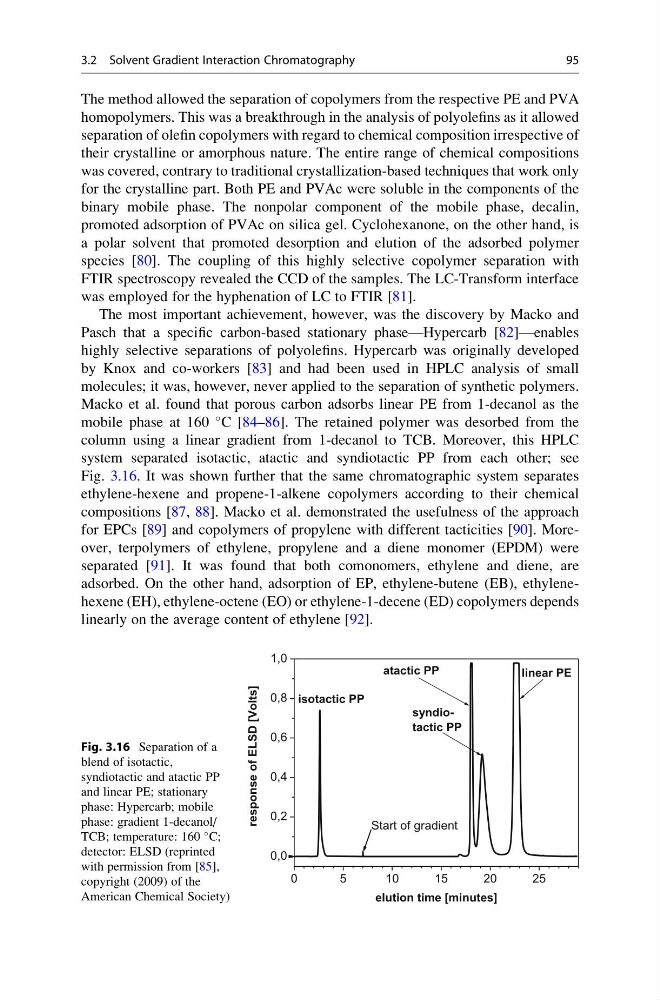
Macko et al. found that porous carbon adsorbs linear PE from 1-decanol as the
mobile phase at 160
C [84–86]. The retained polymer was desorbed from the
column using a linear gradient from 1-decanol to TCB. Moreover, this HPLC
system separated isotactic, atactic and syndiotactic PP from each other; see
Fig. 3.16. It was shown further that the same chromatographic system separates
ethylene-hexene and propene-1-alkene copolymers according to their chemical
compositions [87, 88]. Macko et al. demonstrated the usefulness of the approach
for EPCs [89] and copolymers of propylene with different tacticities [90]. Moreover, terpolymers of ethylene, propylene and a diene monomer (EPDM) were
separated [91]. It was found that both comonomers, ethylene and diene, are
adsorbed. On the other hand, adsorption of EP, ethylene-butene (EB), ethylenehexene (EH), ethylene-octene (EO) or ethylene-1-decene (ED) copolymers depends
linearly on the average content of ethylene [92].
0
5
10
15
20
25
0,0
0,2
0,4
0,6
0,8
1,0
isotactic PP
linear PE
syndiotactic PP
response of ELSD [Volts]
elution time [minutes]
atactic PP
Start of gradient
Fig. 3.16 Separation of a
blend of isotactic,
syndiotactic and atactic PP
and linear PE; stationary
phase: Hypercarb; mobile
phase: gradient 1-decanol/
TCB; temperature: 160
C;
detector: ELSD (reprinted
with permission from [85],
copyright (2009) of the
American Chemical Society)
3.2 Solvent Gradient Interaction Chromatography
95
homopolymers. This was a breakthrough in the analysis of polyolefins as it allowed
separation of olefin copolymers with regard to chemical composition irrespective of
their crystalline or amorphous nature. The entire range of chemical compositions
was covered, contrary to traditional crystallization-based techniques that work only
for the crystalline part. Both PE and PVAc were soluble in the components of the
binary mobile phase. The nonpolar component of the mobile phase, decalin,
promoted adsorption of PVAc on silica gel. Cyclohexanone, on the other hand, is
a polar solvent that promoted desorption and elution of the adsorbed polymer
species [80]. The coupling of this highly selective copolymer separation with
FTIR spectroscopy revealed the CCD of the samples. The LC-Transform interface
was employed for the hyphenation of LC to FTIR [81].
The most important achievement, however, was the discovery by Macko and
Pasch that a specific carbon-based stationary phase—Hypercarb [82]—enables
highly selective separations of polyolefins. Hypercarb was originally developed
by Knox and co-workers [83] and had been used in HPLC analysis of small
molecules; it was, however, never applied to the separation of synthetic polymers.
Macko et al. found that porous carbon adsorbs linear PE from 1-decanol as the
mobile phase at 160
C [84–86]. The retained polymer was desorbed from the
column using a linear gradient from 1-decanol to TCB. Moreover, this HPLC
system separated isotactic, atactic and syndiotactic PP from each other; see
Fig. 3.16. It was shown further that the same chromatographic system separates
ethylene-hexene and propene-1-alkene copolymers according to their chemical
compositions [87, 88]. Macko et al. demonstrated the usefulness of the approach
for EPCs [89] and copolymers of propylene with different tacticities [90]. Moreover, terpolymers of ethylene, propylene and a diene monomer (EPDM) were
separated [91]. It was found that both comonomers, ethylene and diene, are
adsorbed. On the other hand, adsorption of EP, ethylene-butene (EB), ethylenehexene (EH), ethylene-octene (EO) or ethylene-1-decene (ED) copolymers depends
linearly on the average content of ethylene [92].
0
5
10
15
20
25
0,0
0,2
0,4
0,6
0,8
1,0
isotactic PP
linear PE
syndiotactic PP
response of ELSD [Volts]
elution time [minutes]
atactic PP
Start of gradient
Fig. 3.16 Separation of a
blend of isotactic,
syndiotactic and atactic PP
and linear PE; stationary
phase: Hypercarb; mobile
phase: gradient 1-decanol/
TCB; temperature: 160
C;
detector: ELSD (reprinted
with permission from [85],
copyright (2009) of the
American Chemical Society)
3.2 Solvent Gradient Interaction Chromatography
95