

3.1.3.5 Analysis of the PE-PMMA Block Copolymer
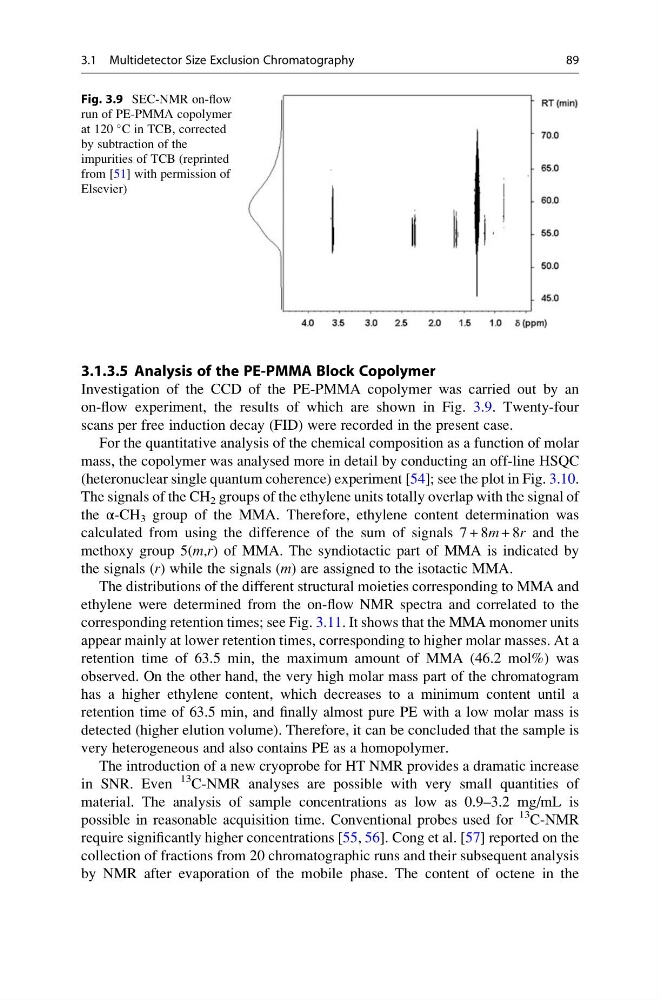
Investigation of the CCD of the PE-PMMA copolymer was carried out by an
on-flow experiment, the results of which are shown in Fig. 3.9. Twenty-four
scans per free induction decay (FID) were recorded in the present case.
For the quantitative analysis of the chemical composition as a function of molar
mass, the copolymer was analysed more in detail by conducting an off-line HSQC
(heteronuclear single quantum coherence) experiment [54]; see the plot in Fig. 3.10.
The signals of the CH 2 groups of the ethylene units totally overlap with the signal of
the α-CH 3 group of the MMA. Therefore, ethylene content determination was
calculated from using the difference of the sum of signals 7 + 8m + 8r and the
methoxy group 5(m,r) of MMA. The syndiotactic part of MMA is indicated by
the signals (r) while the signals (m) are assigned to the isotactic MMA.
The distributions of the different structural moieties corresponding to MMA and
ethylene were determined from the on-flow NMR spectra and correlated to the
corresponding retention times; see Fig. 3.11. It shows that the MMA monomer units
appear mainly at lower retention times, corresponding to higher molar masses. At a
retention time of 63.5 min, the maximum amount of MMA (46.2 mol%) was
observed. On the other hand, the very high molar mass part of the chromatogram
has a higher ethylene content, which decreases to a minimum content until a
retention time of 63.5 min, and finally almost pure PE with a low molar mass is
detected (higher elution volume). Therefore, it can be concluded that the sample is
very heterogeneous and also contains PE as a homopolymer.
The introduction of a new cryoprobe for HT NMR provides a dramatic increase
in SNR. Even
13 C-NMR analyses are possible with very small quantities of
material. The analysis of sample concentrations as low as 0.9–3.2 mg/mL is
possible in reasonable acquisition time. Conventional probes used for
13 C-NMR
require significantly higher concentrations [55, 56]. Cong et al. [57] reported on the
collection of fractions from 20 chromatographic runs and their subsequent analysis
by NMR after evaporation of the mobile phase. The content of octene in the
Fig. 3.9 SEC-NMR on-flow
run of PE-PMMA copolymer
at 120
C in TCB, corrected
by subtraction of the
impurities of TCB (reprinted
from [51] with permission of
Elsevier)
3.1 Multidetector Size Exclusion Chromatography
89
Investigation of the CCD of the PE-PMMA copolymer was carried out by an
on-flow experiment, the results of which are shown in Fig. 3.9. Twenty-four
scans per free induction decay (FID) were recorded in the present case.
For the quantitative analysis of the chemical composition as a function of molar
mass, the copolymer was analysed more in detail by conducting an off-line HSQC
(heteronuclear single quantum coherence) experiment [54]; see the plot in Fig. 3.10.
The signals of the CH 2 groups of the ethylene units totally overlap with the signal of
the α-CH 3 group of the MMA. Therefore, ethylene content determination was
calculated from using the difference of the sum of signals 7 + 8m + 8r and the
methoxy group 5(m,r) of MMA. The syndiotactic part of MMA is indicated by
the signals (r) while the signals (m) are assigned to the isotactic MMA.
The distributions of the different structural moieties corresponding to MMA and
ethylene were determined from the on-flow NMR spectra and correlated to the
corresponding retention times; see Fig. 3.11. It shows that the MMA monomer units
appear mainly at lower retention times, corresponding to higher molar masses. At a
retention time of 63.5 min, the maximum amount of MMA (46.2 mol%) was
observed. On the other hand, the very high molar mass part of the chromatogram
has a higher ethylene content, which decreases to a minimum content until a
retention time of 63.5 min, and finally almost pure PE with a low molar mass is
detected (higher elution volume). Therefore, it can be concluded that the sample is
very heterogeneous and also contains PE as a homopolymer.
The introduction of a new cryoprobe for HT NMR provides a dramatic increase
in SNR. Even
13 C-NMR analyses are possible with very small quantities of
material. The analysis of sample concentrations as low as 0.9–3.2 mg/mL is
possible in reasonable acquisition time. Conventional probes used for
13 C-NMR
require significantly higher concentrations [55, 56]. Cong et al. [57] reported on the
collection of fractions from 20 chromatographic runs and their subsequent analysis
by NMR after evaporation of the mobile phase. The content of octene in the
Fig. 3.9 SEC-NMR on-flow
run of PE-PMMA copolymer
at 120
C in TCB, corrected
by subtraction of the
impurities of TCB (reprinted
from [51] with permission of
Elsevier)
3.1 Multidetector Size Exclusion Chromatography
89