

transformation mixture on LB agar plates containing the
appropriate antibiotic and incubate overnight at 37
C. If all
steps were successful, there will be no or little colonies in the
negative control and at least one order of magnitude more
colonies in the experiment.
11. Purify plasmid DNA from six colonies for restriction analysis
and sequencing.
4 Notes
1. E. coli strain Pir1 (F-Δlac169 rpoS(Am) robA1 creC510
hsdR514 endA recA1 uidA(ΔMluI)::pir-116) or Pir2
(F-Δlac169 rpoS(Am) robA1 creC510 hsdR514 endA recA1
uidA(ΔMluI)::pir) is for use with vectors that contain the R6Kγ
origin of replication. The pir gene encodes the replication
protein π, which is required to replicate and maintain plasmids
containing the R6Kγ origin. Other strains including BW23473
or BW23474 can also be used.
2. Refer to general guidelines for primer selection [21] and/or
use a primer design tool available from vector mapping software or web-services (SnapGene or NEBuilder for the
planning of homology-based cloning projects and RF-Clon
ing.org for designing hybrid RF cloning primers). Also check
the propensity of the primers to form dimers or secondary
structures. Structures with a ΔG greater than À6 kcal/mole
suggest that redesign may be required.
3. It is important to have a sharp, specific PCR band for the SLIC
reaction. Gel purification of PCR products considerably
reduces the amount and the purity of the DNA. Large and
difficult-to-amplify cDNAs (more than 2 kb) can be splitted
into smaller fragments which are easier to prepare and can be
assembled more efficiently by SLIC.
4. Incubation time controls the formation of compatible singlestranded ends and is thus a critical parameter for T4 polymerase
treatment. Do not hesitate to optimize the amount of T4 DNA
polymerase and incubation time when a new batch of polymerase is used or when the overhang length between PCR products and vector is changed.
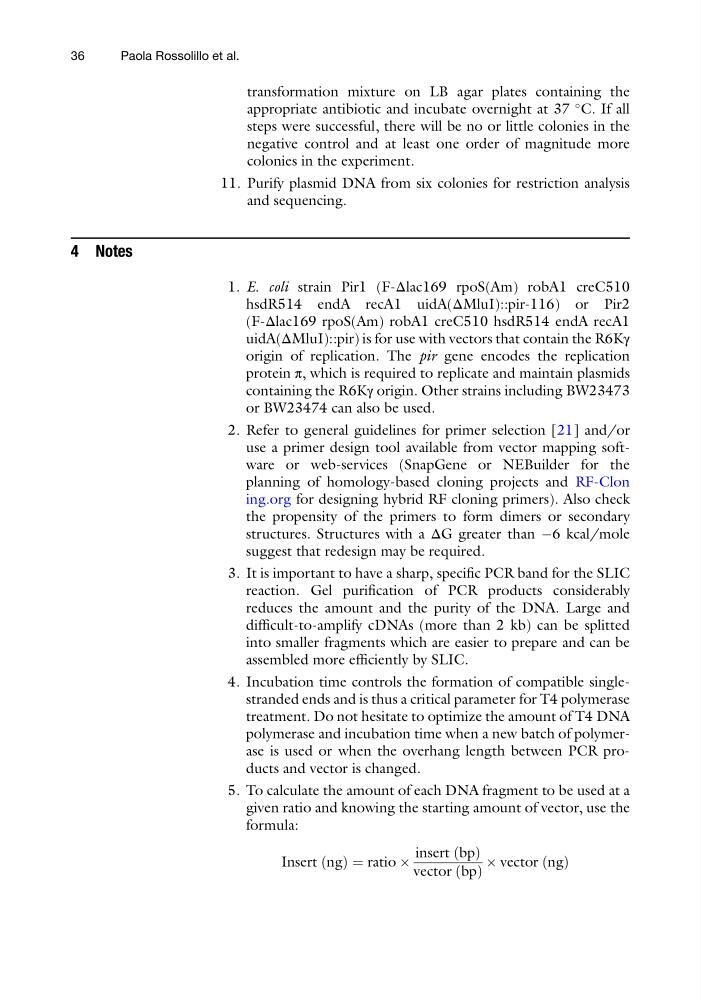
5. To calculate the amount of each DNA fragment to be used at a
given ratio and knowing the starting amount of vector, use the
formula:
Insert ng
ð Þ ¼ ratio Â
insert bp
ð Þ
vector bp
ð Þ
 vector ng
ð Þ
36
Paola Rossolillo et al.
appropriate antibiotic and incubate overnight at 37
C. If all
steps were successful, there will be no or little colonies in the
negative control and at least one order of magnitude more
colonies in the experiment.
11. Purify plasmid DNA from six colonies for restriction analysis
and sequencing.
4 Notes
1. E. coli strain Pir1 (F-Δlac169 rpoS(Am) robA1 creC510
hsdR514 endA recA1 uidA(ΔMluI)::pir-116) or Pir2
(F-Δlac169 rpoS(Am) robA1 creC510 hsdR514 endA recA1
uidA(ΔMluI)::pir) is for use with vectors that contain the R6Kγ
origin of replication. The pir gene encodes the replication
protein π, which is required to replicate and maintain plasmids
containing the R6Kγ origin. Other strains including BW23473
or BW23474 can also be used.
2. Refer to general guidelines for primer selection [21] and/or
use a primer design tool available from vector mapping software or web-services (SnapGene or NEBuilder for the
planning of homology-based cloning projects and RF-Clon
ing.org for designing hybrid RF cloning primers). Also check
the propensity of the primers to form dimers or secondary
structures. Structures with a ΔG greater than À6 kcal/mole
suggest that redesign may be required.
3. It is important to have a sharp, specific PCR band for the SLIC
reaction. Gel purification of PCR products considerably
reduces the amount and the purity of the DNA. Large and
difficult-to-amplify cDNAs (more than 2 kb) can be splitted
into smaller fragments which are easier to prepare and can be
assembled more efficiently by SLIC.
4. Incubation time controls the formation of compatible singlestranded ends and is thus a critical parameter for T4 polymerase
treatment. Do not hesitate to optimize the amount of T4 DNA
polymerase and incubation time when a new batch of polymerase is used or when the overhang length between PCR products and vector is changed.
5. To calculate the amount of each DNA fragment to be used at a
given ratio and knowing the starting amount of vector, use the
formula:
Insert ng
ð Þ ¼ ratio Â
insert bp
ð Þ
vector bp
ð Þ
 vector ng
ð Þ
36
Paola Rossolillo et al.