

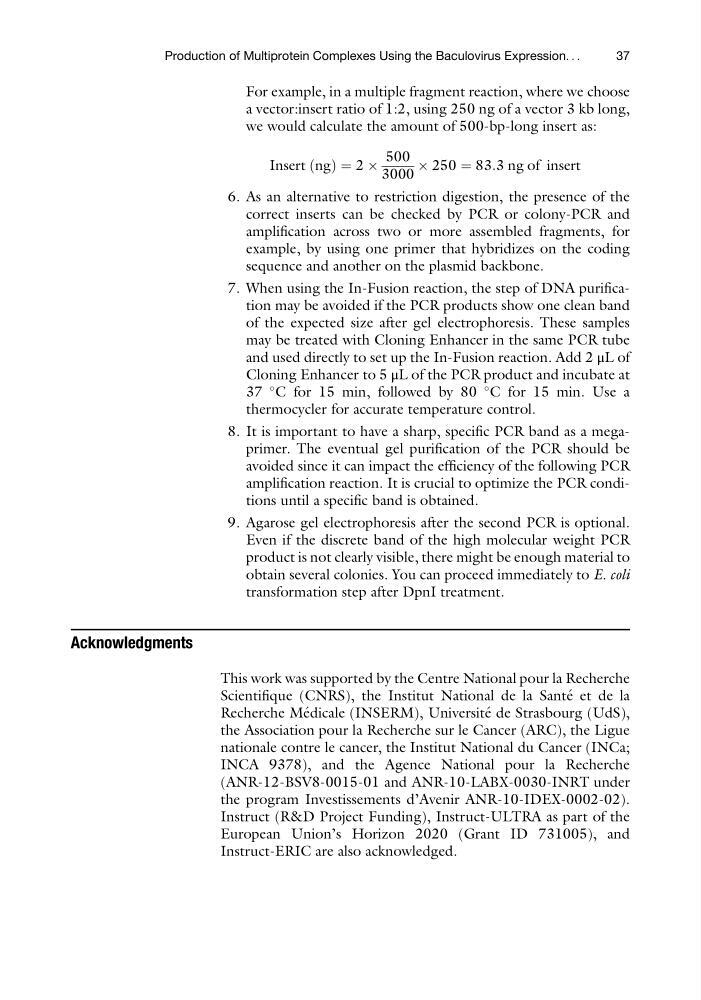
For example, in a multiple fragment reaction, where we choose
a vector:insert ratio of 1:2, using 250 ng of a vector 3 kb long,
we would calculate the amount of 500-bp-long insert as:
Insert ng
ð Þ ¼ 2 Â
500
3000
 250 ¼ 83:3 ng of insert
6. As an alternative to restriction digestion, the presence of the
correct inserts can be checked by PCR or colony-PCR and
amplification across two or more assembled fragments, for
example, by using one primer that hybridizes on the coding
sequence and another on the plasmid backbone.
7. When using the In-Fusion reaction, the step of DNA purification may be avoided if the PCR products show one clean band
of the expected size after gel electrophoresis. These samples
may be treated with Cloning Enhancer in the same PCR tube
and used directly to set up the In-Fusion reaction. Add 2 μL of
Cloning Enhancer to 5 μL of the PCR product and incubate at
37
C for 15 min, followed by 80
C for 15 min. Use a
thermocycler for accurate temperature control.
8. It is important to have a sharp, specific PCR band as a megaprimer. The eventual gel purification of the PCR should be
avoided since it can impact the efficiency of the following PCR
amplification reaction. It is crucial to optimize the PCR conditions until a specific band is obtained.
9. Agarose gel electrophoresis after the second PCR is optional.
Even if the discrete band of the high molecular weight PCR
product is not clearly visible, there might be enough material to
obtain several colonies. You can proceed immediately to E. coli
transformation step after DpnI treatment.
Acknowledgments
This work was supported by the Centre National pour la Recherche
Scientifique (CNRS), the Institut National de la Sante ´ et de la
Recherche Me ´dicale (INSERM), Universite ´ de Strasbourg (UdS),
the Association pour la Recherche sur le Cancer (ARC), the Ligue
nationale contre le cancer, the Institut National du Cancer (INCa;
INCA 9378), and the Agence National pour la Recherche
(ANR-12-BSV8-0015-01 and ANR-10-LABX-0030-INRT under
the program Investissements d’Avenir ANR-10-IDEX-0002-02).
Instruct (R&D Project Funding), Instruct-ULTRA as part of the
European Union’s Horizon 2020 (Grant ID 731005), and
Instruct-ERIC are also acknowledged.
Production of Multiprotein Complexes Using the Baculovirus Expression. . .
37
a vector:insert ratio of 1:2, using 250 ng of a vector 3 kb long,
we would calculate the amount of 500-bp-long insert as:
Insert ng
ð Þ ¼ 2 Â
500
3000
 250 ¼ 83:3 ng of insert
6. As an alternative to restriction digestion, the presence of the
correct inserts can be checked by PCR or colony-PCR and
amplification across two or more assembled fragments, for
example, by using one primer that hybridizes on the coding
sequence and another on the plasmid backbone.
7. When using the In-Fusion reaction, the step of DNA purification may be avoided if the PCR products show one clean band
of the expected size after gel electrophoresis. These samples
may be treated with Cloning Enhancer in the same PCR tube
and used directly to set up the In-Fusion reaction. Add 2 μL of
Cloning Enhancer to 5 μL of the PCR product and incubate at
37
C for 15 min, followed by 80
C for 15 min. Use a
thermocycler for accurate temperature control.
8. It is important to have a sharp, specific PCR band as a megaprimer. The eventual gel purification of the PCR should be
avoided since it can impact the efficiency of the following PCR
amplification reaction. It is crucial to optimize the PCR conditions until a specific band is obtained.
9. Agarose gel electrophoresis after the second PCR is optional.
Even if the discrete band of the high molecular weight PCR
product is not clearly visible, there might be enough material to
obtain several colonies. You can proceed immediately to E. coli
transformation step after DpnI treatment.
Acknowledgments
This work was supported by the Centre National pour la Recherche
Scientifique (CNRS), the Institut National de la Sante ´ et de la
Recherche Me ´dicale (INSERM), Universite ´ de Strasbourg (UdS),
the Association pour la Recherche sur le Cancer (ARC), the Ligue
nationale contre le cancer, the Institut National du Cancer (INCa;
INCA 9378), and the Agence National pour la Recherche
(ANR-12-BSV8-0015-01 and ANR-10-LABX-0030-INRT under
the program Investissements d’Avenir ANR-10-IDEX-0002-02).
Instruct (R&D Project Funding), Instruct-ULTRA as part of the
European Union’s Horizon 2020 (Grant ID 731005), and
Instruct-ERIC are also acknowledged.
Production of Multiprotein Complexes Using the Baculovirus Expression. . .
37