

3.4 In-Fusion
Reaction with pOPIN
Vectors
Ligation of the PCR products with linearized pOPIN vectors were
performed according to the manufacturer’s recommendations
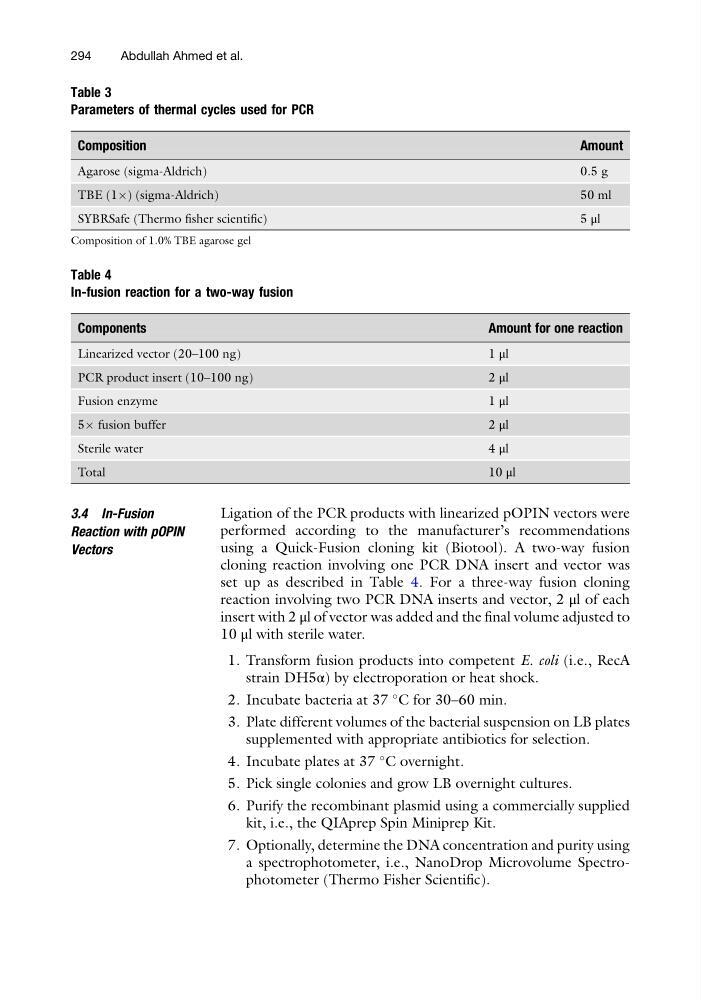
using a Quick-Fusion cloning kit (Biotool). A two-way fusion
cloning reaction involving one PCR DNA insert and vector was
set up as described in Table 4. For a three-way fusion cloning
reaction involving two PCR DNA inserts and vector, 2 μl of each
insert with 2 μl of vector was added and the final volume adjusted to
10 μl with sterile water.
1. Transform fusion products into competent E. coli (i.e., RecA
strain DH5α) by electroporation or heat shock.
2. Incubate bacteria at 37
C for 30–60 min.
3. Plate different volumes of the bacterial suspension on LB plates
supplemented with appropriate antibiotics for selection.
4. Incubate plates at 37
C overnight.
5. Pick single colonies and grow LB overnight cultures.
6. Purify the recombinant plasmid using a commercially supplied
kit, i.e., the QIAprep Spin Miniprep Kit.
7. Optionally, determine the DNA concentration and purity using
a spectrophotometer, i.e., NanoDrop Microvolume Spectrophotometer (Thermo Fisher Scientific).
Table 3
Parameters of thermal cycles used for PCR
Composition
Amount
Agarose (sigma-Aldrich)
0.5 g
TBE (1Â) (sigma-Aldrich)
50 ml
SYBRSafe (Thermo fisher scientific)
5 μl
Composition of 1.0% TBE agarose gel
Table 4
In-fusion reaction for a two-way fusion
Components
Amount for one reaction
Linearized vector (20–100 ng)
1 μl
PCR product insert (10–100 ng)
2 μl
Fusion enzyme
1 μl
5Â fusion buffer
2 μl
Sterile water
4 μl
Total
10 μl
294
Abdullah Ahmed et al.
Reaction with pOPIN
Vectors
Ligation of the PCR products with linearized pOPIN vectors were
performed according to the manufacturer’s recommendations
using a Quick-Fusion cloning kit (Biotool). A two-way fusion
cloning reaction involving one PCR DNA insert and vector was
set up as described in Table 4. For a three-way fusion cloning
reaction involving two PCR DNA inserts and vector, 2 μl of each
insert with 2 μl of vector was added and the final volume adjusted to
10 μl with sterile water.
1. Transform fusion products into competent E. coli (i.e., RecA
strain DH5α) by electroporation or heat shock.
2. Incubate bacteria at 37
C for 30–60 min.
3. Plate different volumes of the bacterial suspension on LB plates
supplemented with appropriate antibiotics for selection.
4. Incubate plates at 37
C overnight.
5. Pick single colonies and grow LB overnight cultures.
6. Purify the recombinant plasmid using a commercially supplied
kit, i.e., the QIAprep Spin Miniprep Kit.
7. Optionally, determine the DNA concentration and purity using
a spectrophotometer, i.e., NanoDrop Microvolume Spectrophotometer (Thermo Fisher Scientific).
Table 3
Parameters of thermal cycles used for PCR
Composition
Amount
Agarose (sigma-Aldrich)
0.5 g
TBE (1Â) (sigma-Aldrich)
50 ml
SYBRSafe (Thermo fisher scientific)
5 μl
Composition of 1.0% TBE agarose gel
Table 4
In-fusion reaction for a two-way fusion
Components
Amount for one reaction
Linearized vector (20–100 ng)
1 μl
PCR product insert (10–100 ng)
2 μl
Fusion enzyme
1 μl
5Â fusion buffer
2 μl
Sterile water
4 μl
Total
10 μl
294
Abdullah Ahmed et al.