

E ¼
k D!A1 þ k D!A2
k D!A þ k D!A þ
1
τ D
ð3Þ
where E is the efficiency, k is the transfer rate, D is the donor, and τ
is the lifetime.
The cumulative FRET efficiencies in a complex multiplexed
acceptor(s)–donor(s) (Fig. 2) further developed by FRET from
single to multiplexed signaling events [17] can be calculated using
the normalized transfer rates related as:
k
0
T ¼
k T
Γ þ k nr
¼
R 0
R
6
, E ¼
k
0
T
k
0
T þ 1
ð4Þ
where k T is the transferred rate, k
0
T is the normalized transferred
rate, k nr is the non-radiative decay, R is the distance between donor
and acceptor, R 0 is the Fo ¨rster radius, and E is the efficiency.
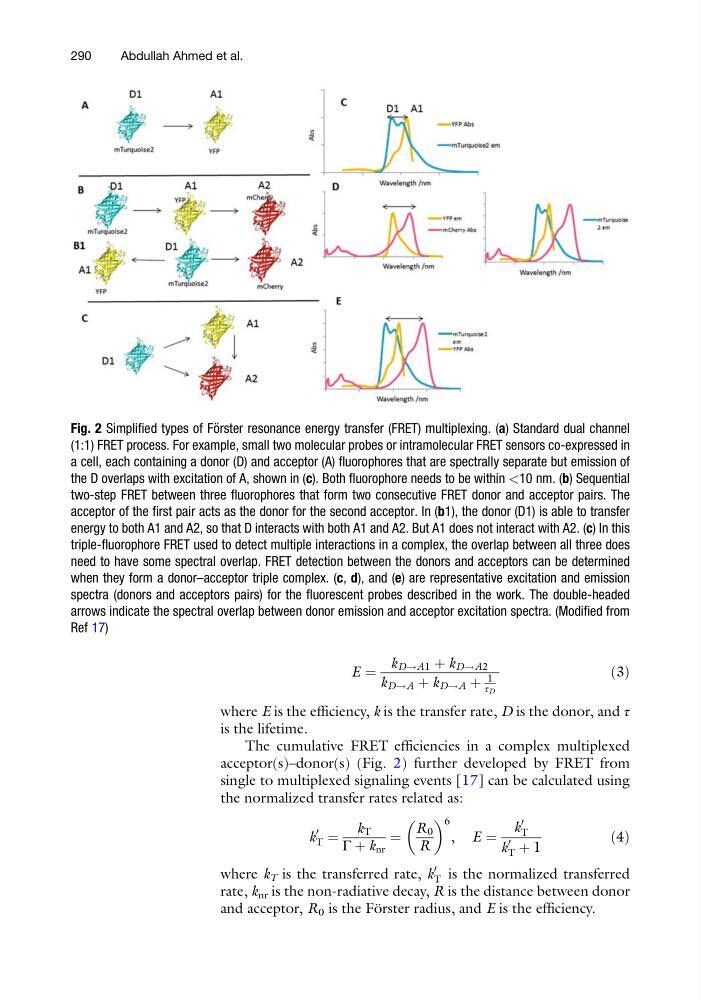
Fig. 2 Simplified types of Fo ¨ rster resonance energy transfer (FRET) multiplexing. (a) Standard dual channel
(1:1) FRET process. For example, small two molecular probes or intramolecular FRET sensors co-expressed in
a cell, each containing a donor (D) and acceptor (A) fluorophores that are spectrally separate but emission of
the D overlaps with excitation of A, shown in (c). Both fluorophore needs to be within <10 nm. (b) Sequential
two-step FRET between three fluorophores that form two consecutive FRET donor and acceptor pairs. The
acceptor of the first pair acts as the donor for the second acceptor. In (b1), the donor (D1) is able to transfer
energy to both A1 and A2, so that D interacts with both A1 and A2. But A1 does not interact with A2. (c) In this
triple-fluorophore FRET used to detect multiple interactions in a complex, the overlap between all three does
need to have some spectral overlap. FRET detection between the donors and acceptors can be determined
when they form a donor–acceptor triple complex. (c, d), and (e) are representative excitation and emission
spectra (donors and acceptors pairs) for the fluorescent probes described in the work. The double-headed
arrows indicate the spectral overlap between donor emission and acceptor excitation spectra. (Modified from
Ref 17)
290
Abdullah Ahmed et al.
k D!A1 þ k D!A2
k D!A þ k D!A þ
1
τ D
ð3Þ
where E is the efficiency, k is the transfer rate, D is the donor, and τ
is the lifetime.
The cumulative FRET efficiencies in a complex multiplexed
acceptor(s)–donor(s) (Fig. 2) further developed by FRET from
single to multiplexed signaling events [17] can be calculated using
the normalized transfer rates related as:
k
0
T ¼
k T
Γ þ k nr
¼
R 0
R
6
, E ¼
k
0
T
k
0
T þ 1
ð4Þ
where k T is the transferred rate, k
0
T is the normalized transferred
rate, k nr is the non-radiative decay, R is the distance between donor
and acceptor, R 0 is the Fo ¨rster radius, and E is the efficiency.
Fig. 2 Simplified types of Fo ¨ rster resonance energy transfer (FRET) multiplexing. (a) Standard dual channel
(1:1) FRET process. For example, small two molecular probes or intramolecular FRET sensors co-expressed in
a cell, each containing a donor (D) and acceptor (A) fluorophores that are spectrally separate but emission of
the D overlaps with excitation of A, shown in (c). Both fluorophore needs to be within <10 nm. (b) Sequential
two-step FRET between three fluorophores that form two consecutive FRET donor and acceptor pairs. The
acceptor of the first pair acts as the donor for the second acceptor. In (b1), the donor (D1) is able to transfer
energy to both A1 and A2, so that D interacts with both A1 and A2. But A1 does not interact with A2. (c) In this
triple-fluorophore FRET used to detect multiple interactions in a complex, the overlap between all three does
need to have some spectral overlap. FRET detection between the donors and acceptors can be determined
when they form a donor–acceptor triple complex. (c, d), and (e) are representative excitation and emission
spectra (donors and acceptors pairs) for the fluorescent probes described in the work. The double-headed
arrows indicate the spectral overlap between donor emission and acceptor excitation spectra. (Modified from
Ref 17)
290
Abdullah Ahmed et al.