

64
J. Kumar V. and K. A. Reddy
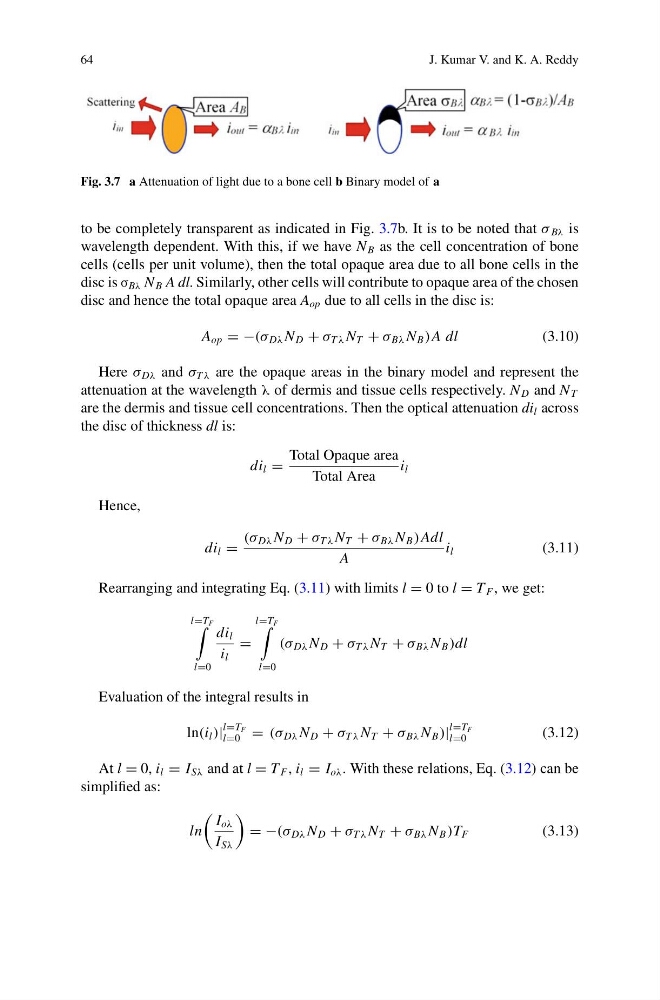
Fig. 3.7 a Attenuation of light due to a bone cell b Binary model of a
to be completely transparent as indicated in Fig. 3.7b. It is to be noted that σ Bλ is
wavelength dependent. With this, if we have N B as the cell concentration of bone
cells (cells per unit volume), then the total opaque area due to all bone cells in the
disc is σ Bλ N B A dl. Similarly, other cells will contribute to opaque area of the chosen
disc and hence the total opaque area A op due to all cells in the disc is:
A op = −(σ Dλ N D + σ T λ N T + σ Bλ N B )A dl
(3.10)
Here σ Dλ and σ T λ are the opaque areas in the binary model and represent the
attenuation at the wavelength λ of dermis and tissue cells respectively. N D and N T
are the dermis and tissue cell concentrations. Then the optical attenuation di l across
the disc of thickness dl is:
di l =
Total Opaque area
Total Area
i l
Hence,
di l =
(σ Dλ N D + σ T λ N T + σ Bλ N B )Adl
A
i l
(3.11)
Rearranging and integrating Eq. (3.11) with limits l = 0 to l = T F , we get:
l=T F
l=0
di l
i l
=
l=T F
l=0
(σ Dλ N D + σ T λ N T + σ Bλ N B )dl
Evaluation of the integral results in
ln(i l )|
l=T F
l=0 = (σ Dλ N D + σ T λ N T + σ Bλ N B )|
l=T F
l=0
(3.12)
At l = 0, i l = I Sλ and at l = T F , i l = I oλ . With these relations, Eq. (3.12) can be
simplified as:
ln
I oλ
I Sλ
= −(σ Dλ N D + σ T λ N T + σ Bλ N B )T F
(3.13)
J. Kumar V. and K. A. Reddy
Fig. 3.7 a Attenuation of light due to a bone cell b Binary model of a
to be completely transparent as indicated in Fig. 3.7b. It is to be noted that σ Bλ is
wavelength dependent. With this, if we have N B as the cell concentration of bone
cells (cells per unit volume), then the total opaque area due to all bone cells in the
disc is σ Bλ N B A dl. Similarly, other cells will contribute to opaque area of the chosen
disc and hence the total opaque area A op due to all cells in the disc is:
A op = −(σ Dλ N D + σ T λ N T + σ Bλ N B )A dl
(3.10)
Here σ Dλ and σ T λ are the opaque areas in the binary model and represent the
attenuation at the wavelength λ of dermis and tissue cells respectively. N D and N T
are the dermis and tissue cell concentrations. Then the optical attenuation di l across
the disc of thickness dl is:
di l =
Total Opaque area
Total Area
i l
Hence,
di l =
(σ Dλ N D + σ T λ N T + σ Bλ N B )Adl
A
i l
(3.11)
Rearranging and integrating Eq. (3.11) with limits l = 0 to l = T F , we get:
l=T F
l=0
di l
i l
=
l=T F
l=0
(σ Dλ N D + σ T λ N T + σ Bλ N B )dl
Evaluation of the integral results in
ln(i l )|
l=T F
l=0 = (σ Dλ N D + σ T λ N T + σ Bλ N B )|
l=T F
l=0
(3.12)
At l = 0, i l = I Sλ and at l = T F , i l = I oλ . With these relations, Eq. (3.12) can be
simplified as:
ln
I oλ
I Sλ
= −(σ Dλ N D + σ T λ N T + σ Bλ N B )T F
(3.13)