

1 Skin Perfusion Studies: Historical Notes and Modern Measuring …
17
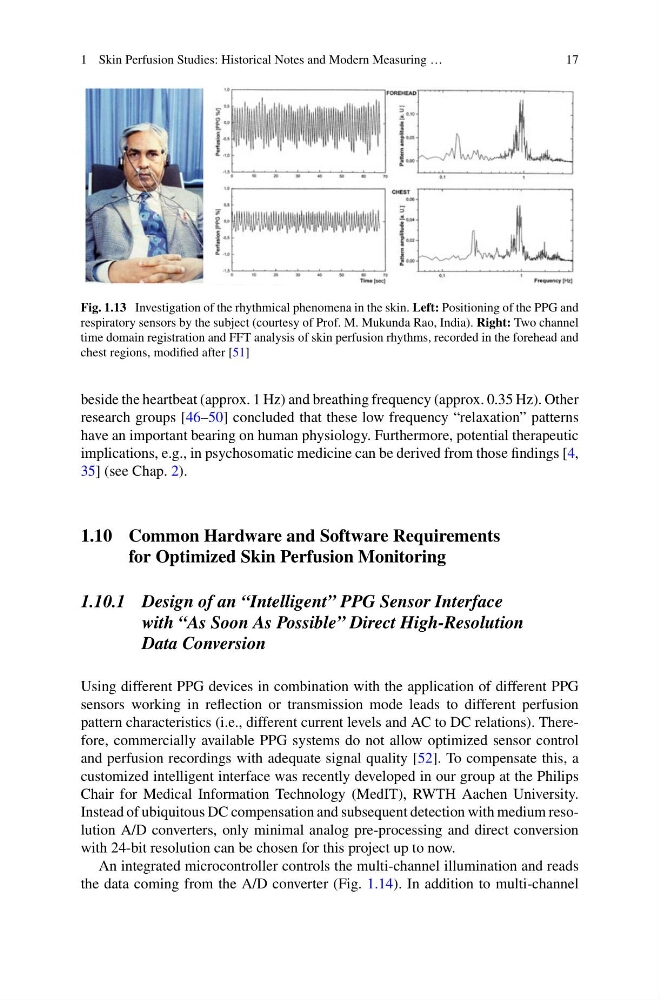
Fig. 1.13 Investigation of the rhythmical phenomena in the skin. Left: Positioning of the PPG and
respiratory sensors by the subject (courtesy of Prof. M. Mukunda Rao, India). Right: Two channel
time domain registration and FFT analysis of skin perfusion rhythms, recorded in the forehead and
chest regions, modified after [51]
beside the heartbeat (approx. 1 Hz) and breathing frequency (approx. 0.35 Hz). Other
research groups [46–50] concluded that these low frequency “relaxation” patterns
have an important bearing on human physiology. Furthermore, potential therapeutic
implications, e.g., in psychosomatic medicine can be derived from those findings [4,
35] (see Chap. 2).
1.10 Common Hardware and Software Requirements
for Optimized Skin Perfusion Monitoring
1.10.1 Design of an “Intelligent” PPG Sensor Interface
with “As Soon As Possible” Direct High-Resolution
Data Conversion
Using different PPG devices in combination with the application of different PPG
sensors working in reflection or transmission mode leads to different perfusion
pattern characteristics (i.e., different current levels and AC to DC relations). Therefore, commercially available PPG systems do not allow optimized sensor control
and perfusion recordings with adequate signal quality [52]. To compensate this, a
customized intelligent interface was recently developed in our group at the Philips
Chair for Medical Information Technology (MedIT), RWTH Aachen University.
Instead of ubiquitous DC compensation and subsequent detection with medium resolution A/D converters, only minimal analog pre-processing and direct conversion
with 24-bit resolution can be chosen for this project up to now.
An integrated microcontroller controls the multi-channel illumination and reads
the data coming from the A/D converter (Fig. 1.14). In addition to multi-channel
17
Fig. 1.13 Investigation of the rhythmical phenomena in the skin. Left: Positioning of the PPG and
respiratory sensors by the subject (courtesy of Prof. M. Mukunda Rao, India). Right: Two channel
time domain registration and FFT analysis of skin perfusion rhythms, recorded in the forehead and
chest regions, modified after [51]
beside the heartbeat (approx. 1 Hz) and breathing frequency (approx. 0.35 Hz). Other
research groups [46–50] concluded that these low frequency “relaxation” patterns
have an important bearing on human physiology. Furthermore, potential therapeutic
implications, e.g., in psychosomatic medicine can be derived from those findings [4,
35] (see Chap. 2).
1.10 Common Hardware and Software Requirements
for Optimized Skin Perfusion Monitoring
1.10.1 Design of an “Intelligent” PPG Sensor Interface
with “As Soon As Possible” Direct High-Resolution
Data Conversion
Using different PPG devices in combination with the application of different PPG
sensors working in reflection or transmission mode leads to different perfusion
pattern characteristics (i.e., different current levels and AC to DC relations). Therefore, commercially available PPG systems do not allow optimized sensor control
and perfusion recordings with adequate signal quality [52]. To compensate this, a
customized intelligent interface was recently developed in our group at the Philips
Chair for Medical Information Technology (MedIT), RWTH Aachen University.
Instead of ubiquitous DC compensation and subsequent detection with medium resolution A/D converters, only minimal analog pre-processing and direct conversion
with 24-bit resolution can be chosen for this project up to now.
An integrated microcontroller controls the multi-channel illumination and reads
the data coming from the A/D converter (Fig. 1.14). In addition to multi-channel