

1 Skin Perfusion Studies: Historical Notes and Modern Measuring …
15
the same magnitude as that obtained from a person with normal skin. If the person
to be tested has a fair skin, the intensity of the source is reduced suitably so that
the received signal is again on par with that obtained from a person with a normal
skin. Thus the PPG characteristics if forced to have the variation as depicted in the
central loop of Fig. 1.10 and any measurements made on the detected PPG with
this condition is independent of the interfering parameters listed above and thus the
detected PPG becomes “quantified”.
1.8 “Historical” PPG Multi-Sensor System Designed
for the Indo-European Project
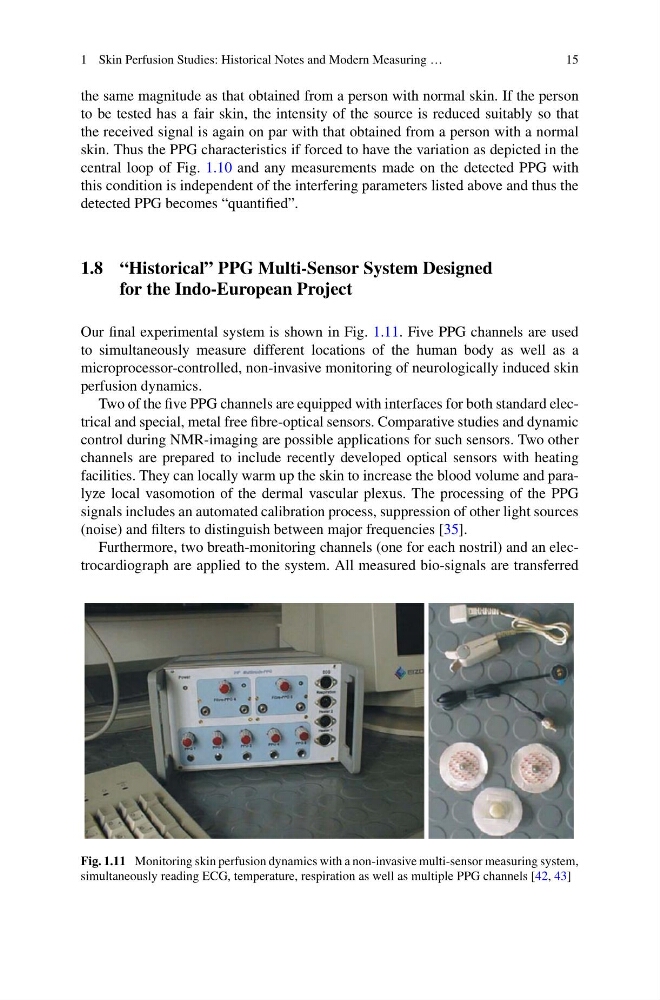
Our final experimental system is shown in Fig. 1.11. Five PPG channels are used
to simultaneously measure different locations of the human body as well as a
microprocessor-controlled, non-invasive monitoring of neurologically induced skin
perfusion dynamics.
Two of the five PPG channels are equipped with interfaces for both standard electrical and special, metal free fibre-optical sensors. Comparative studies and dynamic
control during NMR-imaging are possible applications for such sensors. Two other
channels are prepared to include recently developed optical sensors with heating
facilities. They can locally warm up the skin to increase the blood volume and paralyze local vasomotion of the dermal vascular plexus. The processing of the PPG
signals includes an automated calibration process, suppression of other light sources
(noise) and filters to distinguish between major frequencies [35].
Furthermore, two breath-monitoring channels (one for each nostril) and an electrocardiograph are applied to the system. All measured bio-signals are transferred
Fig. 1.11 Monitoring skin perfusion dynamics with a non-invasive multi-sensor measuring system,
simultaneously reading ECG, temperature, respiration as well as multiple PPG channels [42, 43]
15
the same magnitude as that obtained from a person with normal skin. If the person
to be tested has a fair skin, the intensity of the source is reduced suitably so that
the received signal is again on par with that obtained from a person with a normal
skin. Thus the PPG characteristics if forced to have the variation as depicted in the
central loop of Fig. 1.10 and any measurements made on the detected PPG with
this condition is independent of the interfering parameters listed above and thus the
detected PPG becomes “quantified”.
1.8 “Historical” PPG Multi-Sensor System Designed
for the Indo-European Project
Our final experimental system is shown in Fig. 1.11. Five PPG channels are used
to simultaneously measure different locations of the human body as well as a
microprocessor-controlled, non-invasive monitoring of neurologically induced skin
perfusion dynamics.
Two of the five PPG channels are equipped with interfaces for both standard electrical and special, metal free fibre-optical sensors. Comparative studies and dynamic
control during NMR-imaging are possible applications for such sensors. Two other
channels are prepared to include recently developed optical sensors with heating
facilities. They can locally warm up the skin to increase the blood volume and paralyze local vasomotion of the dermal vascular plexus. The processing of the PPG
signals includes an automated calibration process, suppression of other light sources
(noise) and filters to distinguish between major frequencies [35].
Furthermore, two breath-monitoring channels (one for each nostril) and an electrocardiograph are applied to the system. All measured bio-signals are transferred
Fig. 1.11 Monitoring skin perfusion dynamics with a non-invasive multi-sensor measuring system,
simultaneously reading ECG, temperature, respiration as well as multiple PPG channels [42, 43]