

12 Selected Clinical Applications of Functional PPGI Perfusion Mapping …
217
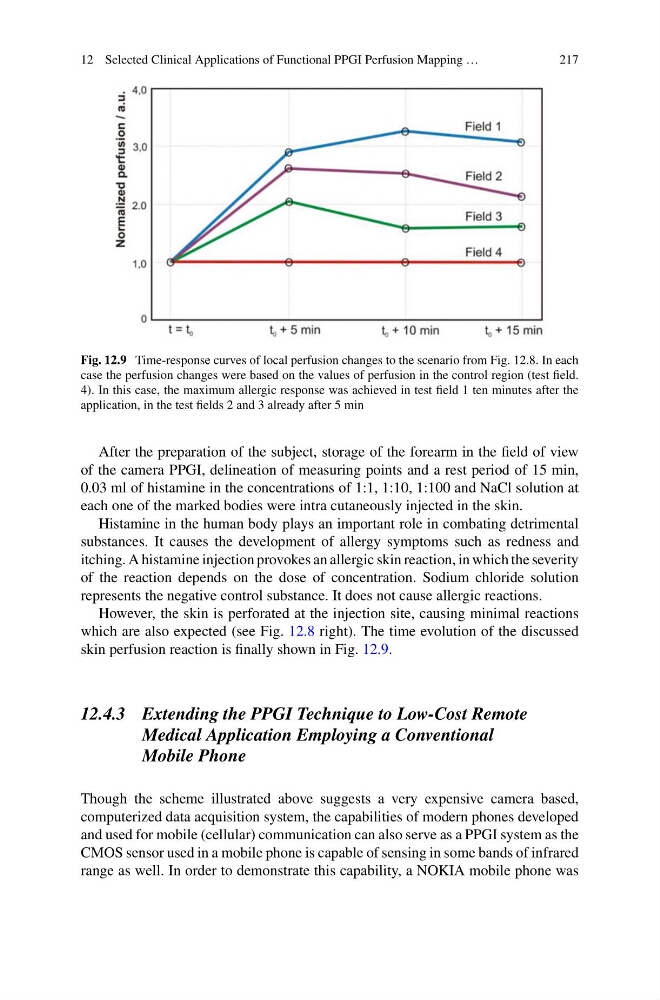
Fig. 12.9 Time-response curves of local perfusion changes to the scenario from Fig. 12.8. In each
case the perfusion changes were based on the values of perfusion in the control region (test field.
4). In this case, the maximum allergic response was achieved in test field 1 ten minutes after the
application, in the test fields 2 and 3 already after 5 min
After the preparation of the subject, storage of the forearm in the field of view
of the camera PPGI, delineation of measuring points and a rest period of 15 min,
0.03 ml of histamine in the concentrations of 1:1, 1:10, 1:100 and NaCl solution at
each one of the marked bodies were intra cutaneously injected in the skin.
Histamine in the human body plays an important role in combating detrimental
substances. It causes the development of allergy symptoms such as redness and
itching. A histamine injection provokes an allergic skin reaction, in which the severity
of the reaction depends on the dose of concentration. Sodium chloride solution
represents the negative control substance. It does not cause allergic reactions.
However, the skin is perforated at the injection site, causing minimal reactions
which are also expected (see Fig. 12.8 right). The time evolution of the discussed
skin perfusion reaction is finally shown in Fig. 12.9.
12.4.3 Extending the PPGI Technique to Low-Cost Remote
Medical Application Employing a Conventional
Mobile Phone
Though the scheme illustrated above suggests a very expensive camera based,
computerized data acquisition system, the capabilities of modern phones developed
and used for mobile (cellular) communication can also serve as a PPGI system as the
CMOS sensor used in a mobile phone is capable of sensing in some bands of infrared
range as well. In order to demonstrate this capability, a NOKIA mobile phone was
217
Fig. 12.9 Time-response curves of local perfusion changes to the scenario from Fig. 12.8. In each
case the perfusion changes were based on the values of perfusion in the control region (test field.
4). In this case, the maximum allergic response was achieved in test field 1 ten minutes after the
application, in the test fields 2 and 3 already after 5 min
After the preparation of the subject, storage of the forearm in the field of view
of the camera PPGI, delineation of measuring points and a rest period of 15 min,
0.03 ml of histamine in the concentrations of 1:1, 1:10, 1:100 and NaCl solution at
each one of the marked bodies were intra cutaneously injected in the skin.
Histamine in the human body plays an important role in combating detrimental
substances. It causes the development of allergy symptoms such as redness and
itching. A histamine injection provokes an allergic skin reaction, in which the severity
of the reaction depends on the dose of concentration. Sodium chloride solution
represents the negative control substance. It does not cause allergic reactions.
However, the skin is perforated at the injection site, causing minimal reactions
which are also expected (see Fig. 12.8 right). The time evolution of the discussed
skin perfusion reaction is finally shown in Fig. 12.9.
12.4.3 Extending the PPGI Technique to Low-Cost Remote
Medical Application Employing a Conventional
Mobile Phone
Though the scheme illustrated above suggests a very expensive camera based,
computerized data acquisition system, the capabilities of modern phones developed
and used for mobile (cellular) communication can also serve as a PPGI system as the
CMOS sensor used in a mobile phone is capable of sensing in some bands of infrared
range as well. In order to demonstrate this capability, a NOKIA mobile phone was