

198
N. Blanik
must be illuminated homogeneously, or else tracked objects would possess locationdependent brightness values. Assuming only translational movements of the monitored object within the image plane, the temporal change of a tracked picture element
equals zero:
dg(t)
dt
= 0
(11.9)
Together with Eq. 11.8, it follows that:
d f
dx
dx
dt
+
d f
dy
dy
dt
+
d f
dt
= (∇ f )
T
· ·
v +
d f
dt
= 0
(11.10)
in which
v corresponds to the displacement vector of the optical flow. In general,
v can be estimated directly from Eq. 11.10 but as in the block matching method,
there is a possibility of an aperture problem. This can lead to ambiguities and, thus,
inaccuracies in the calculated vector field, for example, a single point on an edge can
be assigned to any position of the shifted edge.
Ambiguities of Eq. 11.10 may be mitigated by introducing global and local
methods: the former assumes a dependency of displacement vector of any pixel,
and aims to obtain optimum smoothness of distribution in the resulting vector field
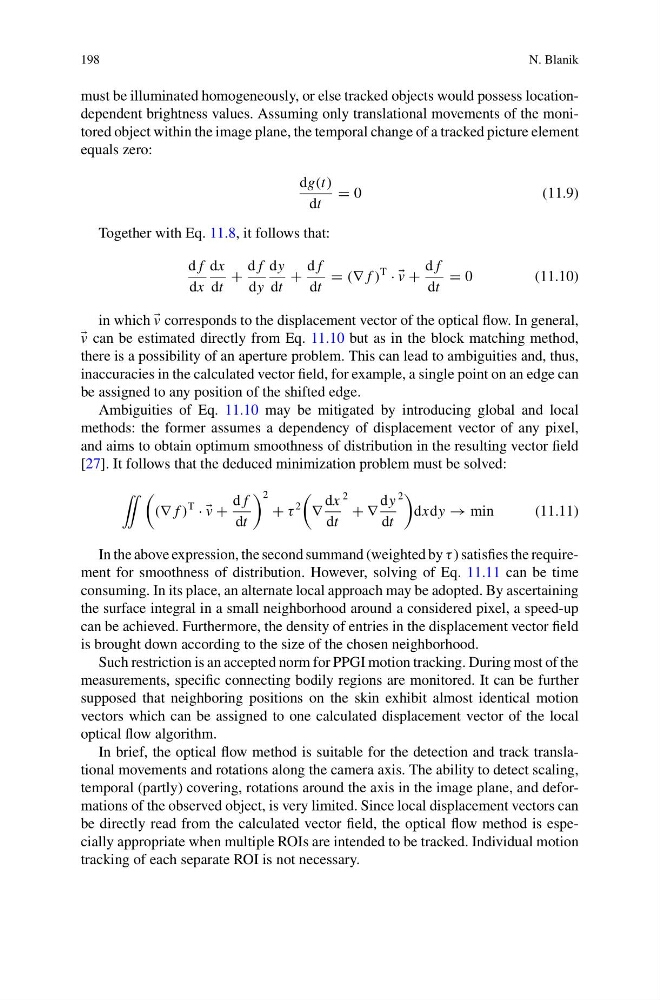
[27]. It follows that the deduced minimization problem must be solved:
¨
(∇ f )
T
· ·
v +
d f
dt
2
+ τ
2
∇
dx
dt
2
+ ∇
dy
dt
2
dxdy → min
(11.11)
In the above expression, the second summand (weighted by τ ) satisfies the requirement for smoothness of distribution. However, solving of Eq. 11.11 can be time
consuming. In its place, an alternate local approach may be adopted. By ascertaining
the surface integral in a small neighborhood around a considered pixel, a speed-up
can be achieved. Furthermore, the density of entries in the displacement vector field
is brought down according to the size of the chosen neighborhood.
Such restriction is an accepted norm for PPGI motion tracking. During most of the
measurements, specific connecting bodily regions are monitored. It can be further
supposed that neighboring positions on the skin exhibit almost identical motion
vectors which can be assigned to one calculated displacement vector of the local
optical flow algorithm.
In brief, the optical flow method is suitable for the detection and track translational movements and rotations along the camera axis. The ability to detect scaling,
temporal (partly) covering, rotations around the axis in the image plane, and deformations of the observed object, is very limited. Since local displacement vectors can
be directly read from the calculated vector field, the optical flow method is especially appropriate when multiple ROIs are intended to be tracked. Individual motion
tracking of each separate ROI is not necessary.
N. Blanik
must be illuminated homogeneously, or else tracked objects would possess locationdependent brightness values. Assuming only translational movements of the monitored object within the image plane, the temporal change of a tracked picture element
equals zero:
dg(t)
dt
= 0
(11.9)
Together with Eq. 11.8, it follows that:
d f
dx
dx
dt
+
d f
dy
dy
dt
+
d f
dt
= (∇ f )
T
· ·
v +
d f
dt
= 0
(11.10)
in which
v corresponds to the displacement vector of the optical flow. In general,
v can be estimated directly from Eq. 11.10 but as in the block matching method,
there is a possibility of an aperture problem. This can lead to ambiguities and, thus,
inaccuracies in the calculated vector field, for example, a single point on an edge can
be assigned to any position of the shifted edge.
Ambiguities of Eq. 11.10 may be mitigated by introducing global and local
methods: the former assumes a dependency of displacement vector of any pixel,
and aims to obtain optimum smoothness of distribution in the resulting vector field
[27]. It follows that the deduced minimization problem must be solved:
¨
(∇ f )
T
· ·
v +
d f
dt
2
+ τ
2
∇
dx
dt
2
+ ∇
dy
dt
2
dxdy → min
(11.11)
In the above expression, the second summand (weighted by τ ) satisfies the requirement for smoothness of distribution. However, solving of Eq. 11.11 can be time
consuming. In its place, an alternate local approach may be adopted. By ascertaining
the surface integral in a small neighborhood around a considered pixel, a speed-up
can be achieved. Furthermore, the density of entries in the displacement vector field
is brought down according to the size of the chosen neighborhood.
Such restriction is an accepted norm for PPGI motion tracking. During most of the
measurements, specific connecting bodily regions are monitored. It can be further
supposed that neighboring positions on the skin exhibit almost identical motion
vectors which can be assigned to one calculated displacement vector of the local
optical flow algorithm.
In brief, the optical flow method is suitable for the detection and track translational movements and rotations along the camera axis. The ability to detect scaling,
temporal (partly) covering, rotations around the axis in the image plane, and deformations of the observed object, is very limited. Since local displacement vectors can
be directly read from the calculated vector field, the optical flow method is especially appropriate when multiple ROIs are intended to be tracked. Individual motion
tracking of each separate ROI is not necessary.