

11 Remote Space- and Time-Resolved Skin Perfusion Detection …
197
rate and the properties of the optical systems. The smaller the selected search area,
the less the computational effort. Additionally, images containing repeating patterns
are especially vulnerable to incorrect assignments during the matching process, to
the extent that the matching criteria are minimized not only at the shifted position
of the original block, but also at other similar locations. Consequently, a smaller
search radius minimizes the risk of mismatching blocks because possible incorrect
assignments are excluded at the outset.
Successfully tracking of a ROI through a complete video sequence requires an
iteration of this procedure for each frame. In the process, matching can be conducted
either always with the initial image or, previously determined regions in each case
may be compared to the new frame. The latter enables the tracked object to gradually
change its appearance, faces the risk of the likelihood of errors in tracking all along
for the entire remaining duration of measurement.
To sum up, it may be stated that the block matching algorithm is especially suited
for compensating PPGI sequences containing only small translative movements. The
required computing capacity advances rapidly with enlargening of the search area and
matching accuracy (the subdivision inside the search up to pixel or even interpolated
subpixel level).
Recovery of scaling, (partly) covering, or rotation/deformation of the tracked
object is hardly supported by the block matching algorithm.
Several variants of the algorithm exist depending on the application. In general,
these aim at minimizing the required mathematical steps or to improve matching
results [23, 24]. By way of explanation, a hierarchic search starts with large block
size to estimate global movements in the frame, and thereafter, the block size is
decreased progressively to determine local motion patterns. The previous estimated
displacement vector is thereby used as the new center of the concerned search area.
11.5.2.2 Optical Flow Method
The optical flow method is an easy-to-implement algorithm, used to detect movements of objects in two consecutive frames, by analyzing the displacement of brightness information in the image plane. A vector field is calculated representing individual displacements for each single pixel. This vector field is often directly addressed
as the optical flow. There exist a number of approaches to quantify this field [25, 26].
Estimation of the optical flow is achieved by analysis of the spatial and temporal
derivation of the pixel intensity in the observed image region. It is assumed that the
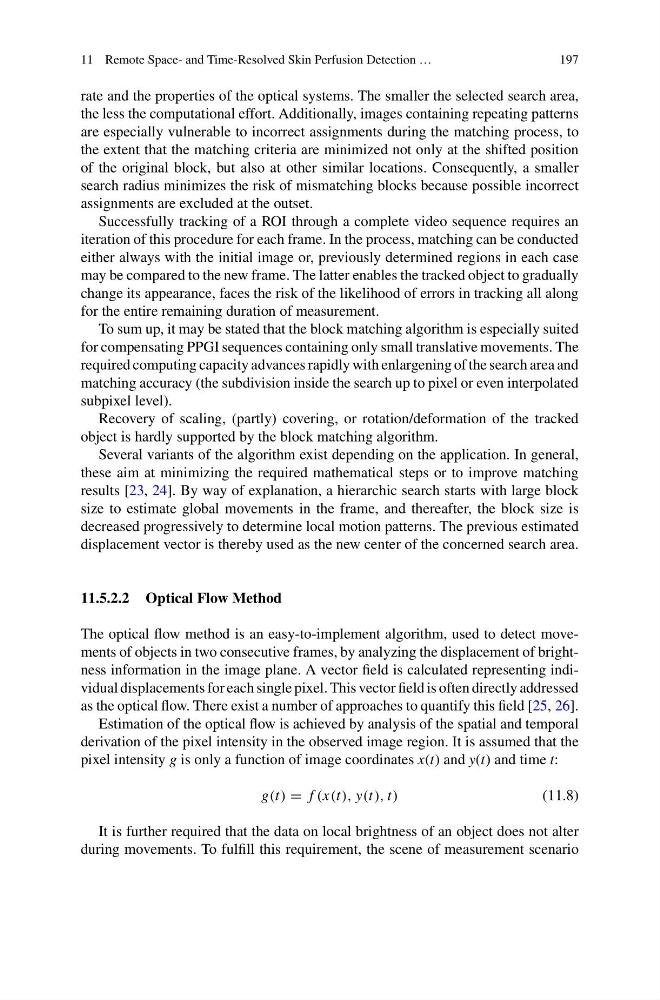
pixel intensity g is only a function of image coordinates x(t) and y(t) and time t:
g(t) = f (x(t), y(t), t)
(11.8)
It is further required that the data on local brightness of an object does not alter
during movements. To fulfill this requirement, the scene of measurement scenario
197
rate and the properties of the optical systems. The smaller the selected search area,
the less the computational effort. Additionally, images containing repeating patterns
are especially vulnerable to incorrect assignments during the matching process, to
the extent that the matching criteria are minimized not only at the shifted position
of the original block, but also at other similar locations. Consequently, a smaller
search radius minimizes the risk of mismatching blocks because possible incorrect
assignments are excluded at the outset.
Successfully tracking of a ROI through a complete video sequence requires an
iteration of this procedure for each frame. In the process, matching can be conducted
either always with the initial image or, previously determined regions in each case
may be compared to the new frame. The latter enables the tracked object to gradually
change its appearance, faces the risk of the likelihood of errors in tracking all along
for the entire remaining duration of measurement.
To sum up, it may be stated that the block matching algorithm is especially suited
for compensating PPGI sequences containing only small translative movements. The
required computing capacity advances rapidly with enlargening of the search area and
matching accuracy (the subdivision inside the search up to pixel or even interpolated
subpixel level).
Recovery of scaling, (partly) covering, or rotation/deformation of the tracked
object is hardly supported by the block matching algorithm.
Several variants of the algorithm exist depending on the application. In general,
these aim at minimizing the required mathematical steps or to improve matching
results [23, 24]. By way of explanation, a hierarchic search starts with large block
size to estimate global movements in the frame, and thereafter, the block size is
decreased progressively to determine local motion patterns. The previous estimated
displacement vector is thereby used as the new center of the concerned search area.
11.5.2.2 Optical Flow Method
The optical flow method is an easy-to-implement algorithm, used to detect movements of objects in two consecutive frames, by analyzing the displacement of brightness information in the image plane. A vector field is calculated representing individual displacements for each single pixel. This vector field is often directly addressed
as the optical flow. There exist a number of approaches to quantify this field [25, 26].
Estimation of the optical flow is achieved by analysis of the spatial and temporal
derivation of the pixel intensity in the observed image region. It is assumed that the
pixel intensity g is only a function of image coordinates x(t) and y(t) and time t:
g(t) = f (x(t), y(t), t)
(11.8)
It is further required that the data on local brightness of an object does not alter
during movements. To fulfill this requirement, the scene of measurement scenario