

196
N. Blanik
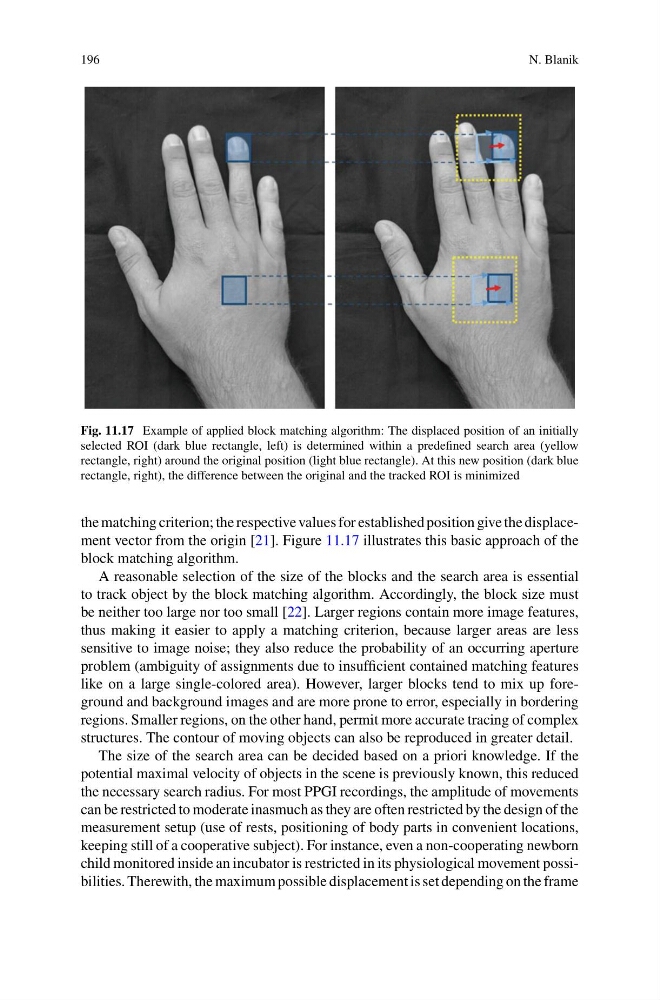
Fig. 11.17 Example of applied block matching algorithm: The displaced position of an initially
selected ROI (dark blue rectangle, left) is determined within a predefined search area (yellow
rectangle, right) around the original position (light blue rectangle). At this new position (dark blue
rectangle, right), the difference between the original and the tracked ROI is minimized
the matching criterion; the respective values for established position give the displacement vector from the origin [21]. Figure 11.17 illustrates this basic approach of the
block matching algorithm.
A reasonable selection of the size of the blocks and the search area is essential
to track object by the block matching algorithm. Accordingly, the block size must
be neither too large nor too small [22]. Larger regions contain more image features,
thus making it easier to apply a matching criterion, because larger areas are less
sensitive to image noise; they also reduce the probability of an occurring aperture
problem (ambiguity of assignments due to insufficient contained matching features
like on a large single-colored area). However, larger blocks tend to mix up foreground and background images and are more prone to error, especially in bordering
regions. Smaller regions, on the other hand, permit more accurate tracing of complex
structures. The contour of moving objects can also be reproduced in greater detail.
The size of the search area can be decided based on a priori knowledge. If the
potential maximal velocity of objects in the scene is previously known, this reduced
the necessary search radius. For most PPGI recordings, the amplitude of movements
can be restricted to moderate inasmuch as they are often restricted by the design of the
measurement setup (use of rests, positioning of body parts in convenient locations,
keeping still of a cooperative subject). For instance, even a non-cooperating newborn
child monitored inside an incubator is restricted in its physiological movement possibilities. Therewith, the maximum possible displacement is set depending on the frame
N. Blanik
Fig. 11.17 Example of applied block matching algorithm: The displaced position of an initially
selected ROI (dark blue rectangle, left) is determined within a predefined search area (yellow
rectangle, right) around the original position (light blue rectangle). At this new position (dark blue
rectangle, right), the difference between the original and the tracked ROI is minimized
the matching criterion; the respective values for established position give the displacement vector from the origin [21]. Figure 11.17 illustrates this basic approach of the
block matching algorithm.
A reasonable selection of the size of the blocks and the search area is essential
to track object by the block matching algorithm. Accordingly, the block size must
be neither too large nor too small [22]. Larger regions contain more image features,
thus making it easier to apply a matching criterion, because larger areas are less
sensitive to image noise; they also reduce the probability of an occurring aperture
problem (ambiguity of assignments due to insufficient contained matching features
like on a large single-colored area). However, larger blocks tend to mix up foreground and background images and are more prone to error, especially in bordering
regions. Smaller regions, on the other hand, permit more accurate tracing of complex
structures. The contour of moving objects can also be reproduced in greater detail.
The size of the search area can be decided based on a priori knowledge. If the
potential maximal velocity of objects in the scene is previously known, this reduced
the necessary search radius. For most PPGI recordings, the amplitude of movements
can be restricted to moderate inasmuch as they are often restricted by the design of the
measurement setup (use of rests, positioning of body parts in convenient locations,
keeping still of a cooperative subject). For instance, even a non-cooperating newborn
child monitored inside an incubator is restricted in its physiological movement possibilities. Therewith, the maximum possible displacement is set depending on the frame