

11 Remote Space- and Time-Resolved Skin Perfusion Detection …
199
11.5.2.3 Kanade-Lucas-Tomasi (KLT) Feature Tracker
The Kanade-Lucas-Thomasi (KLT) Feature Tracker, named after its inventors, is an
algorithm to detect and track suited features inside of video sequences. It is based on
the fact that only feature correspondences best suited are tracked by the algorithm
[28, 29].
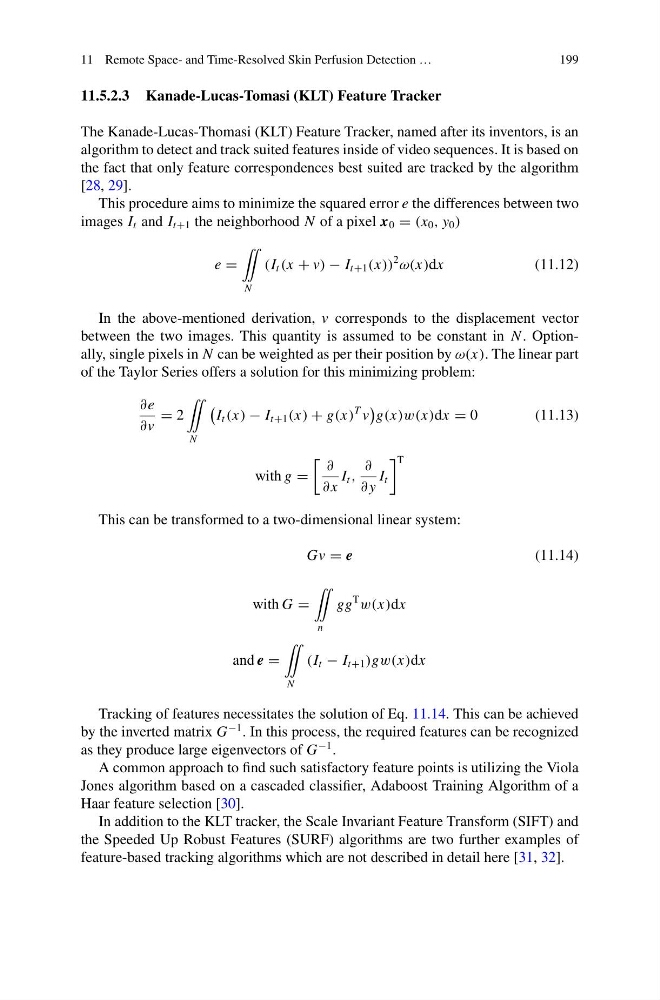
This procedure aims to minimize the squared error e the differences between two
images I t and I t+1 the neighborhood N of a pixel x 0 = (x 0 , y 0 )
e =
¨
N
(I t (x + v) − I t+1 (x))
2
ω(x)dx
(11.12)
In the above-mentioned derivation, v corresponds to the displacement vector
between the two images. This quantity is assumed to be constant in N . Optionally, single pixels in N can be weighted as per their position by ω(x). The linear part
of the Taylor Series offers a solution for this minimizing problem:
∂e
∂v
= 2
¨
N
I t (x) − I t+1 (x) + g(x)
T v
g(x)w(x)dx = 0
(11.13)
with g =
∂
∂ x
I t ,
∂
∂ y
I t
T
This can be transformed to a two-dimensional linear system:
Gv = e
(11.14)
with G =
¨
n
gg
T
w(x)dx
and e =
¨
N
(I t − I t+1 )gw(x)dx
Tracking of features necessitates the solution of Eq. 11.14. This can be achieved
by the inverted matrix G
−1 . In this process, the required features can be recognized
as they produce large eigenvectors of G
−1 .
A common approach to find such satisfactory feature points is utilizing the Viola
Jones algorithm based on a cascaded classifier, Adaboost Training Algorithm of a
Haar feature selection [30].
In addition to the KLT tracker, the Scale Invariant Feature Transform (SIFT) and
the Speeded Up Robust Features (SURF) algorithms are two further examples of
feature-based tracking algorithms which are not described in detail here [31, 32].
199
11.5.2.3 Kanade-Lucas-Tomasi (KLT) Feature Tracker
The Kanade-Lucas-Thomasi (KLT) Feature Tracker, named after its inventors, is an
algorithm to detect and track suited features inside of video sequences. It is based on
the fact that only feature correspondences best suited are tracked by the algorithm
[28, 29].
This procedure aims to minimize the squared error e the differences between two
images I t and I t+1 the neighborhood N of a pixel x 0 = (x 0 , y 0 )
e =
¨
N
(I t (x + v) − I t+1 (x))
2
ω(x)dx
(11.12)
In the above-mentioned derivation, v corresponds to the displacement vector
between the two images. This quantity is assumed to be constant in N . Optionally, single pixels in N can be weighted as per their position by ω(x). The linear part
of the Taylor Series offers a solution for this minimizing problem:
∂e
∂v
= 2
¨
N
I t (x) − I t+1 (x) + g(x)
T v
g(x)w(x)dx = 0
(11.13)
with g =
∂
∂ x
I t ,
∂
∂ y
I t
T
This can be transformed to a two-dimensional linear system:
Gv = e
(11.14)
with G =
¨
n
gg
T
w(x)dx
and e =
¨
N
(I t − I t+1 )gw(x)dx
Tracking of features necessitates the solution of Eq. 11.14. This can be achieved
by the inverted matrix G
−1 . In this process, the required features can be recognized
as they produce large eigenvectors of G
−1 .
A common approach to find such satisfactory feature points is utilizing the Viola
Jones algorithm based on a cascaded classifier, Adaboost Training Algorithm of a
Haar feature selection [30].
In addition to the KLT tracker, the Scale Invariant Feature Transform (SIFT) and
the Speeded Up Robust Features (SURF) algorithms are two further examples of
feature-based tracking algorithms which are not described in detail here [31, 32].