

184
N. Blanik
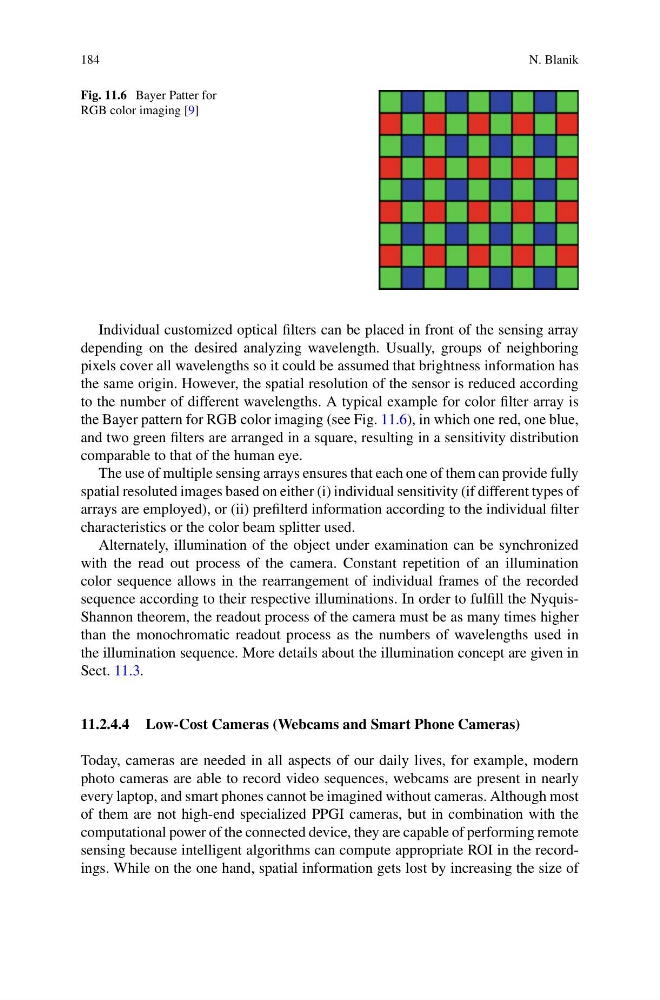
Fig. 11.6 Bayer Patter for
RGB color imaging [9]
Individual customized optical filters can be placed in front of the sensing array
depending on the desired analyzing wavelength. Usually, groups of neighboring
pixels cover all wavelengths so it could be assumed that brightness information has
the same origin. However, the spatial resolution of the sensor is reduced according
to the number of different wavelengths. A typical example for color filter array is
the Bayer pattern for RGB color imaging (see Fig. 11.6), in which one red, one blue,
and two green filters are arranged in a square, resulting in a sensitivity distribution
comparable to that of the human eye.
The use of multiple sensing arrays ensures that each one of them can provide fully
spatial resoluted images based on either (i) individual sensitivity (if different types of
arrays are employed), or (ii) prefilterd information according to the individual filter
characteristics or the color beam splitter used.
Alternately, illumination of the object under examination can be synchronized
with the read out process of the camera. Constant repetition of an illumination
color sequence allows in the rearrangement of individual frames of the recorded
sequence according to their respective illuminations. In order to fulfill the NyquisShannon theorem, the readout process of the camera must be as many times higher
than the monochromatic readout process as the numbers of wavelengths used in
the illumination sequence. More details about the illumination concept are given in
Sect. 11.3.
11.2.4.4 Low-Cost Cameras (Webcams and Smart Phone Cameras)
Today, cameras are needed in all aspects of our daily lives, for example, modern
photo cameras are able to record video sequences, webcams are present in nearly
every laptop, and smart phones cannot be imagined without cameras. Although most
of them are not high-end specialized PPGI cameras, but in combination with the
computational power of the connected device, they are capable of performing remote
sensing because intelligent algorithms can compute appropriate ROI in the recordings. While on the one hand, spatial information gets lost by increasing the size of
N. Blanik
Fig. 11.6 Bayer Patter for
RGB color imaging [9]
Individual customized optical filters can be placed in front of the sensing array
depending on the desired analyzing wavelength. Usually, groups of neighboring
pixels cover all wavelengths so it could be assumed that brightness information has
the same origin. However, the spatial resolution of the sensor is reduced according
to the number of different wavelengths. A typical example for color filter array is
the Bayer pattern for RGB color imaging (see Fig. 11.6), in which one red, one blue,
and two green filters are arranged in a square, resulting in a sensitivity distribution
comparable to that of the human eye.
The use of multiple sensing arrays ensures that each one of them can provide fully
spatial resoluted images based on either (i) individual sensitivity (if different types of
arrays are employed), or (ii) prefilterd information according to the individual filter
characteristics or the color beam splitter used.
Alternately, illumination of the object under examination can be synchronized
with the read out process of the camera. Constant repetition of an illumination
color sequence allows in the rearrangement of individual frames of the recorded
sequence according to their respective illuminations. In order to fulfill the NyquisShannon theorem, the readout process of the camera must be as many times higher
than the monochromatic readout process as the numbers of wavelengths used in
the illumination sequence. More details about the illumination concept are given in
Sect. 11.3.
11.2.4.4 Low-Cost Cameras (Webcams and Smart Phone Cameras)
Today, cameras are needed in all aspects of our daily lives, for example, modern
photo cameras are able to record video sequences, webcams are present in nearly
every laptop, and smart phones cannot be imagined without cameras. Although most
of them are not high-end specialized PPGI cameras, but in combination with the
computational power of the connected device, they are capable of performing remote
sensing because intelligent algorithms can compute appropriate ROI in the recordings. While on the one hand, spatial information gets lost by increasing the size of