

11 Remote Space- and Time-Resolved Skin Perfusion Detection …
183
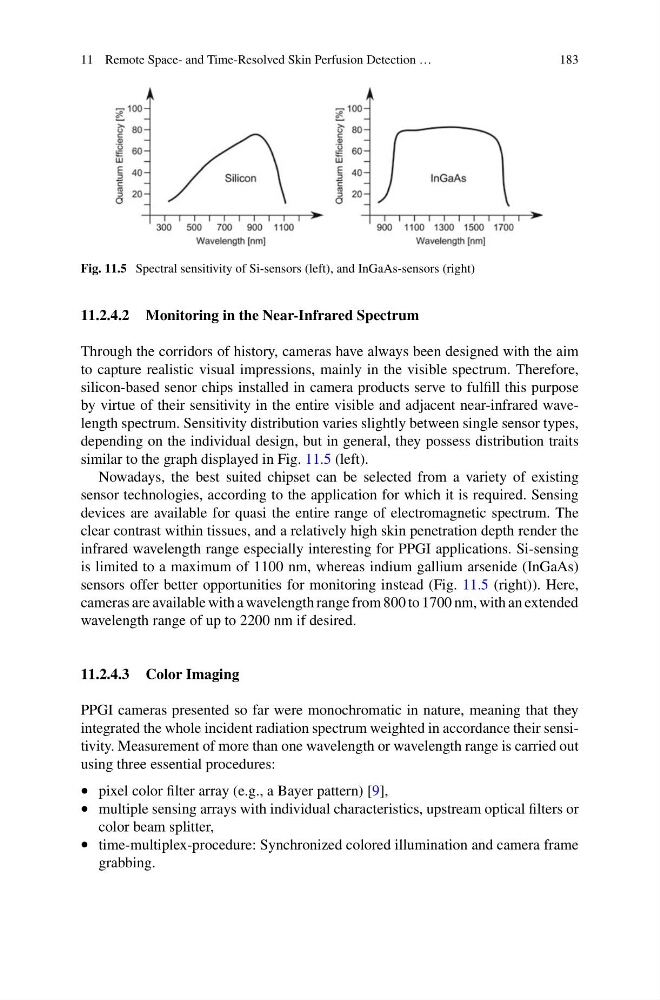
Fig. 11.5 Spectral sensitivity of Si-sensors (left), and InGaAs-sensors (right)
11.2.4.2 Monitoring in the Near-Infrared Spectrum
Through the corridors of history, cameras have always been designed with the aim
to capture realistic visual impressions, mainly in the visible spectrum. Therefore,
silicon-based senor chips installed in camera products serve to fulfill this purpose
by virtue of their sensitivity in the entire visible and adjacent near-infrared wavelength spectrum. Sensitivity distribution varies slightly between single sensor types,
depending on the individual design, but in general, they possess distribution traits
similar to the graph displayed in Fig. 11.5 (left).
Nowadays, the best suited chipset can be selected from a variety of existing
sensor technologies, according to the application for which it is required. Sensing
devices are available for quasi the entire range of electromagnetic spectrum. The
clear contrast within tissues, and a relatively high skin penetration depth render the
infrared wavelength range especially interesting for PPGI applications. Si-sensing
is limited to a maximum of 1100 nm, whereas indium gallium arsenide (InGaAs)
sensors offer better opportunities for monitoring instead (Fig. 11.5 (right)). Here,
cameras are available with a wavelength range from 800 to 1700 nm, with an extended
wavelength range of up to 2200 nm if desired.
11.2.4.3 Color Imaging
PPGI cameras presented so far were monochromatic in nature, meaning that they
integrated the whole incident radiation spectrum weighted in accordance their sensitivity. Measurement of more than one wavelength or wavelength range is carried out
using three essential procedures:
• pixel color filter array (e.g., a Bayer pattern) [9],
• multiple sensing arrays with individual characteristics, upstream optical filters or
color beam splitter,
• time-multiplex-procedure: Synchronized colored illumination and camera frame
grabbing.
183
Fig. 11.5 Spectral sensitivity of Si-sensors (left), and InGaAs-sensors (right)
11.2.4.2 Monitoring in the Near-Infrared Spectrum
Through the corridors of history, cameras have always been designed with the aim
to capture realistic visual impressions, mainly in the visible spectrum. Therefore,
silicon-based senor chips installed in camera products serve to fulfill this purpose
by virtue of their sensitivity in the entire visible and adjacent near-infrared wavelength spectrum. Sensitivity distribution varies slightly between single sensor types,
depending on the individual design, but in general, they possess distribution traits
similar to the graph displayed in Fig. 11.5 (left).
Nowadays, the best suited chipset can be selected from a variety of existing
sensor technologies, according to the application for which it is required. Sensing
devices are available for quasi the entire range of electromagnetic spectrum. The
clear contrast within tissues, and a relatively high skin penetration depth render the
infrared wavelength range especially interesting for PPGI applications. Si-sensing
is limited to a maximum of 1100 nm, whereas indium gallium arsenide (InGaAs)
sensors offer better opportunities for monitoring instead (Fig. 11.5 (right)). Here,
cameras are available with a wavelength range from 800 to 1700 nm, with an extended
wavelength range of up to 2200 nm if desired.
11.2.4.3 Color Imaging
PPGI cameras presented so far were monochromatic in nature, meaning that they
integrated the whole incident radiation spectrum weighted in accordance their sensitivity. Measurement of more than one wavelength or wavelength range is carried out
using three essential procedures:
• pixel color filter array (e.g., a Bayer pattern) [9],
• multiple sensing arrays with individual characteristics, upstream optical filters or
color beam splitter,
• time-multiplex-procedure: Synchronized colored illumination and camera frame
grabbing.