

182
N. Blanik
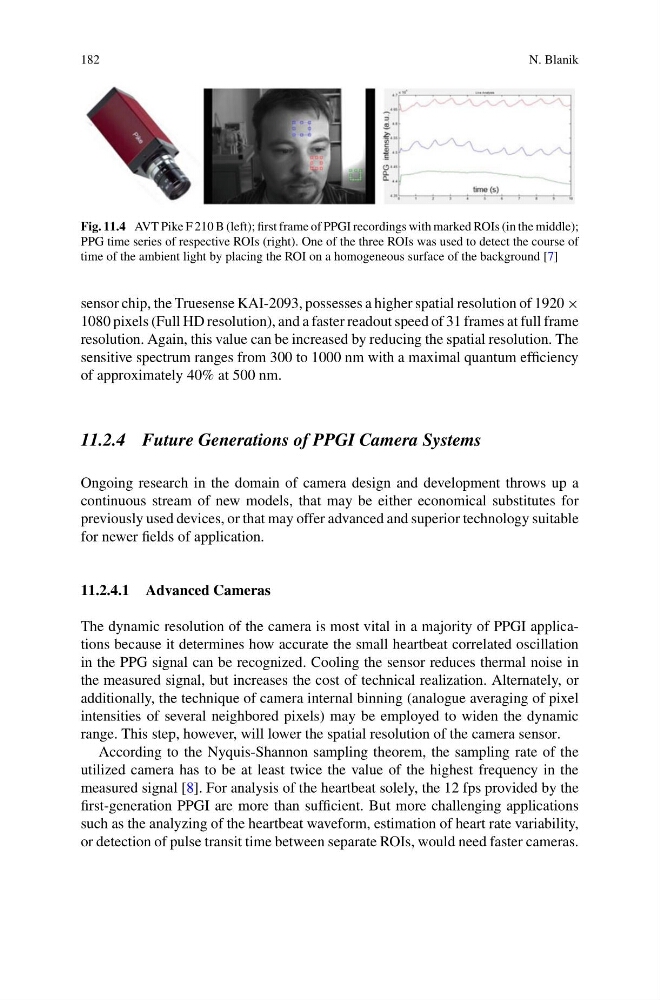
Fig. 11.4 AVT Pike F 210 B (left); first frame of PPGI recordings with marked ROIs (in the middle);
PPG time series of respective ROIs (right). One of the three ROIs was used to detect the course of
time of the ambient light by placing the ROI on a homogeneous surface of the background [7]
sensor chip, the Truesense KAI-2093, possesses a higher spatial resolution of 1920 ×
1080 pixels (Full HD resolution), and a faster readout speed of 31 frames at full frame
resolution. Again, this value can be increased by reducing the spatial resolution. The
sensitive spectrum ranges from 300 to 1000 nm with a maximal quantum efficiency
of approximately 40% at 500 nm.
11.2.4 Future Generations of PPGI Camera Systems
Ongoing research in the domain of camera design and development throws up a
continuous stream of new models, that may be either economical substitutes for
previously used devices, or that may offer advanced and superior technology suitable
for newer fields of application.
11.2.4.1 Advanced Cameras
The dynamic resolution of the camera is most vital in a majority of PPGI applications because it determines how accurate the small heartbeat correlated oscillation
in the PPG signal can be recognized. Cooling the sensor reduces thermal noise in
the measured signal, but increases the cost of technical realization. Alternately, or
additionally, the technique of camera internal binning (analogue averaging of pixel
intensities of several neighbored pixels) may be employed to widen the dynamic
range. This step, however, will lower the spatial resolution of the camera sensor.
According to the Nyquis-Shannon sampling theorem, the sampling rate of the
utilized camera has to be at least twice the value of the highest frequency in the
measured signal [8]. For analysis of the heartbeat solely, the 12 fps provided by the
first-generation PPGI are more than sufficient. But more challenging applications
such as the analyzing of the heartbeat waveform, estimation of heart rate variability,
or detection of pulse transit time between separate ROIs, would need faster cameras.
N. Blanik
Fig. 11.4 AVT Pike F 210 B (left); first frame of PPGI recordings with marked ROIs (in the middle);
PPG time series of respective ROIs (right). One of the three ROIs was used to detect the course of
time of the ambient light by placing the ROI on a homogeneous surface of the background [7]
sensor chip, the Truesense KAI-2093, possesses a higher spatial resolution of 1920 ×
1080 pixels (Full HD resolution), and a faster readout speed of 31 frames at full frame
resolution. Again, this value can be increased by reducing the spatial resolution. The
sensitive spectrum ranges from 300 to 1000 nm with a maximal quantum efficiency
of approximately 40% at 500 nm.
11.2.4 Future Generations of PPGI Camera Systems
Ongoing research in the domain of camera design and development throws up a
continuous stream of new models, that may be either economical substitutes for
previously used devices, or that may offer advanced and superior technology suitable
for newer fields of application.
11.2.4.1 Advanced Cameras
The dynamic resolution of the camera is most vital in a majority of PPGI applications because it determines how accurate the small heartbeat correlated oscillation
in the PPG signal can be recognized. Cooling the sensor reduces thermal noise in
the measured signal, but increases the cost of technical realization. Alternately, or
additionally, the technique of camera internal binning (analogue averaging of pixel
intensities of several neighbored pixels) may be employed to widen the dynamic
range. This step, however, will lower the spatial resolution of the camera sensor.
According to the Nyquis-Shannon sampling theorem, the sampling rate of the
utilized camera has to be at least twice the value of the highest frequency in the
measured signal [8]. For analysis of the heartbeat solely, the 12 fps provided by the
first-generation PPGI are more than sufficient. But more challenging applications
such as the analyzing of the heartbeat waveform, estimation of heart rate variability,
or detection of pulse transit time between separate ROIs, would need faster cameras.