

11 Remote Space- and Time-Resolved Skin Perfusion Detection …
185
ROIs; on the other hand, the dynamic sensitivity of the commonly less sensitive senor
chips can be increased. In doing so, the heartbeat-correlated AC part of the signal
can be recorded even with 8 bit sensor arrays. Once again, opportunities are born
to extract PPG information from the different color channels of the chip; thereby,
increasing the quality of the extractable vital parameters.
In combination with the primary functionalities of the device (e.g., the telecommunication task of a smartphone), new possible fields of applications open up for PPGI
technology. The smartphone can become part of fitness trackers, ambient assisted
living, or even a medical monitor for emergency tele-aid.
11.2.5 Remote Blood Volume Pulse Detection Without
Spatial Resolution
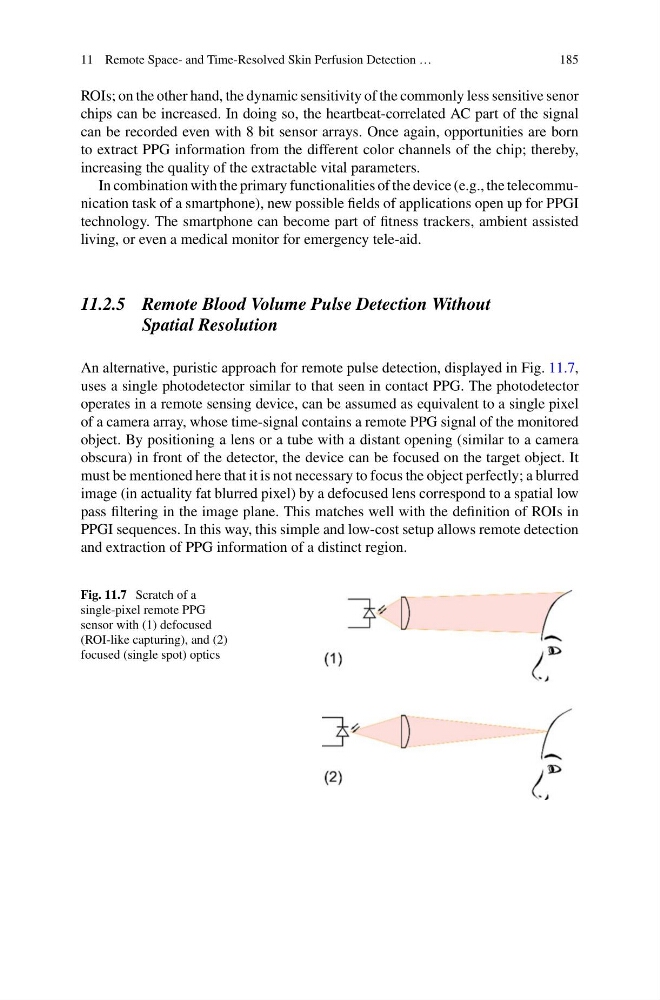
An alternative, puristic approach for remote pulse detection, displayed in Fig. 11.7,
uses a single photodetector similar to that seen in contact PPG. The photodetector
operates in a remote sensing device, can be assumed as equivalent to a single pixel
of a camera array, whose time-signal contains a remote PPG signal of the monitored
object. By positioning a lens or a tube with a distant opening (similar to a camera
obscura) in front of the detector, the device can be focused on the target object. It
must be mentioned here that it is not necessary to focus the object perfectly; a blurred
image (in actuality fat blurred pixel) by a defocused lens correspond to a spatial low
pass filtering in the image plane. This matches well with the definition of ROIs in
PPGI sequences. In this way, this simple and low-cost setup allows remote detection
and extraction of PPG information of a distinct region.
Fig. 11.7 Scratch of a
single-pixel remote PPG
sensor with (1) defocused
(ROI-like capturing), and (2)
focused (single spot) optics
185
ROIs; on the other hand, the dynamic sensitivity of the commonly less sensitive senor
chips can be increased. In doing so, the heartbeat-correlated AC part of the signal
can be recorded even with 8 bit sensor arrays. Once again, opportunities are born
to extract PPG information from the different color channels of the chip; thereby,
increasing the quality of the extractable vital parameters.
In combination with the primary functionalities of the device (e.g., the telecommunication task of a smartphone), new possible fields of applications open up for PPGI
technology. The smartphone can become part of fitness trackers, ambient assisted
living, or even a medical monitor for emergency tele-aid.
11.2.5 Remote Blood Volume Pulse Detection Without
Spatial Resolution
An alternative, puristic approach for remote pulse detection, displayed in Fig. 11.7,
uses a single photodetector similar to that seen in contact PPG. The photodetector
operates in a remote sensing device, can be assumed as equivalent to a single pixel
of a camera array, whose time-signal contains a remote PPG signal of the monitored
object. By positioning a lens or a tube with a distant opening (similar to a camera
obscura) in front of the detector, the device can be focused on the target object. It
must be mentioned here that it is not necessary to focus the object perfectly; a blurred
image (in actuality fat blurred pixel) by a defocused lens correspond to a spatial low
pass filtering in the image plane. This matches well with the definition of ROIs in
PPGI sequences. In this way, this simple and low-cost setup allows remote detection
and extraction of PPG information of a distinct region.
Fig. 11.7 Scratch of a
single-pixel remote PPG
sensor with (1) defocused
(ROI-like capturing), and (2)
focused (single spot) optics