

10 Photon-Tissue Interaction Modelled by Monte Carlo Method …
171
Fig. 10.6 Simulation of photon distribution in tissue under a classical (focused, reflective) PPG
sensor. 6 mm distance between the light injection point (λ = 940 nm in this case) and the 1 mm ×
1 mm photodetector. 3 million photons are injected, 1516 received. The longest photon path in
tissue amounts to 20 mm. Displayed are only trajectories of photons that reach the photodetector
after multiple scattering collisions [10]
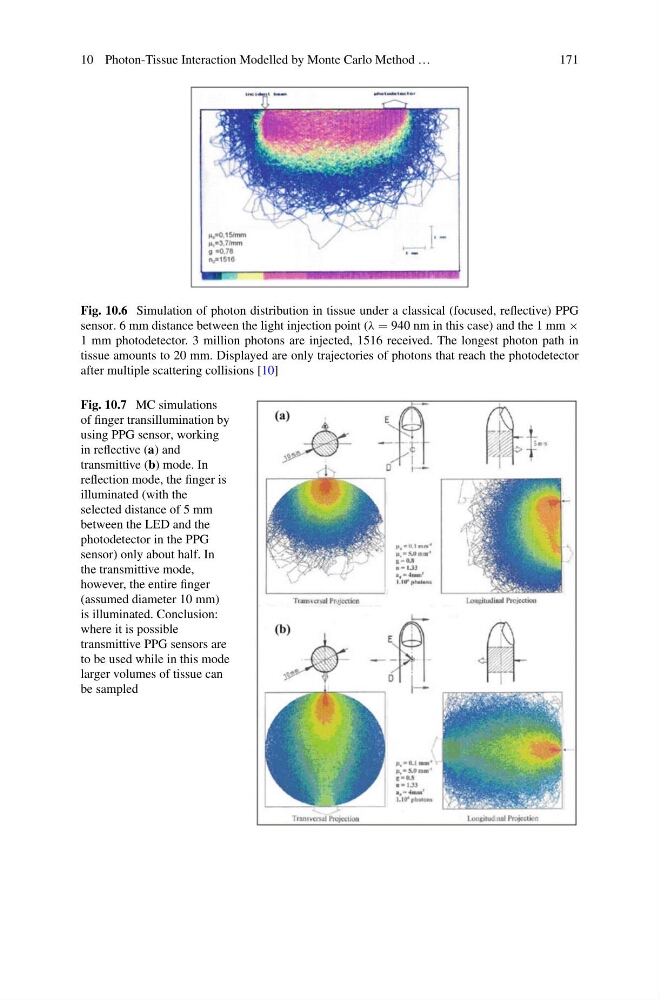
Fig. 10.7 MC simulations
of finger transillumination by
using PPG sensor, working
in reflective (a) and
transmittive (b) mode. In
reflection mode, the finger is
illuminated (with the
selected distance of 5 mm
between the LED and the
photodetector in the PPG
sensor) only about half. In
the transmittive mode,
however, the entire finger
(assumed diameter 10 mm)
is illuminated. Conclusion:
where it is possible
transmittive PPG sensors are
to be used while in this mode
larger volumes of tissue can
be sampled
171
Fig. 10.6 Simulation of photon distribution in tissue under a classical (focused, reflective) PPG
sensor. 6 mm distance between the light injection point (λ = 940 nm in this case) and the 1 mm ×
1 mm photodetector. 3 million photons are injected, 1516 received. The longest photon path in
tissue amounts to 20 mm. Displayed are only trajectories of photons that reach the photodetector
after multiple scattering collisions [10]
Fig. 10.7 MC simulations
of finger transillumination by
using PPG sensor, working
in reflective (a) and
transmittive (b) mode. In
reflection mode, the finger is
illuminated (with the
selected distance of 5 mm
between the LED and the
photodetector in the PPG
sensor) only about half. In
the transmittive mode,
however, the entire finger
(assumed diameter 10 mm)
is illuminated. Conclusion:
where it is possible
transmittive PPG sensors are
to be used while in this mode
larger volumes of tissue can
be sampled