

10 Photon-Tissue Interaction Modelled by Monte Carlo Method …
169
Different research groups try to not only estimate simulation parameters for
discrete wavelengths but to produce measurements for the whole optical spectrum from 300 nm to 900 nm. Measurement data for oxyhaemoglobin and reduced
haemoglobin have been published by Prahl [5, 6]. Jacques [7] further published
functional approximations for absorption and scattering coefficients of different skin
components. As a functional description of the anisotropic parameter g linear interpolation has been used throughout this paper. The continuous representation of
simulation parameters in relation to wavelengths permits simulations at arbitrary
wavelengths, which offers a great advantage for parameterizing simulation runs.
Optimizations of different sensor concepts in regard to wavelength are thus possible.
10.5 Skin Model
The skin is the largest human organ, it has a surface of about 1.5–1.8 m
2 and a weight
of about 5 kg. Its thickness varies from 1 mm to 4 mm. In the first approximation, it
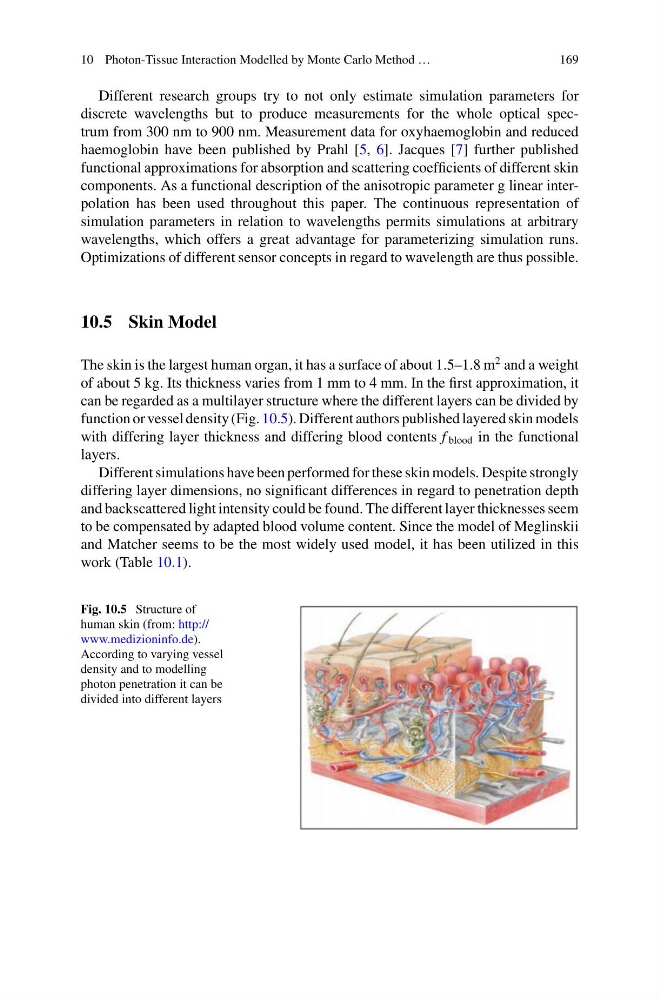
can be regarded as a multilayer structure where the different layers can be divided by
function or vessel density (Fig. 10.5). Different authors published layered skin models
with differing layer thickness and differing blood contents f blood in the functional
layers.
Different simulations have been performed for these skin models. Despite strongly
differing layer dimensions, no significant differences in regard to penetration depth
and backscattered light intensity could be found. The different layer thicknesses seem
to be compensated by adapted blood volume content. Since the model of Meglinskii
and Matcher seems to be the most widely used model, it has been utilized in this
work (Table 10.1).
Fig. 10.5 Structure of
human skin (from: http://
www.medizioninfo.de).
According to varying vessel
density and to modelling
photon penetration it can be
divided into different layers
169
Different research groups try to not only estimate simulation parameters for
discrete wavelengths but to produce measurements for the whole optical spectrum from 300 nm to 900 nm. Measurement data for oxyhaemoglobin and reduced
haemoglobin have been published by Prahl [5, 6]. Jacques [7] further published
functional approximations for absorption and scattering coefficients of different skin
components. As a functional description of the anisotropic parameter g linear interpolation has been used throughout this paper. The continuous representation of
simulation parameters in relation to wavelengths permits simulations at arbitrary
wavelengths, which offers a great advantage for parameterizing simulation runs.
Optimizations of different sensor concepts in regard to wavelength are thus possible.
10.5 Skin Model
The skin is the largest human organ, it has a surface of about 1.5–1.8 m
2 and a weight
of about 5 kg. Its thickness varies from 1 mm to 4 mm. In the first approximation, it
can be regarded as a multilayer structure where the different layers can be divided by
function or vessel density (Fig. 10.5). Different authors published layered skin models
with differing layer thickness and differing blood contents f blood in the functional
layers.
Different simulations have been performed for these skin models. Despite strongly
differing layer dimensions, no significant differences in regard to penetration depth
and backscattered light intensity could be found. The different layer thicknesses seem
to be compensated by adapted blood volume content. Since the model of Meglinskii
and Matcher seems to be the most widely used model, it has been utilized in this
work (Table 10.1).
Fig. 10.5 Structure of
human skin (from: http://
www.medizioninfo.de).
According to varying vessel
density and to modelling
photon penetration it can be
divided into different layers