

168
M. Hülsbusch and V. Blazek
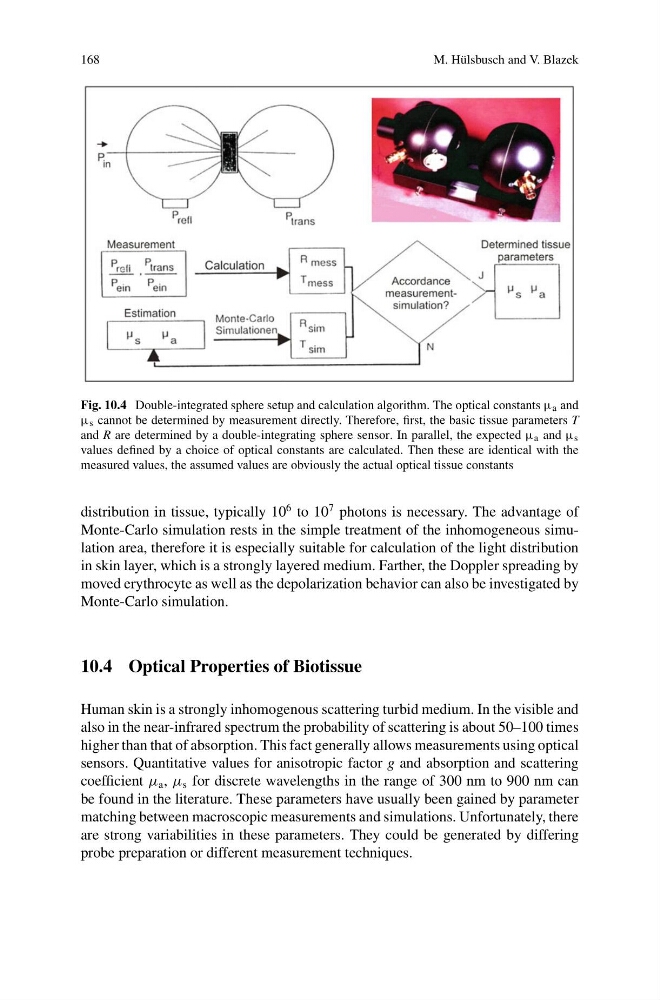
Fig. 10.4 Double-integrated sphere setup and calculation algorithm. The optical constants μ a and
μ s cannot be determined by measurement directly. Therefore, first, the basic tissue parameters T
and R are determined by a double-integrating sphere sensor. In parallel, the expected μ a and μ s
values defined by a choice of optical constants are calculated. Then these are identical with the
measured values, the assumed values are obviously the actual optical tissue constants
distribution in tissue, typically 10
6 to 10
7 photons is necessary. The advantage of
Monte-Carlo simulation rests in the simple treatment of the inhomogeneous simulation area, therefore it is especially suitable for calculation of the light distribution
in skin layer, which is a strongly layered medium. Farther, the Doppler spreading by
moved erythrocyte as well as the depolarization behavior can also be investigated by
Monte-Carlo simulation.
10.4 Optical Properties of Biotissue
Human skin is a strongly inhomogenous scattering turbid medium. In the visible and
also in the near-infrared spectrum the probability of scattering is about 50–100 times
higher than that of absorption. This fact generally allows measurements using optical
sensors. Quantitative values for anisotropic factor g and absorption and scattering
coefficient μ a , μ s for discrete wavelengths in the range of 300 nm to 900 nm can
be found in the literature. These parameters have usually been gained by parameter
matching between macroscopic measurements and simulations. Unfortunately, there
are strong variabilities in these parameters. They could be generated by differing
probe preparation or different measurement techniques.
M. Hülsbusch and V. Blazek
Fig. 10.4 Double-integrated sphere setup and calculation algorithm. The optical constants μ a and
μ s cannot be determined by measurement directly. Therefore, first, the basic tissue parameters T
and R are determined by a double-integrating sphere sensor. In parallel, the expected μ a and μ s
values defined by a choice of optical constants are calculated. Then these are identical with the
measured values, the assumed values are obviously the actual optical tissue constants
distribution in tissue, typically 10
6 to 10
7 photons is necessary. The advantage of
Monte-Carlo simulation rests in the simple treatment of the inhomogeneous simulation area, therefore it is especially suitable for calculation of the light distribution
in skin layer, which is a strongly layered medium. Farther, the Doppler spreading by
moved erythrocyte as well as the depolarization behavior can also be investigated by
Monte-Carlo simulation.
10.4 Optical Properties of Biotissue
Human skin is a strongly inhomogenous scattering turbid medium. In the visible and
also in the near-infrared spectrum the probability of scattering is about 50–100 times
higher than that of absorption. This fact generally allows measurements using optical
sensors. Quantitative values for anisotropic factor g and absorption and scattering
coefficient μ a , μ s for discrete wavelengths in the range of 300 nm to 900 nm can
be found in the literature. These parameters have usually been gained by parameter
matching between macroscopic measurements and simulations. Unfortunately, there
are strong variabilities in these parameters. They could be generated by differing
probe preparation or different measurement techniques.