

elements are connected in the correct order. The
Golden Gate system also demonstrates its superiority as the CutSmart
® cloning method can also
be used. In this procedure, restriction enzyme
and ligase are combined with the DNA to be
cloned in one reaction, in which both restriction
and ligation occurred. Depending on the temperature (37 C or 16 C), either restriction or
ligation occurs. The temperature is cycled for 8–
50 times to achieve a very high efficiency compared to normal cloning. Because the recognition
site of the restriction enzymes has been cut off in
the resulting DNA molecules, cloned DNA
molecules can no longer serve as substrate for the
enzymes and are enriched in the pot.
The vector used for plant transformation is a
typical binary vector. Its T–DNA contains the CDS
of the Cas9 enzyme which is controlled by the
ubiquitin promoter from parsley (pUbi4-2(parsley)).
Our experiments revealed that this promoter showed
the best efficiency in genome editing compared to
other promoters like the CaMV35S promoter. As
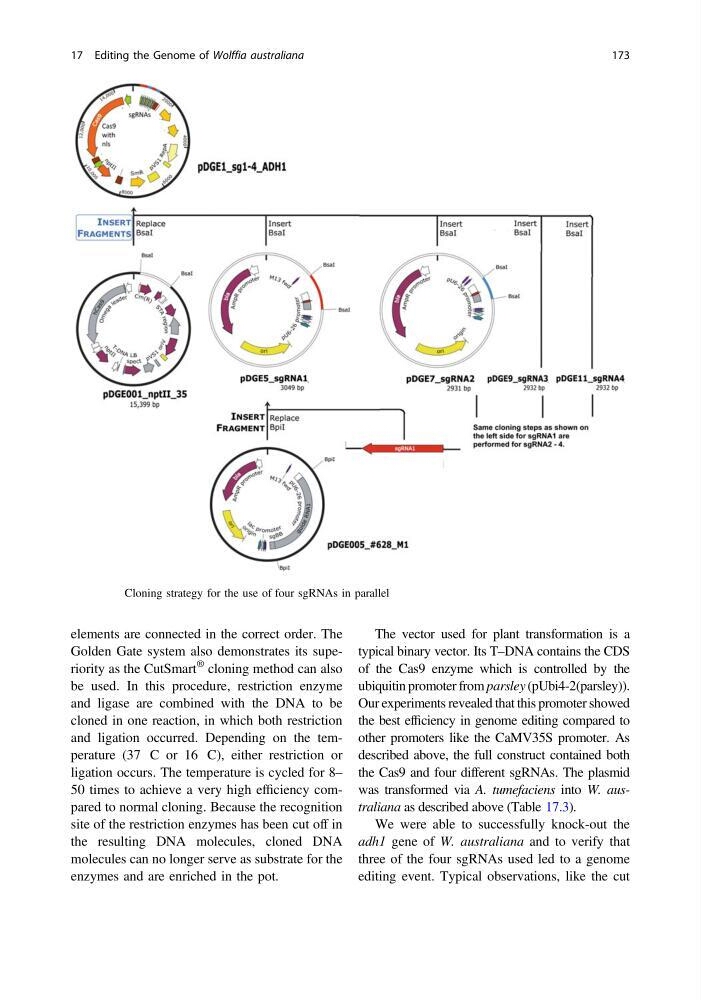
described above, the full construct contained both
the Cas9 and four different sgRNAs. The plasmid
was transformed via A. tumefaciens into W. australiana as described above (Table 17.3).
We were able to successfully knock-out the
adh1 gene of W. australiana and to verify that
three of the four sgRNAs used led to a genome
editing event. Typical observations, like the cut
Fig. 17.3 Cloning strategy for the use of four sgRNAs in parallel
17 Editing the Genome of Wolffia australiana
173
Golden Gate system also demonstrates its superiority as the CutSmart
® cloning method can also
be used. In this procedure, restriction enzyme
and ligase are combined with the DNA to be
cloned in one reaction, in which both restriction
and ligation occurred. Depending on the temperature (37 C or 16 C), either restriction or
ligation occurs. The temperature is cycled for 8–
50 times to achieve a very high efficiency compared to normal cloning. Because the recognition
site of the restriction enzymes has been cut off in
the resulting DNA molecules, cloned DNA
molecules can no longer serve as substrate for the
enzymes and are enriched in the pot.
The vector used for plant transformation is a
typical binary vector. Its T–DNA contains the CDS
of the Cas9 enzyme which is controlled by the
ubiquitin promoter from parsley (pUbi4-2(parsley)).
Our experiments revealed that this promoter showed
the best efficiency in genome editing compared to
other promoters like the CaMV35S promoter. As
described above, the full construct contained both
the Cas9 and four different sgRNAs. The plasmid
was transformed via A. tumefaciens into W. australiana as described above (Table 17.3).
We were able to successfully knock-out the
adh1 gene of W. australiana and to verify that
three of the four sgRNAs used led to a genome
editing event. Typical observations, like the cut
Fig. 17.3 Cloning strategy for the use of four sgRNAs in parallel
17 Editing the Genome of Wolffia australiana
173