

annealed. Premade plasmids for CRISPR/Cas9
are available for plants and can be cloned using
the Golden Gate system as well (Ordon et al.
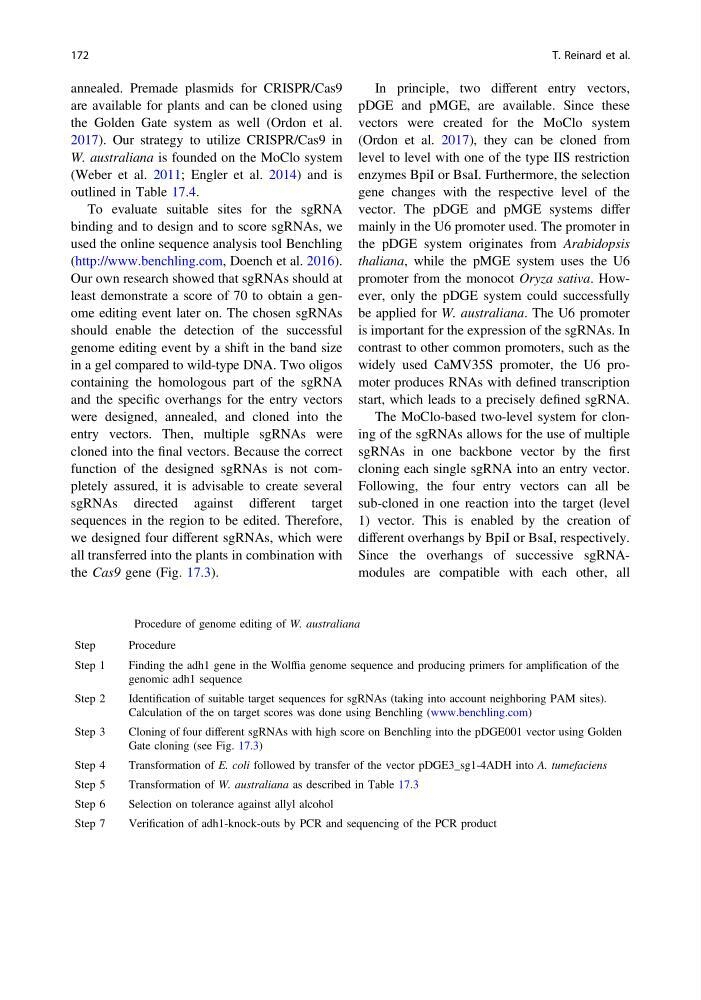
2017). Our strategy to utilize CRISPR/Cas9 in
W. australiana is founded on the MoClo system
(Weber et al. 2011; Engler et al. 2014) and is
outlined in Table 17.4.
To evaluate suitable sites for the sgRNA
binding and to design and to score sgRNAs, we
used the online sequence analysis tool Benchling
(http://www.benchling.com, Doench et al. 2016).
Our own research showed that sgRNAs should at
least demonstrate a score of 70 to obtain a genome editing event later on. The chosen sgRNAs
should enable the detection of the successful
genome editing event by a shift in the band size
in a gel compared to wild-type DNA. Two oligos
containing the homologous part of the sgRNA
and the specific overhangs for the entry vectors
were designed, annealed, and cloned into the
entry vectors. Then, multiple sgRNAs were
cloned into the final vectors. Because the correct
function of the designed sgRNAs is not completely assured, it is advisable to create several
sgRNAs directed against different target
sequences in the region to be edited. Therefore,
we designed four different sgRNAs, which were
all transferred into the plants in combination with
the Cas9 gene (Fig. 17.3).
In principle, two different entry vectors,
pDGE and pMGE, are available. Since these
vectors were created for the MoClo system
(Ordon et al. 2017), they can be cloned from
level to level with one of the type IIS restriction
enzymes BpiI or BsaI. Furthermore, the selection
gene changes with the respective level of the
vector. The pDGE and pMGE systems differ
mainly in the U6 promoter used. The promoter in
the pDGE system originates from Arabidopsis
thaliana, while the pMGE system uses the U6
promoter from the monocot Oryza sativa. However, only the pDGE system could successfully
be applied for W. australiana. The U6 promoter
is important for the expression of the sgRNAs. In
contrast to other common promoters, such as the
widely used CaMV35S promoter, the U6 promoter produces RNAs with defined transcription
start, which leads to a precisely defined sgRNA.
The MoClo-based two-level system for cloning of the sgRNAs allows for the use of multiple
sgRNAs in one backbone vector by the first
cloning each single sgRNA into an entry vector.
Following, the four entry vectors can all be
sub-cloned in one reaction into the target (level
1) vector. This is enabled by the creation of
different overhangs by BpiI or BsaI, respectively.
Since the overhangs of successive sgRNAmodules are compatible with each other, all
Table 17.4 Procedure of genome editing of W. australiana
Step
Procedure
Step 1
Finding the adh1 gene in the Wolffia genome sequence and producing primers for amplification of the
genomic adh1 sequence
Step 2
Identification of suitable target sequences for sgRNAs (taking into account neighboring PAM sites).
Calculation of the on target scores was done using Benchling (www.benchling.com)
Step 3
Cloning of four different sgRNAs with high score on Benchling into the pDGE001 vector using Golden
Gate cloning (see Fig. 17.3)
Step 4
Transformation of E. coli followed by transfer of the vector pDGE3_sg1-4ADH into A. tumefaciens
Step 5
Transformation of W. australiana as described in Table 17.3
Step 6
Selection on tolerance against allyl alcohol
Step 7
Verification of adh1-knock-outs by PCR and sequencing of the PCR product
172
T. Reinard et al.
are available for plants and can be cloned using
the Golden Gate system as well (Ordon et al.
2017). Our strategy to utilize CRISPR/Cas9 in
W. australiana is founded on the MoClo system
(Weber et al. 2011; Engler et al. 2014) and is
outlined in Table 17.4.
To evaluate suitable sites for the sgRNA
binding and to design and to score sgRNAs, we
used the online sequence analysis tool Benchling
(http://www.benchling.com, Doench et al. 2016).
Our own research showed that sgRNAs should at
least demonstrate a score of 70 to obtain a genome editing event later on. The chosen sgRNAs
should enable the detection of the successful
genome editing event by a shift in the band size
in a gel compared to wild-type DNA. Two oligos
containing the homologous part of the sgRNA
and the specific overhangs for the entry vectors
were designed, annealed, and cloned into the
entry vectors. Then, multiple sgRNAs were
cloned into the final vectors. Because the correct
function of the designed sgRNAs is not completely assured, it is advisable to create several
sgRNAs directed against different target
sequences in the region to be edited. Therefore,
we designed four different sgRNAs, which were
all transferred into the plants in combination with
the Cas9 gene (Fig. 17.3).
In principle, two different entry vectors,
pDGE and pMGE, are available. Since these
vectors were created for the MoClo system
(Ordon et al. 2017), they can be cloned from
level to level with one of the type IIS restriction
enzymes BpiI or BsaI. Furthermore, the selection
gene changes with the respective level of the
vector. The pDGE and pMGE systems differ
mainly in the U6 promoter used. The promoter in
the pDGE system originates from Arabidopsis
thaliana, while the pMGE system uses the U6
promoter from the monocot Oryza sativa. However, only the pDGE system could successfully
be applied for W. australiana. The U6 promoter
is important for the expression of the sgRNAs. In
contrast to other common promoters, such as the
widely used CaMV35S promoter, the U6 promoter produces RNAs with defined transcription
start, which leads to a precisely defined sgRNA.
The MoClo-based two-level system for cloning of the sgRNAs allows for the use of multiple
sgRNAs in one backbone vector by the first
cloning each single sgRNA into an entry vector.
Following, the four entry vectors can all be
sub-cloned in one reaction into the target (level
1) vector. This is enabled by the creation of
different overhangs by BpiI or BsaI, respectively.
Since the overhangs of successive sgRNAmodules are compatible with each other, all
Table 17.4 Procedure of genome editing of W. australiana
Step
Procedure
Step 1
Finding the adh1 gene in the Wolffia genome sequence and producing primers for amplification of the
genomic adh1 sequence
Step 2
Identification of suitable target sequences for sgRNAs (taking into account neighboring PAM sites).
Calculation of the on target scores was done using Benchling (www.benchling.com)
Step 3
Cloning of four different sgRNAs with high score on Benchling into the pDGE001 vector using Golden
Gate cloning (see Fig. 17.3)
Step 4
Transformation of E. coli followed by transfer of the vector pDGE3_sg1-4ADH into A. tumefaciens
Step 5
Transformation of W. australiana as described in Table 17.3
Step 6
Selection on tolerance against allyl alcohol
Step 7
Verification of adh1-knock-outs by PCR and sequencing of the PCR product
172
T. Reinard et al.